Israeli strike in Gaza kills three journalists, first responders say
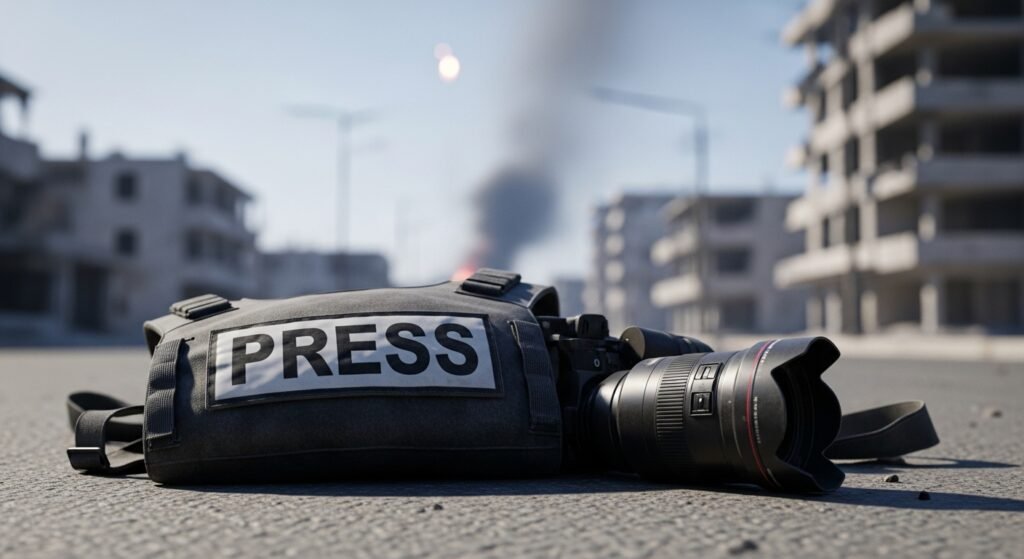
Press Freedom Under Fire: 3 Journalists Killed in Gaza Strike as Ceasefire Fragility Exposed
2. Brainx Perspective
At Brainx, we believe the continued loss of journalists in conflict zones acts as a devastating blindfold on the world’s conscience. This latest tragedy highlights the perilous reality for press workers in Gaza, who are not merely observers but frequent casualties. It raises urgent questions about the rules of engagement during the current truce and the sanctity of humanitarian missions in active zones.
3. The News
A devastating Israeli airstrike in central Gaza has claimed the lives of three Palestinian journalists, casting a long shadow over the current ceasefire and reigniting international debate regarding the safety of media personnel in the region.
The Incident: A Targeted Strike? According to the Gaza Civil Defence agency, the strike occurred in the al-Zahra area of central Gaza. The victims were traveling in a vehicle when it was hit.
- The Victims: The journalists were identified as Mohammed Salah Qeshta, Anas Ghunaim, and Abdul Raouf Shaat.
- The Mission: They were reportedly on assignment for the Egyptian Relief Committee, a humanitarian organization. Their task was to film and document camps for displaced people, providing visibility to the ongoing humanitarian crisis.
- The Vehicle: A spokesperson for the humanitarian organization stated that the car was explicitly marked with their logo, asserting they were “targeted during a humanitarian mission.”
Conflicting Narratives As with many incidents in this conflict, the accounts differ sharply between the parties involved.
- The Israeli Position: The Israeli military confirmed a strike in the area, stating they targeted “several suspects who operated a drone affiliated with Hamas… in a manner that posed a threat” to their troops. They have stated the incident is under examination.
- The Palestinian Position: The Palestinian Journalists Syndicate has condemned the act as a “war crime.” They argue this is part of a “systematic Israeli policy aimed at silencing the Palestinian voice” and obstructing the documentation of facts on the ground.
A Bloody Wednesday: Beyond the Press The death of the journalists was part of a broader wave of violence on Wednesday that saw at least eight other fatalities across the strip, despite the nominal ceasefire.
- Child Casualties: Medics reported that three people, including a 10-year-old boy, were killed by Israeli tank fire in central Gaza.
- Khan Younis Incident: In the southern Khan Younis area, a 13-year-old boy named Mutasem al-Shrafi and a woman were killed by gunfire. Mutasem’s father confirmed his son was shot dead by Israeli troops in the eastern part of the city.
- The “Yellow Line”: The Israeli military reported killing a “terrorist” who crossed the “Yellow Line”—the demarcation zone separating territory still under Israeli control during the ceasefire.
The Context of a Fragile Truce While a ceasefire officially began on October 10, the violence has been persistent and deadly.
- Palestinian Toll: Since the truce began, the health ministry reports that at least 466 Palestinians have been killed.
- Israeli Toll: Over the same period, the Israeli military has reported the deaths of three soldiers due to attacks by Palestinian armed groups.
The Deadliest Conflict for Journalists This incident adds to a grim statistic that has defined this war. The Committee to Protect Journalists (CPJ) has documented the killing of at least 206 journalists and media workers by Israeli fire since the war began in October 2023.
- Access Denied: With foreign media, including major outlets like BBC News and CNN, barred from entering Gaza independently, the world relies entirely on local Palestinian journalists.
- The Cost of Truth: Their deaths represent a direct loss of information, leaving the international community dependent on filtered narratives or controlled military tours.
4. “Why It Matters”
This incident matters because the erasure of journalists creates a dangerous information vacuum, allowing the “fog of war” to obscure potential war crimes. For the common man, it signals that even during a “ceasefire,” safety is an illusion. If protected classes like the press and aid workers are not safe, the prospect of a lasting peace remains terrifyingly distant.
Leave a Reply