Iran warns it will retaliate if US attacks as protesters defy crackdown
1. Catchy Headline
Iran on the Brink: US Threatens Military Strikes as Protests Erupt in 100 Cities
2. Brainx Perspective (Intro)
At Brainx, we believe the current uprising in Iran represents a critical historical pivot point, distinct from the 2022 movements. This development highlights a dangerous convergence: a populace driven to the edge by hyperinflation and a US administration openly weighing military intervention. The situation is no longer just a domestic civil rights struggle; it has evolved into a geopolitical flashpoint that threatens to destabilize the entire Middle East.
3. The News (Body)
Overview: A Nation in Revolt
Iran is currently witnessing its most widespread and volatile unrest since the 2022 “Women, Life, Freedom” movement. What began in Tehran as an economic outcry against soaring inflation has rapidly metastasized into a nationwide revolution calling for the end of the clerical rule of Supreme Leader Ayatollah Ali Khamenei. As of Saturday, January 10, 2026, protests have been reported in over 100 cities and towns across every single province in the country.
The situation has escalated into a bloody confrontation between demonstrators and state security forces, with the United States signaling potential military involvement, adding a layer of international urgency to the crisis.
The Human Toll: A Deadly Crackdown
Despite an almost total information blackout, verified reports paint a grim picture of the violence on the ground.
- Casualty Figures: Human rights groups and hospital staff report that the death toll is rising rapidly. Medics at two major hospitals confirmed to international media that over 100 bodies were brought in within a 48-hour window.
- Specific Incident Reports:
- Rasht: BBC Persian verified 70 bodies arrived at a single hospital on Friday night.
- Tehran: A health worker reported 38 deaths at one facility.
- Verified Totals: Human Rights Activists in Iran report at least 162 protesters and 41 security personnel killed. Norway-based Iran Human Rights estimates the number at 192 protesters, including six confirmed children.
- State Rhetoric: The Iranian Attorney General has labeled protesters “enemies of God” (moharebeh), a legal classification in Islamic Republic law that carries the mandatory death penalty. Supreme Leader Khamenei dismissed the millions of citizens as “vandals” seeking to please US President Donald Trump.
The Geopolitical Standoff: Trump vs. Tehran
The unrest has drawn the immediate attention of the White House, shifting the conflict from internal strife to a potential international war.
- US Threat: President Donald Trump took to social media, declaring that “Iran is looking at FREEDOM” and asserting that the USA “stands ready to help.”
- Military Options: US media outlets, including the Wall Street Journal and New York Times, report that President Trump has been briefed on “preliminary” military options, including airstrikes. This follows US strikes on Iranian nuclear facilities last year.
- Iran’s Ultimatum: In response, Iran’s parliament speaker issued a stark warning: if the US attacks, Iran will retaliate by targeting Israel, as well as US military bases and commercial shipping centers in the region.
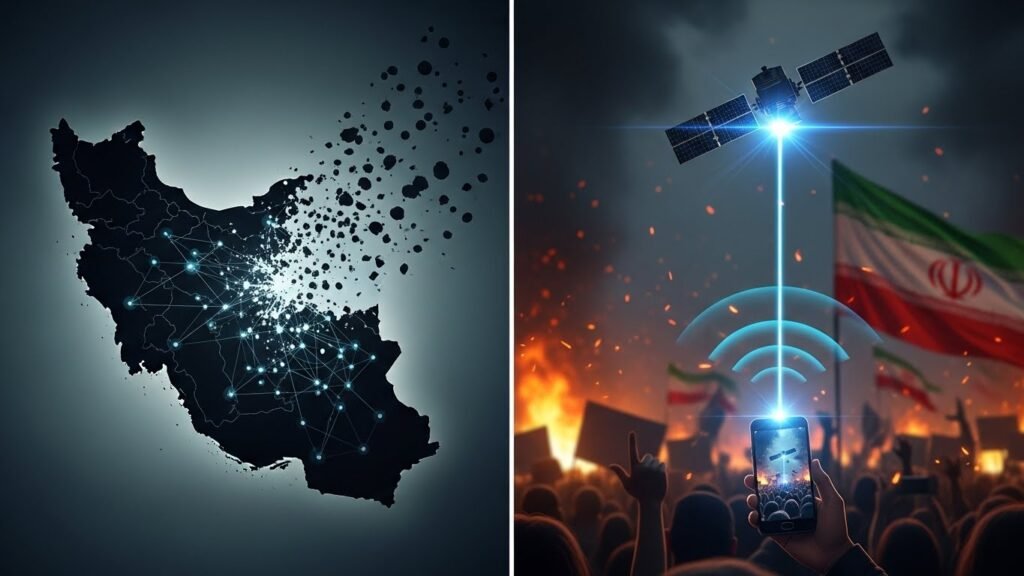
The Digital Iron Curtain: Cyber Warfare
The Iranian state has deployed its most severe internet restrictions to date in an attempt to hide the scale of the crackdown.
- Total Blackout: Unlike previous shutdowns where only international sites were blocked, the government has now severely restricted the domestic “intranet.”
- Information Vacuum: International journalists are barred from reporting, making verification difficult.
- Starlink: Alireza Manafi, an internet researcher, noted that satellite internet like Starlink remains the only viable connection to the outside world, though using it carries significant risk of detection by state security.
Ground Realities: Clashes and Chaos
Verified footage from BBC Verify and citizen journalists shows a country appearing to be in a state of civil war.
- Mashhad: In Iran’s second-largest city, protesters are seen using dumpsters and bonfires as barricades against security forces.
- Tehran: In the Gisha, Punak, and Heravi districts, large crowds are marching, banging pots and pans (a symbol of economic hunger), and chanting anti-regime slogans.
- Live Fire: Videos show security forces firing live ammunition from footbridges into crowds, while protesters attempt to flee or take cover.
The Opposition: The Return of the Shah’s Son?
Reza Pahlavi, the US-based exiled son of the last Shah of Iran, has emerged as a central figure in the opposition narrative.
- Call to Action: In a video statement on X (formerly Twitter), Pahlavi claimed that the Islamic Republic is facing a “severe shortage of mercenaries” and that security forces are defecting.
- US Alignment: He explicitly aligned with President Trump, stating the US leader “is ready to help.”
- Safety Warning: While encouraging continued protests, he urged citizens to stay in groups to minimize the risk of being picked off by security forces.
Deep Dive Analysis: The Anatomy of the 2026 Uprising
To understand why this specific news event is dominating global headlines, we must look deeper than the daily casualty counts. This is a convergence of three distinct crises: Economic, Social, and Military.
1. The Economic Trigger
Unlike the 2022 protests, which were sparked by social grievances (the hijab law), the 2026 uprising is rooted in survival. “Soaring inflation” is a sterile term for what is happening on the ground: the collapse of the purchasing power of the Rial. When the middle class cannot afford bread, the barrier of fear regarding security forces evaporates. The chanting of slogans in working-class neighborhoods—traditionally the base of the regime’s support—signals that the government has lost its economic legitimacy.
2. The Shift in US Policy
The rhetoric from President Trump marks a significant departure from standard diplomatic scolding. By stating the US is “ready to help” and leaking reports of military briefings, Washington is signaling a return to a “maximum pressure” campaign, but with a kinetic edge. This places the Iranian regime in a “use it or lose it” dilemma: do they crack down harder to survive internally, risking US strikes, or do they show weakness, risking total collapse?
3. The Technology Gap
The unprecedented restriction of the domestic intranet indicates panic. Usually, Iran keeps the internal network running for banking and government services. Shutting this down cripples their own economy, suggesting they view the flow of information between cities as an existential threat greater than economic paralysis.
4. “Why It Matters” (Conclusion)
For the common man, this news signals a period of extreme global volatility. A conflict involving Iran, Israel, and the US would inevitably spike global oil prices and disrupt supply chains. For the future of the Middle East, we are witnessing a defining struggle: either the consolidation of a nuclear-capable hardline state or the violent birth of a new, secular Iran. The coming days will decide which history is written.
Leave a Reply