Syrian army seizes country’s largest oil field from Kurdish forces
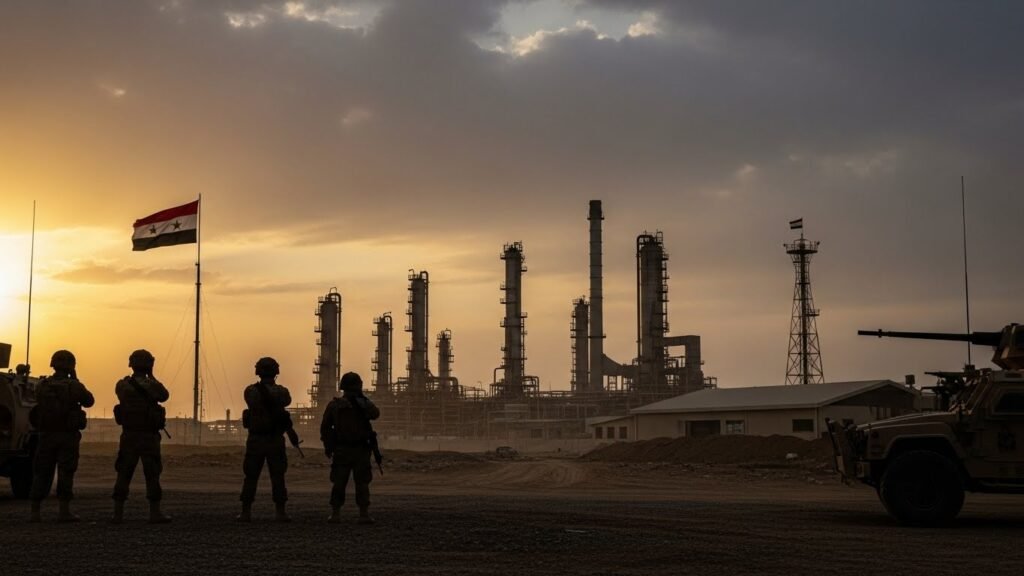
Power Shift in Syria: Army Seizes Largest Oilfield as Kurdish Forces Retreat East
At Brainx, we believe this rapid military advance by Syrian government forces represents a pivotal moment in the post-Assad era. The seizure of the Omar oilfield is not merely a tactical victory; it highlights the central government’s aggressive drive to consolidate economic lifelines, signaling that the window for Kurdish autonomy in the north-east may be closing despite recent diplomatic gestures.
The News: Strategic Rebalancing on the Euphrates
In a major strategic development, Syrian government troops have successfully retaken control of the country’s largest oil facility, the Omar oilfield, along with nearby gas fields. This advance follows a significant withdrawal by the Kurdish-led Syrian Democratic Forces (SDF) from key positions in the Deir Ezzor province.
Key Developments on the Ground:
- Strategic Capture: Syrian officials confirmed on Sunday that government forces have secured the Omar oilfield on the eastern bank of the Euphrates River. This facility was previously a primary source of revenue for the SDF.
- The Tabqa Dam: Prior to the oilfield seizure, the army also captured the strategic Tabqa dam and the town of Tabqa on the river’s south-western bank.
- SDF Withdrawal: The retreat of Kurdish forces comes after high-level talks with US officials. The SDF announced a redeployment to the east of the Euphrates following deadly clashes in Aleppo last week that left at least 12 dead.
- Scorched Earth Allegations: As they retreated, Syrian authorities accused the SDF of blowing up two bridges on the Euphrates, including the new al-Rashid bridge in Raqqa, to hinder further government advances.
- Independent Confirmation: The UK-based Syrian Observatory for Human Rights confirmed the SDF withdrawal from “entire villages and towns” in eastern Deir Ezzor, including the Tanak and Omar oil fields.
The Political Backdrop:
This military maneuvering occurs amidst a complex political struggle between the SDF and the administration of President Ahmed al-Sharaa. Since the fall of Bashar al-Assad in late 2024, al-Sharaa has attempted to integrate Kurdish military and civilian structures into the national fold—a process that has stalled for nearly a year.
- Mixed Signals: Just days before the military push, President al-Sharaa issued a historic decree making Kurdish a national language and recognizing the Kurdish New Year (Nowruz) as an official holiday. This was the first formal recognition of Kurdish rights since 1946.
- Failed Agreements: A deal signed in March 2025 to integrate the SDF into Syrian institutions remains unimplemented, with both sides trading blame for the deadlock.
- The US Dilemma: The United States finds itself in a precarious position, attempting to broker a ceasefire while supporting both its long-time ally, the SDF, and the new Syrian government.
Why It Matters
For the common Syrian citizen, the government’s recapture of the oilfields could mean the potential for stabilized fuel prices and funding for reconstruction after years of economic ruin. However, for the Kurdish minority, losing their economic leverage (oil) puts their demand for autonomy at serious risk. This development suggests that the future of Syria will likely be determined by central authority rather than federalism.
Leave a Reply