Syria agrees ceasefire with Kurdish-led forces after two weeks of clashes
Here is the rewritten and enhanced news article, designed to be unique, SEO-optimized, and AdSense-friendly.
Syria United: Historic 14-Point Deal Merges SDF into National Army, Ending Years of Division
This development highlights a monumental shift in the post-civil war landscape of the Middle East. At Brainx, we believe that the reintegration of the Kurdish-led SDF into Syria’s central command is not just a military merger, but a critical test of national reconciliation. It signals the end of a fragmented map and the beginning of a unified state, though the true challenge will be balancing renewed central authority with the historic recognition of Kurdish rights.
The Historic Announcement: A Nation Reconnected
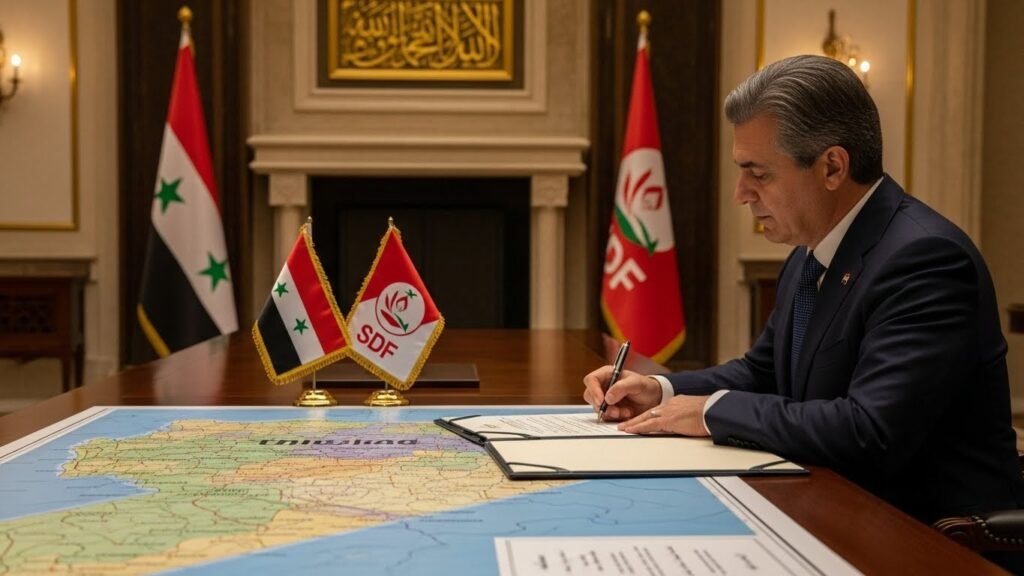
In a watershed moment for the region, the Syrian government has announced an immediate, nationwide ceasefire with the Kurdish-led Syrian Democratic Forces (SDF). This agreement effectively restores central government control over the entirety of the Syrian territory, bringing an end to nearly two weeks of intense skirmishes and closing a decade-long chapter of semi-autonomous rule in the northeast.
The announcement was made in Damascus by President Ahmed al-Sharaa, following high-level diplomatic talks involving the United States. The deal is codified in a comprehensive 14-point agreement designed to dissolve the administrative borders that have separated northeast Syria from the rest of the country for years.
Key Details of the 14-Point Agreement
The agreement is sweeping in its scope, covering military, economic, and social integration. Key components include:
- Restoration of State Control: Syrian state institutions will immediately reassert administrative authority over three strategic governorates: al-Hasakah, Deir Ezzor, and Raqqa.
- Military Integration: The SDF, previously a US-backed autonomous force, will not be disbanded but rather integrated. Its fighters and security personnel will undergo a vetting process before being formally inducted into Syria’s Ministry of Defence and Ministry of Interior.
- Resource Management: Control over vital economic assets—specifically the lucrative oil and gas fields and international border crossings—will transfer from the Kurdish administration back to Damascus. This is expected to revitalize the national economy.
- ISIS Detainees: The Syrian government will assume full responsibility for the high-security prisons and detention camps currently holding tens of thousands of foreign Islamic State (ISIS) fighters and their families, addressing a major international security concern.
- Cultural Recognition: In a historic first since independence from France in 1946, the state has pledged to recognize Kurdish cultural and linguistic rights. The Kurdish language will be granted official status, and the Kurdish New Year (Newroz) will be designated a national holiday.
Diplomatic Breakthrough: The US Role
The path to this agreement was paved by intensive diplomacy. The announcement followed a crucial meeting between President al-Sharaa and US Special Envoy to Syria, Tom Barrack, in Damascus.
While the United States has spent the last decade arming and training the SDF as its primary local partner against ISIS, this deal marks a shift in American strategy toward stabilization and unification. Envoy Barrack praised the accord, describing it as a necessary step toward a “unified Syria.”
SDF Commander Mazloum Abdi, a central figure in the negotiations and the fight against ISIS, was scheduled to attend the signing in person. However, adverse weather conditions delayed his travel, postponing his arrival in Damascus until Monday. Despite his absence, the agreement has been finalized and signed.
The End of an Era for Kurdish Autonomy
For the past decade, the Kurdish-led administration carved out a semi-autonomous region in northeastern Syria amidst the chaos of the civil war. With American military backing, they played the leading role in dismantling the physical caliphate of the Islamic State.
However, the geopolitical reality has shifted. President al-Sharaa recently stated that it was “unacceptable” for a militia to control a quarter of the national territory and hold the country’s primary natural resources hostage. This pressure, combined with stalled previous negotiations, culminated in Syrian government forces moving into Raqqa and key oil facilities earlier on Sunday following an SDF withdrawal, forcing the momentum toward this final deal.
The Continued Fight Against Terror
Crucially, the agreement does not signal an end to counter-terrorism operations. The deal explicitly reaffirms Syria’s continued participation in the US-led coalition against the Islamic State. By integrating the battle-hardened SDF units into the national army, the state aims to maintain pressure on sleeper cells while operating under a single, unified flag.
Why It Matters
For the common Syrian citizen, this deal offers a glimmer of hope for economic recovery; the return of oil revenues to the central treasury could help alleviate the country’s crippling energy shortages and inflation. On a broader scale, it represents a rare successful diplomatic closure to a proxy conflict. By formally recognizing Kurdish identity within the state framework, Syria attempts to heal deep ethnic wounds, offering a potential blueprint for stability in a region long plagued by sectarian division.
Leave a Reply