BBC says it will defend Trump defamation lawsuit over Panorama speech edit
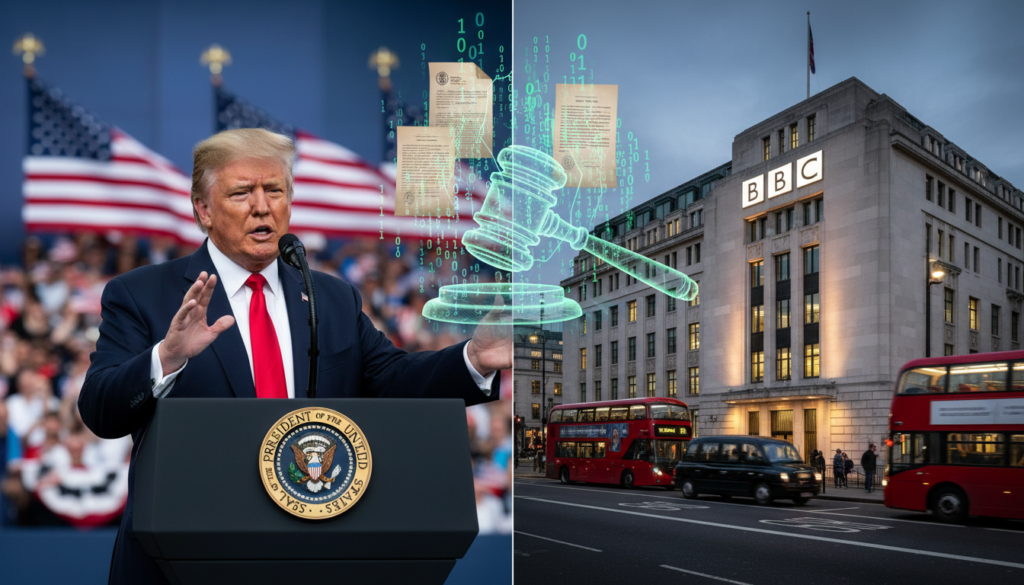
The $5 Billion Edit: Analyzing Trump’s Historic Lawsuit Against the BBC and Its Global Legal Implications
Brainx Perspective
At Brainx, we believe this lawsuit represents a watershed moment for global media. It forces a brutal confrontation between traditional broadcasting ethics and the borderless reality of the digital age. This $5 billion legal battle isn’t merely about a speech edit; it is a litmus test for how international defamation laws apply when content crosses oceans via VPNs. It challenges the very definition of accountability in a world where data borders no longer exist.
The News: A Deep Dive into the Media Trial of the Century
The landscape of international journalism is currently shaking under the weight of a $5 billion (£3.7bn) lawsuit filed by United States President Donald Trump against the British Broadcasting Corporation (BBC). This legal action, filed in a Florida court, transcends typical celebrity defamation cases. It strikes at the heart of public service broadcasting, editorial integrity, and the geopolitical relationship between the US and the UK.
Below is a comprehensive breakdown of the crisis, the legal arguments, and the fallout.
1. The Core Incident: The Anatomy of a Controversial Edit
The dispute hinges on a specific sequence aired in a BBC Panorama documentary ahead of the 2024 US election. President Trump’s legal team alleges that the broadcaster engaged in “malicious” and “deceptive” editing of his January 6, 2021, speech to manufacture a narrative of violence.
- The Reality of the Speech:
- Part A (The Beginning): Trump told supporters, “We’re going to walk down to the Capitol, and we’re going to cheer on our brave senators…”
- The Gap: Approximately 50 minutes of unrelated political discourse followed this statement.
- Part B (The End): Nearly an hour later, he stated, “And we fight. We fight like hell.”
- The Broadcast Version:
- The Panorama editors spliced Part A and Part B together, removing the 50-minute gap.
- The Resulting Narrative: The clip presented a contiguous thought: “We’re going to walk down to the Capitol… and I’ll be there with you. And we fight. We fight like hell.”
- The Allegation:
- Trump’s attorneys argue that removing the interim context converted a political rally speech into a “direct call for violent action.” They claim this was not an accidental cut for time, but a deliberate attempt to defame the President and violate trade practice laws.
2. The Legal Battlefield: “Actual Malice” vs. Negligence
To win a defamation suit of this magnitude in the United States, particularly as a public figure, the burden of proof is exceptionally high. This case revives the debates surrounding the landmark New York Times Co. v. Sullivan (1964) precedent.
- The Sullivan Standard: Public officials cannot simply prove a statement was false. They must prove “Actual Malice.”
- Defining Actual Malice:
- Knowledge of Falsity: Did the BBC know the edit created a lie before they aired it?
- Reckless Disregard: Did the editors act with a “high degree of awareness” that the edit was misleading but proceeded anyway?
- The BBC’s Defense:
- The BBC has admitted the edit caused a “mistaken impression” and issued an apology.
- However, they argue this constitutes negligence, not malice. They maintain they were analyzing political rhetoric, not fabricating a timeline of events.
- The Counter-Argument: Trump’s legal team is using the BBC’s internal chaos as evidence. They argue that the subsequent resignations of top leadership prove the organization knew the edit was a catastrophic breach of ethics, thereby satisfying the “reckless disregard” standard.
3. The Digital Frontier: VPNs and Jurisdictional Reach
Perhaps the most groundbreaking aspect of this lawsuit is the argument regarding jurisdiction. The BBC is a UK entity, and the content was technically geoblocked to the UK. However, Trump’s team is utilizing a novel legal theory involving Virtual Private Networks (VPNs).
- The “Long Arm” of the Internet:
- The BBC argues the documentary was for UK eyes only via BBC iPlayer.
- Trump’s filing counters that the internet has no borders. They cite data showing a spike in VPN usage in Florida, allowing US residents to “spoof” their location and access the content.
- Third-Party Liability:
- The suit also alleges the content reached Florida via third-party distributors and streaming services like BritBox.
- The Precedent:
- If the Florida court accepts jurisdiction based on VPN usage, it implies that content creators can be sued in any country where a user is savvy enough to bypass a firewall. This would effectively destroy the legal concept of territorial broadcasting rights.
4. Institutional Collapse: The Fallout in London
The mere filing of the lawsuit has caused what insiders describe as an “implosion” within the BBC. The corporation’s reputation for robust editorial oversight has been severely compromised.
- Key Resignations:
- Tim Davie (Director General): His resignation marks a failure of executive oversight.
- Deborah Turness (Head of News): Her departure suggests that the checks and balances within the newsroom failed to catch a glaring editorial error.
- The Leaked Memo:
- Evidence includes a leaked internal memo that harshly criticized the edit before the lawsuit went public. Trump’s lawyers view this memo as the “smoking gun” that proves the BBC was aware of the deception.
5. The Financial and Political Cost
Beyond the courtroom, the shockwaves are being felt in the UK Parliament and the pockets of British citizens.
- Taxpayer Burden:
- The BBC is funded by the “license fee,” a mandatory tax on UK TV owners.
- The Cost: Even if the BBC settles, costs could reach $50m-$100m. A full loss of $5 billion would bankrupt the corporation.
- Political Reaction: Nigel Huddleston, the shadow culture secretary, has expressed grave concern for the “license fee payer,” while Health Minister Stephen Kinnock has pledged the government will “stand up for the BBC.”
- Diplomatic Strain:
- A sitting US President suing a UK state-owned broadcaster places Prime Minister Sir Keir Starmer in a diplomatic bind. Calls for intervention are growing, but interfering in a US legal process carries its own risks.
In-Depth Analysis: Why This Case is Unique
1. The “Apology” Trap The BBC attempted to defuse the situation by apologizing for the “mistaken impression.” In the world of PR, this is damage control. In the world of litigation, it is often viewed as an admission of guilt. Trump’s lawyers are expected to parade this apology in court as proof that the BBC acknowledges the defamatory nature of the content.
2. Commercial vs. State Media Trump has a history of settling with US media giants (like CNN or NBC) for commercial reasons. However, the BBC has no shareholders to appease. Its mandate is to protect its Charter and its reputation for truth. Former BBC executives suggest the corporation may fight this to the bitter end—burning millions in legal fees—rather than settling, simply to prove they did not act with “malice.”
3. The Tech Argument Validity Legal experts are split on the VPN argument. If a user breaks a digital lock (geoblocking) to view content, is the creator liable for what that user sees? A ruling in Trump’s favor here would force global media companies to implement draconian geo-restrictions, potentially fragmenting the World Wide Web into isolated national intranets.
Frequently Asked Questions (FAQ)
Q: Why is the lawsuit amount so high ($5 Billion)? A: Punitive damages in US defamation cases can be astronomical. The figure reflects not just the alleged damage to Trump’s reputation, but an attempt to punish the BBC for what the plaintiff calls “intentional deception.”
Q: Can a UK organization really be sued in Florida? A: Yes, under the “Long Arm Statute.” If the court determines that the BBC’s actions (distributing the documentary) caused harm within the state of Florida, the local court can claim jurisdiction, regardless of where the BBC is headquartered.
Q: What happens to the BBC if they lose? A: A $5 billion judgment is likely beyond the BBC’s immediate liquidity. It would require intervention from the UK government, potentially leading to a restructuring of the organization or a massive increase in the license fee.
Q: Did the BBC editors act alone? A: The resignations of the Director General and Head of News suggest the responsibility is being placed on leadership for failing to maintain editorial standards, rather than just on the individual video editors.
Why It Matters (Conclusion)
This case is a seismic event that could fundamentally alter the future of journalism. If the court rules that broadcasters are liable for global audiences accessing content via VPNs, media outlets may be forced to geo-block news aggressively, ending the era of the open internet. Furthermore, it serves as a stark, billion-dollar warning to newsrooms everywhere: in the digital age, a single editorial shortcut can threaten the very existence of a media empire. The BBC is fighting not just for its money, but for the definition of truth itself.



Leave a Reply