Ben & Jerry’s row deepens as three board members removed
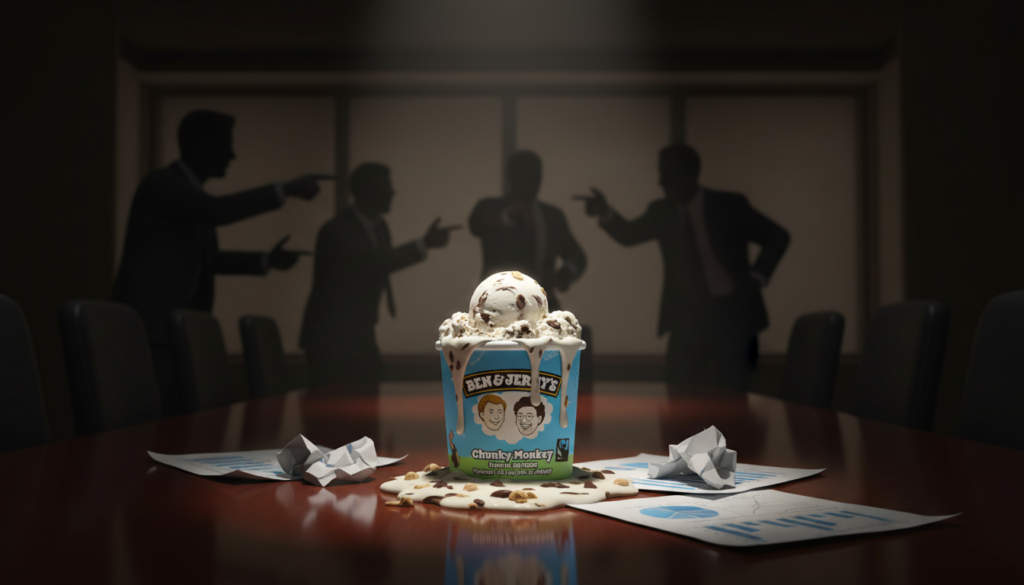
Meltdown in Vermont: The Corporate Coup Dismantling Ben & Jerry’s Activist Soul
Brainx Perspective
This development highlights a critical fracture in the landscape of modern ethical capitalism. At Brainx, we believe the dismantling of Ben & Jerry’s independent board is not merely a governance dispute; it is a litmus test for the viability of purpose-driven brands within global conglomerates. It forces a painful confrontation with reality: when the “social mission” threatens the “economic mission,” corporate sovereignty invariably seeks to silence the activist soul.
The News: A Cold War in the Ice Cream Aisle
The usually sweet relationship between Vermont’s most iconic ice cream brand and its corporate ownership has curdled into a high-stakes governance battle. In a move that insiders are calling a “hostile takeover from within,” Ben & Jerry’s is undergoing a forced restructuring that threatens to erase the progressive activism that defines its brand identity.
The conflict pits the brand’s historic independent board against its new parent entity, The Magnum Ice Cream Company (a standalone entity spun off from Unilever). Through the implementation of new governance bylaws, specifically a strict term-limit policy, the parent company is effectively decapitating the leadership that has fiercely guarded Ben & Jerry’s social conscience for decades.
1. The Mechanism of the Takeover: The “Nine-Year Rule”
At the center of this controversy is a newly imposed governance clause. The Magnum Ice Cream Company has introduced a policy mandating that board directors cannot serve longer than nine years. While term limits are standard in many public companies to ensure rotation, their sudden application to Ben & Jerry’s self-perpetuating board is being viewed as a tactical weapon to purge dissenters.
Key Casualties of the Restructuring:
- Anuradha Mittal (Chair of the Board): A vocal human rights advocate and Executive Director of the Oakland Institute. As the primary architect of the brand’s recent bold political stances, she has been deemed ineligible to serve and is set to leave immediately.
- Daryn Dodson: A pivotal board member who supports the brand’s impact investing strategies, scheduled to depart by year’s end.
- Jennifer Henderson: Another long-standing guardian of the social mission, also forced out by the end of the year.
The “Power Grab” Accusation: Ben Cohen, the co-founder who remains the brand’s spiritual figurehead, has publicly condemned the move. He describes the imposition of these rules as a “blatant power grab designed to strip the board of legal authority and independence.” Cohen argues that by removing these specific members, Magnum is eliminating the institutional memory and courage required to challenge corporate overreach.
2. The Shift from Unilever to Magnum: A Harder Line
To understand the severity of this purge, one must look at the corporate restructuring that precipitated it. For 24 years, Ben & Jerry’s operated under Unilever, a massive conglomerate. While the relationship was fraught with tension, Unilever largely tolerated the Vermont subsidiary’s eccentricities as the price of owning a “cool” brand.
However, the recent spinoff of Unilever’s ice cream division has created The Magnum Ice Cream Company, now the world’s largest standalone ice cream manufacturer. This new entity appears less interested in maintaining the delicate peace and more focused on operational streamlining.
The Clash of Values:
- The Magnum Stance: A spokesperson stated the goal is to build a “powerful, non-partisan values-based position.”
- The Ben & Jerry’s Reality: The independent board argues that the brand has never been non-partisan. Its identity is built on taking explicit sides on polarizing issues like criminal justice reform, LGBTQ+ rights, and foreign policy.
- The Implication: By enforcing a “non-partisan” mandate, critics argue Magnum is attempting to hollow out the brand, turning it into a generic producer of premium ice cream while stripping away the activism that fosters its intense customer loyalty.
3. The Broken Shield: The 2000 Acquisition Agreement
The current crisis is a direct challenge to the unique legal framework established when Ben Cohen and Jerry Greenfield sold the company in 2000. Recognizing that a multinational corporation might one day try to dilute their vision, they negotiated an unprecedented merger agreement.
The “Company Within a Company” Structure:
- The Independent Board: Unlike typical boards appointed by shareholders, the Ben & Jerry’s board was designed to be self-perpetuating. New members were chosen by existing members, not the parent company.
- Authority Over Mission: This board was granted legal authority over the “Social Mission” and “Brand Integrity.”
- The Three-Part Mission: The board is sworn to uphold three equal pillars:
- Product Mission: Making the best ice cream.
- Economic Mission: Sustainable financial growth.
- Social Mission: Innovative ways to improve the world.
The current conflict arises because The Magnum Ice Cream Company is prioritizing the Economic Mission to the detriment of the Social Mission. By using governance technicalities to override the board’s self-selection rights, Magnum is exploiting a loophole that the founders arguably never foresaw.
4. A History of Escalation: Why Now?
The imposition of term limits is the culmination of years of escalating ideological warfare. The relationship reached a breaking point in 2021 regarding the Israeli-Palestinian conflict.
- The Boycott: The independent board decided to halt sales in the Occupied Palestinian Territories (OPT), citing human rights concerns.
- The Backlash: This triggered a geopolitical firestorm, causing headaches for Unilever and angering investors.
- The Lawsuit: In a move unheard of in corporate history, Ben & Jerry’s sued its own parent company (Unilever) to block the sale of its Israeli operations to a local licensee, arguing it violated the 2000 merger agreement.
This incident proved to the corporate owners that the independent board was a genuine liability—a group of activists willing to sacrifice profits and risk diplomatic incidents for their principles. The current “purge” is widely seen as a direct response to ensure such a rebellion never happens again.
5. The End of an Era: Jerry Greenfield’s Departure
The human cost of this corporate battle was highlighted by the quiet exit of co-founder Jerry Greenfield in September. After nearly 50 years, Greenfield left the company, a move that signaled his loss of faith in the current structure. In a letter shared by his co-founder, Greenfield lamented that the company had lost its independence. His departure served as a grim foreshadowing of the aggressive restructuring that is now unfolding.
6. The Paradox of “Woke Capitalism”
This situation serves as a critical case study for the concept of ESG (Environmental, Social, and Governance) investing. It highlights a fundamental tension in the market:
- The Asset: Corporations buy brands like Ben & Jerry’s because their “authenticity” attracts younger, value-driven consumers.
- The Liability: Corporations fear the controversy that true authenticity generates.
Magnum effectively wants the halo of Ben & Jerry’s (the image of goodness) without the heat (the actual political friction). However, as Ben Cohen warned the BBC, “Ben & Jerry’s would be destroyed as a brand if it remains with Magnum.” If the brand stops fighting for specific legislative changes and pivots to generic slogans about “happiness,” it loses its Unique Selling Proposition (USP) in a crowded market.
Why It Matters
This governance collapse matters because it sets a chilling precedent for the future of social enterprise. If Ben & Jerry’s—with its ironclad legal contracts and high-profile founders—cannot protect its mission from corporate dilution, it suggests that “mission-driven business” is an oxymoron at the global scale. For the common consumer, this signals a future where corporate activism is merely a marketing aesthetic, devoid of the power to effect real change. The “Chunky Monkey” may taste the same, but the spirit of rebellion that churned it is being frozen out.




Leave a Reply