Egyptian dissident sorry for tweets as Tories push for deportation from UK
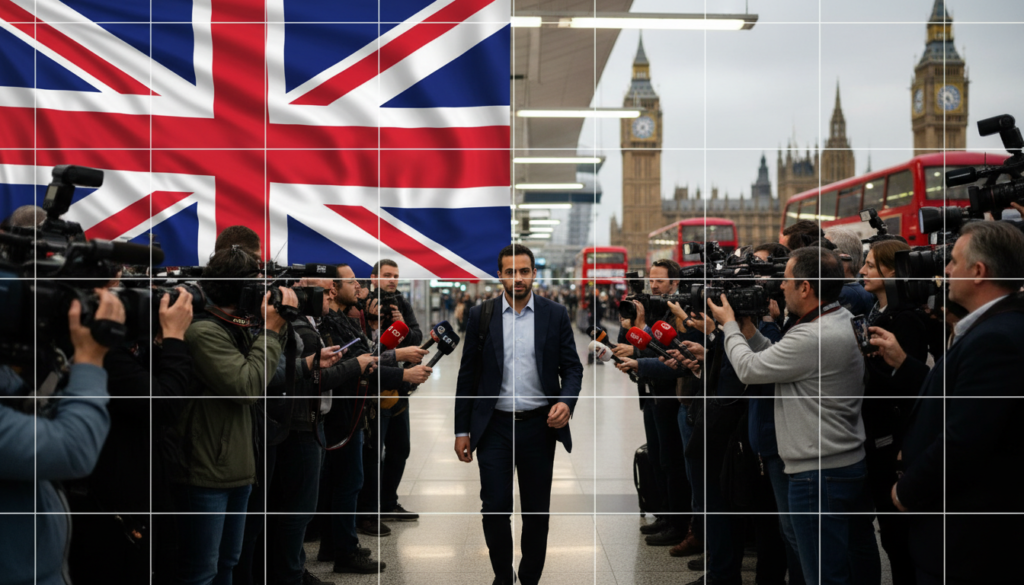
Digital Ghosts and National Identity: The High-Stakes Battle Over Alaa Abd el-Fattah’s British Citizenship
Brainx Perspective
At Brainx, we believe the Alaa Abd el-Fattah case represents a watershed moment for the digital age, exposing the volatile intersection of historic online speech and national identity. This development highlights a growing societal dilemma: can a modern democracy reconcile its commitment to universal human rights with the “eternal” record of a citizen’s extremist rhetoric? It forces us to confront whether citizenship is an unshakeable right or a conditional privilege dependent on political favor and the sanitized nature of one’s past.
The News: A Homecoming Transformed into a Political Firestorm
The arrival of British-Egyptian activist Alaa Abd el-Fattah in the United Kingdom on December 26, 2025, was initially hailed as a crowning achievement for international diplomacy. After nearly a decade of incarceration in Egypt, the pro-democracy blogger was reunited with his family in Brighton. However, the celebration was short-lived. Within forty-eight hours, the narrative shifted from humanitarian triumph to a fierce interrogation of his character, driven by the emergence of a digital footprint that many describe as “abhorrent.”
The Resurfacing of a Radical Past
The controversy centers on a series of social media posts, primarily from the period between 2010 and 2012. These tweets, written during the height of the Arab Spring and regional conflicts, contain violent rhetoric that has shocked the British public and political establishment.
- Violent Rhetoric: Posts from over a decade ago allegedly show Abd el-Fattah calling for violence against “Zionists” and the police. One particularly damning post from 2011 allegedly stated that police “don’t have rights, we should just kill them all.”
- The Activist’s Defense: From his home in Brighton, Abd el-Fattah issued an “unequivocal” apology on December 29, 2025. He characterized the posts as “expressions of a young man’s anger” during a time of extreme regional crises, including the wars in Iraq, Lebanon, and Gaza, as well as rising police brutality in Egypt.
- Claims of Misinterpretation: Abd el-Fattah has argued that many of the posts were being “weaponized in bad faith.” For instance, he claimed a post labeled as “homophobic” was actually a satirical critique of homophobia, and another regarding the Holocaust was intended to mock deniers rather than support them.
Political Backlash and the Vetting Crisis
The discovery of these posts has triggered a massive political crisis for the Labour government. Prime Minister Sir Keir Starmer, who initially expressed that he was “delighted” by the release, has faced intense criticism for an apparent lack of due diligence.
- Conservative Offensive: Kemi Badenoch, the Conservative leader, described the comments as “disgusting and abhorrent,” arguing that while his Egyptian trial was unfair, he should not be elevated to the status of a “moral hero.”
- Reform UK Intervention: Nigel Farage has been even more aggressive, reporting Abd el-Fattah to counter-terrorism police and urging Home Secretary Shabana Mahmood to initiate deportation proceedings.
- Government Retraction: On December 30, 2025, Foreign Secretary Yvette Cooper ordered an urgent review into “serious information failures.” It has become clear that senior ministers were unaware of the specific nature of Abd el-Fattah’s historic tweets when they campaigned for his release.
The Legal Quagmire: Can Citizenship Be Revoked?
Despite the political pressure, the legal path to stripping Abd el-Fattah of his British citizenship is fraught with significant hurdles. Having been granted citizenship in 2021 via his London-born mother, he is a dual national.
- The Statelessness Constraint: Under international and domestic law, the UK cannot revoke citizenship if doing so would leave the individual stateless. While he holds Egyptian nationality, a forced return to Egypt—the very country that recently pardoned him after years of international pressure—is diplomatically and legally complex.
- The “Public Good” Threshold: The Home Secretary has the power to strip citizenship if it is deemed “conducive to the public good.” However, using this power based on speech that occurred before the individual was a citizen and before they even resided in the UK is largely unprecedented in modern British law.
- Precedent and Civil Rights: Human rights groups, such as Reprieve, argue that stripping citizenship for historic social media posts would set a “dangerous precedent.” They contend that it creates a two-tier system where dual nationals are treated as “second-class citizens” whose rights are subject to their behavior and online history.
A Legacy of Activism and Imprisonment
To understand the weight of this case, one must look at Abd el-Fattah’s long history in the Middle East. He rose to fame as a software developer and writer during the 2011 Egyptian uprising that ousted Hosni Mubarak. He has spent much of the last decade in and out of prison under various Egyptian regimes.
- 2011: Arrested on charges of inciting violence during protests; later released.
- 2014: Convicted of violating protest laws and sentenced to five years.
- 2019: Re-arrested during a crackdown on dissent and held in pretrial detention for two years.
- 2021: Sentenced to five years for “spreading fake news” regarding torture in Egyptian prisons.
- 2025: Pardoned by President Abdel Fattah el-Sisi following a sustained global campaign.
The Digital Age Dilemma: Is There a Right to Move On?
The Abd el-Fattah controversy brings a fundamental question of the 2020s to the forefront of British politics: how long should one’s digital past haunt their present?
Supporters of the activist point to his recent work as an advocate for dignity, LGBTQ rights, and religious minorities in Egypt as proof of his growth. Critics, however, argue that the violent nature of his historic calls to “kill” police and Zionists reveals a core ideology that is incompatible with British values.
As the Home Office begins its review in early 2026, the outcome will signal how the UK intends to handle the intersection of national security, freedom of expression, and the permanence of the internet.
Why It Matters
For the common man, this case is a chilling reminder that the “Delete” button is an illusion in the age of global scrutiny. It forces us to ask: do we allow individuals to evolve, or are we forever tethered to our worst digital moments? The resolution of this row will define whether British citizenship remains an unshakeable right or a revokable privilege based on the sanitized nature of one’s past.
Egyptian dissident should be deported from UK, Conservatives say
This video provides essential context on the specific political demands for deportation and the Conservative Party’s official stance on the Abd el-Fattah case.




Leave a Reply