Greenlanders brace for summit that could shape the Arctic’s future – and their own
The Battle for the Arctic: Trump’s Ultimatum for Greenland and the Crisis That Could End NATO
2. Brainx Perspective
At Brainx, we believe the current standoff over Greenland represents more than just a real estate dispute; it is a stress test for the entire post-WWII international order. With the Trump administration signaling that sovereign territory is a tradable commodity—backed by the implicit threat of force recently witnessed in Venezuela—this summit highlights a dangerous paradigm shift. If a NATO ally can be coerced into ceding territory, the very concept of “collective defense” is effectively dead.
3. The News
Washington D.C. has become the epicenter of a geopolitical earthquake this week. In a high-stakes diplomatic confrontation, U.S. Vice President JD Vance and Secretary of State Marco Rubio are hosting their Danish and Greenlandic counterparts at the White House. The agenda is singular and explosive: the future sovereignty of Greenland.
This is no longer a speculative “what if.” Following President Trump’s recent military intervention in Venezuela, his ultimatum to Denmark—”the easy way or the hard way”—has sent shockwaves through European capitals.
The “Crunch Time” Summit
- The Players: The meeting places the U.S. administration against a united front of Danish Foreign Minister Lars Løkke Rasmussen and Greenlandic officials.
- The Context: Just months ago, in March 2025, JD Vance toured the U.S. military’s Pituffik Space Base in Greenland. Now, that visit is being viewed as the precursor to a takeover bid.
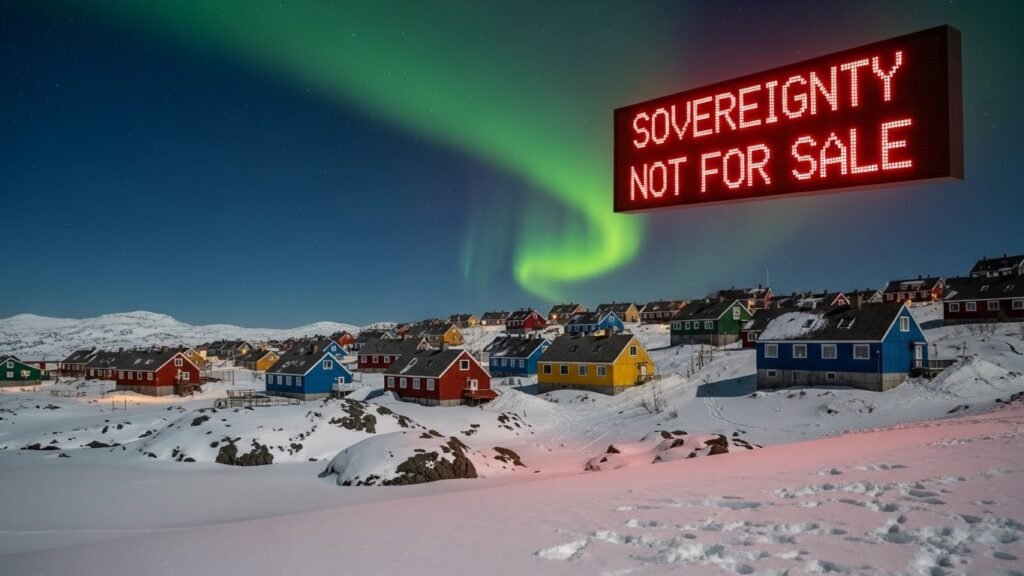
- The Atmosphere: In Nuuk, Greenland’s capital, digital tickers flash warnings of “Trump” and “Sovereignty” in red letters. The local sentiment is one of dread, with residents describing the countdown to this meeting as feeling “like years.”
Why Now? The Venezuela Precedent The timing of this pressure campaign is critical. President Trump’s recent military action to depose the regime in Venezuela has stripped away the assumption that he is bluffing.
- Credible Threat: Mette Frederiksen, the Danish Prime Minister, has publicly warned that if the U.S. attempts to take Greenland by force, it would signal “the end of NATO.”
- The 20-Day Clock: Trump recently told reporters, “Let’s talk about Greenland in 20 days,” effectively setting a deadline that has accelerated diplomatic panic across Europe.
The Strategic Prize: Why the U.S. Wants Title The Trump administration argues that leasing bases is no longer sufficient. They demand “title” (ownership) for three primary reasons:
- The GIUK Gap: This maritime chokepoint between Greenland, Iceland, and the UK is the only exit for Russian submarines from the Arctic into the Atlantic. Control here is vital for tracking Russia’s Northern Fleet.
- Rare Earth Dominance: Greenland sits on vast, untapped reserves of rare earth elements—minerals essential for fighter jets, EVs, and smartphones. Currently, China controls 90% of the global supply chain. Washington views owning Greenland as the only way to break Beijing’s chokehold on these critical resources.
- Missile Defense: As the shortest route between Russia and the U.S. mainland, Greenland is the cornerstone of American missile defense architecture.
Europe Scrambles to “Buy” Security In a desperate bid to appease Washington without ceding territory, European powers are rushing to militarize the Arctic themselves, hoping to prove they can secure the island without a U.S. takeover.
- Germany’s Pivot: German Chancellor Friedrich Merz has taken a surprisingly hawkish stance, stating, “We share the U.S. concerns.” Germany is reportedly offering to station a military brigade in Greenland—a historic move for the Bundeswehr to gain strategic Arctic experience.
- The “Arctic Sentry”: NATO is proposing a maritime “Arctic Sentry” mission, deploying submarines and anti-drone capabilities to protect underwater data cables and energy pipelines from Russian hybrid warfare.
- France and UK: France is hurriedly opening a consulate in Nuuk as a “political signal” of presence, while the UK is in talks to deploy Royal Marines for extended exercises.
The Human Cost Amidst the talk of minerals and missiles, the 57,000 residents of Greenland feel like pawns.
- Independence vs. Annexation: While 85% of Greenlanders desire eventual independence from Denmark, an even higher number reject becoming an American territory.
- Local Voices: “Our country is not for sale,” says Amelie Zeeb, a local resident. The fear is that forced annexation would erase their Inuit culture and burgeoning self-governance.
4. “Why It Matters” (Conclusion)
This crisis matters because it redefines the rules of alliance. For the common man, it signals a return to an era where great powers carve up the map for resources and strategy, ignoring the will of the inhabitants. If the U.S. succeeds in coercing a NATO ally, the global security architecture crumbles, potentially triggering a chaotic “scramble for the Arctic” involving Russia and China.
Brainx Ultimate Deep Dive: The Hidden “Rare Earth” War
(Detailed Analysis for Context)
To truly understand why the U.S. is risking the NATO alliance for an island of ice, we must look beneath the surface—literally. The “Greenland Purchase” is largely a proxy war against China’s tech dominance.
The Chinese Stranglehold China currently refines nearly 90% of the world’s rare earth elements. These are not just for iPhones; they are essential for:
- F-35 Fighter Jets: Which require over 900 lbs of rare earth minerals each.
- Virginia-class Submarines: Which need tons of specific magnetic alloys.
- Green Energy: Wind turbines and EV batteries rely entirely on these inputs.
Greenland as the Solution Greenland holds the world’s largest undeveloped deposits of Neodymium, Praseodymium, and Dysprosium.
- The Kvanefjeld Deposit: This single site in Southern Greenland is estimated to hold enough rare earths to meet global demand for decades.
- The Problem: Developing these mines is expensive, environmentally controversial, and slow. China has previously attempted to invest here (the “Polar Silk Road”), which terrified Washington.
- The Trump Doctrine: The logic is that as long as Greenland remains under Danish rule (with its strict environmental laws and slow bureaucracy), these resources will stay in the ground—or worse, eventually fall to Chinese economic influence. “Title” allows the U.S. to bypass local red tape and extract these minerals immediately for “national security.”
The NATO Dilemma This puts European leaders in an impossible bind.
- If they refuse Trump, he may withdraw U.S. support from NATO or Ukraine.
- If they agree (or stay silent), they validate the idea that sovereignty is optional.
- This is why Chancellor Friedrich Merz and others are offering military solutions (troops, ships) to a resource problem. They are trying to show that NATO can secure the island’s strategic value without the U.S. needing to own the deed.
The next 20 days will determine if the Arctic remains a zone of cooperation or becomes the first battlefield of a resource war between allies.




Leave a Reply