Headline: Iran Universities Erupt: Anti-Government Protests Resume Amid US Military Threats and Nuclear Ultimatum
Brainx Perspective At Brainx, we believe this resurgence of student protests in Iran exposes the fragile grip of the current regime. This development highlights a dual crisis for Tehran: facing an increasingly fearless internal youth rebellion while simultaneously navigating the catastrophic threat of imminent military strikes from the United States.
The News
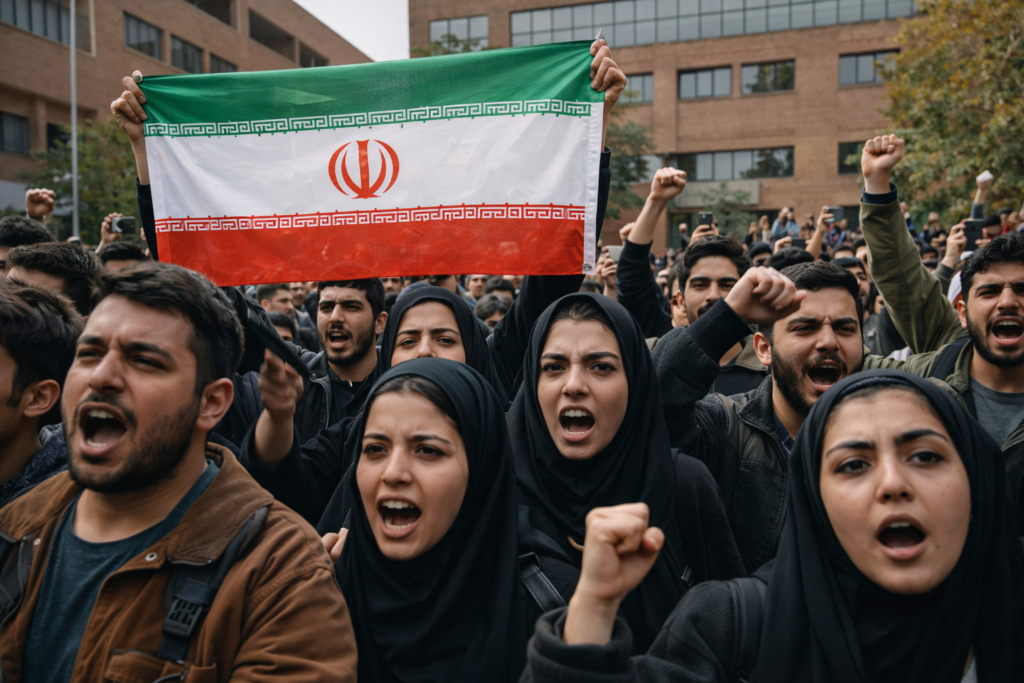
In a dramatic defiance of recent state violence, university students across Iran have reignited large-scale anti-government protests. These demonstrations mark the first significant public mobilization since a devastating crackdown by authorities last month, which human rights organizations estimate left thousands dead. The resurgence of civil unrest on university campuses coincides dangerously with escalating geopolitical tensions, as the United States builds up its military presence in the region and issues a stark ultimatum regarding Tehran’s controversial nuclear program.
Key Facts of the Crisis:
- Campus Uprisings: Students at prominent institutions, including Sharif University of Technology, Shahid Beheshti University, and Amir Kabir University in Tehran, as well as universities in the north-eastern city of Mashhad, have launched massive protests and sit-ins.
- Direct Clashes: Verified footage reveals scuffles breaking out between anti-government demonstrators and pro-regime supporters on university grounds.
- Staggering Death Toll: Protesters are honoring the victims of last month’s mass protests. The US-based Human Rights Activists News Agency (Hrana) reports at least 6,159 confirmed deaths, while investigating 17,000 more.
- US Ultimatum: Following nuclear talks in Switzerland, President Donald Trump has issued a 10-day ultimatum for a diplomatic resolution, openly considering a limited military strike against Iran.
- Divided Opposition: Exiled Iranian opposition groups are fiercely divided, with some urging US military intervention to topple the regime, while internal activists fiercely oppose foreign military strikes.
- Information Warfare: A sophisticated disinformation campaign is currently raging across global social media platforms, with opposing factions attempting to control the narrative of the Iranian people’s true desires.
The Campus Battlegrounds: Tehran and Beyond The epicenter of this renewed defiance is the academic heart of Iran. At the start of the new semester on Saturday, the Sharif University of Technology in Tehran—traditionally a hotbed of intellectual and political discourse—saw hundreds of students marching peacefully. Waving national Iranian flags, the crowds bravely chanted “death to the dictator,” a direct and highly illegal reference to Supreme Leader Ayatollah Ali Khamenei, alongside other fiercely anti-government slogans.
The peaceful nature of these marches, however, was quickly disrupted. Verified video footage shows supporters of a rival, pro-government faction mobilizing nearby, eventually leading to physical scuffles between the two camps. This micro-conflict on campus serves as a microcosm of the broader ideological civil war brewing within the nation.
Simultaneously, the capital’s Shahid Beheshti University hosted a peaceful sit-in protest, while students at Amir Kabir University of Technology were recorded echoing the anti-establishment chants. The unrest is not confined to the capital. In Mashhad, Iran’s second-largest city and a deeply religious conservative stronghold, local students boldly chanted, “Freedom, freedom,” and “Students, shout, shout for your rights.” Reports indicate that these sizable demonstrations are expected to continue, with calls for further rallies circulating rapidly through underground networks. At this stage, the exact number of student arrests remains unconfirmed, but the threat of detention looms large over the academic community.
The Shadow of the Massacre: Analyzing the Death Toll To understand the sheer courage required for these students to protest, one must look at the immediate historical context. These campus rallies were explicitly organized to honor the thousands killed in the mass protests that swept the nation last month. Originally sparked by crippling economic grievances—exacerbated by international sanctions and domestic mismanagement—the unrest quickly evolved into the largest anti-regime uprising since the 1979 Islamic Revolution.
The scale of the state’s response was unprecedented. According to Hrana (the Human Rights Activists News Agency), investigators have confirmed the deaths of at least 6,159 individuals during the crackdown. This staggering figure includes 5,804 civilian protesters, 92 children, and 214 people affiliated with the government. More alarmingly, Hrana is currently investigating reports of an additional 17,000 deaths.
The Iranian government’s official narrative stands in stark contrast. Late last month, state authorities admitted to a death toll of over 3,100 but claimed that the vast majority of the casualties were security personnel or innocent bystanders attacked by foreign-backed “rioters.” This vast discrepancy in casualty reporting highlights the extreme difficulty of obtaining transparent information from within the country, setting the stage for the current digital information war.
The Geopolitical Powder Keg: US Military Threats and Nuclear Diplomacy While the Iranian government battles its own citizens on the streets, it is simultaneously staring down the barrel of a major international military conflict. The United States, backed by its European allies, has long suspected that Iran is utilizing its nuclear energy program as a cover for the development of nuclear weapons—an allegation Tehran has consistently and vehemently denied.
In response to these suspicions, the US has significantly increased its military footprint in the Middle East, positioning naval and air assets within striking distance of Iranian strategic targets. The diplomatic track, however, remains open, albeit barely. US and Iranian officials recently convened in Switzerland for high-stakes talks aimed at curbing Iran’s nuclear ambitions. Both sides reported that “progress had been made.”
Yet, this diplomatic progress is overshadowed by aggressive rhetoric from Washington. President Donald Trump has publicly stated that he is actively considering a “limited military strike” against Iranian targets. Following the Swiss talks, the US leader effectively placed a ticking clock on the crisis, warning that the world will find out “over the next, probably, 10 days” whether a comprehensive nuclear deal will be finalized or if the United States will resort to military action.
This is not the first time the US leadership has weighed in on Iran’s internal dynamics. In the past, President Trump has offered verbal support to anti-government protesters, at one point teasing that “help is on its way.” However, the prospect of actual US bombs dropping on Iranian soil drastically complicates the domestic uprising.
The Disinformation War and the Fractured Opposition As the 10-day ultimatum ticks down, the Iranian opposition finds itself deeply fractured over the prospect of American intervention. Exiled opposition groups, many of whom have not set foot in Iran for decades, are aggressively lobbying Washington to make good on its military threats. Their calculation is that a targeted US strike would cripple the Revolutionary Guard’s infrastructure, paving the way for a rapid downfall of the hardline government.
Conversely, internal opposition groups, student leaders, and domestic human rights activists are overwhelmingly opposed to outside military intervention. They argue that a US strike would not only result in massive civilian casualties but would also hand the regime a perfect excuse to implement martial law, wipe out the remaining domestic opposition under the guise of national security, and unite the fractured country against a foreign invader.
This ideological split has birthed a massive disinformation campaign across social media networks. State-sponsored bot farms, exiled opposition media, and organic activist networks are all vying to control the narrative. Hashtags are manipulated, old footage is recycled as new, and conflicting narratives are amplified to convince the international community of what the “true” Iranian people want—whether that is foreign salvation or organic, internally driven democratic reform.
As the students of Sharif University return to their dormitories tonight, they are caught in the most dangerous crossfire imaginable: a ruthless domestic security apparatus on one side, and the looming specter of an international superpower’s military might on the other.
Why It Matters For the common man, this escalating crisis threatens regional stability and global oil markets. If internal dissent triggers a regime collapse or prompts a US military strike, the resulting geopolitical shockwave will trigger massive global inflation, fundamentally reshape Middle Eastern security alliances, and dictate the human rights landscape for generations to come.


Leave a Reply