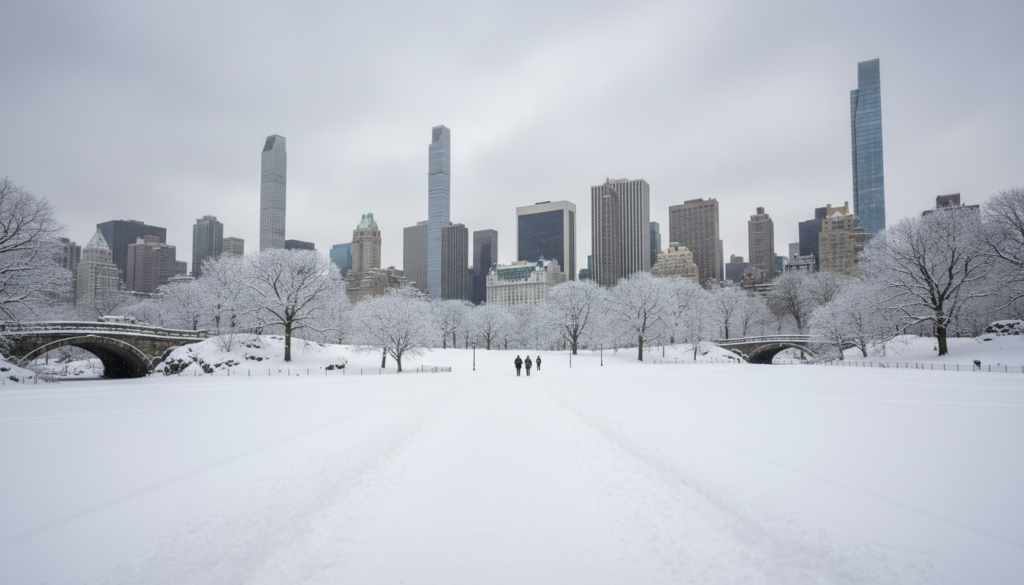
New York blanketed in snow, sparking travel chaos
New York’s Whiteout Crisis: Heavy Snowfall Paralyses the Northeast in a 4-Year Record Event
Brainx Perspective
At Brainx, we believe this historic snowfall is a wake-up call regarding urban resilience and the volatile nature of modern climate patterns. This development highlights the fragility of our “just-in-time” infrastructure; when four inches of snow can ground 900 flights and trigger emergency protocols, we must question our readiness for future extremes.
The News: A Region Under Siege
New York and the surrounding tri-state area are currently reeling from the most significant winter weather event in nearly half a decade. What began as a scenic dusting quickly escalated into a logistical nightmare, forcing state governors to deploy emergency measures as the “Great Northeast Burial” took hold.
Key Facts of the 2026 Winter Crisis:
- The Four-Year Record: For the first time since January 2022, New York City recorded substantial snow accumulation, with Central Park hitting a 4.3-inch (11cm) milestone.
- Regional Hotspots: While Manhattan managed the influx, northern and central New York, including Syracuse and parts of Long Island, reported staggering accumulations ranging from 6 to 10 inches.
- Aviation Paralysis: FlightAware data confirms that over 900 flights were cancelled on Saturday alone. The “ripple effect” caused over 8,000 delays nationwide, primarily affecting JFK, LaGuardia, and Newark hubs.
- State of Emergency: Governor Kathy Hochul declared a state of emergency for more than half of New York’s counties. Similar declarations were mirrored in New Jersey and Connecticut to manage hazardous road conditions.
- “Code Blue” Activation: Authorities have triggered emergency safety protocols to protect the homeless population as temperatures plummet below freezing.
- The Black Ice Threat: The National Weather Service (NWS) has warned that despite the cessation of snowfall, melting slush is refreezing into invisible “black ice,” creating death traps on bridges and overpasses.
Deep Dive: The Anatomy of a Blizzard
I. Understanding the “Big Freeze” of 2026
The current storm system is the result of a “bomb cyclone” effect—a rapid drop in atmospheric pressure that drew moisture from the Atlantic and collided with an Arctic blast moving down from Canada. For a city like New York, which had grown accustomed to milder winters in recent years, the sheer volume of snow delivered in a 12-hour window has overwhelmed standard clearing operations.
In Syracuse and Buffalo, the “lake effect” exacerbated the situation. When cold air moves across the relatively warmer waters of the Great Lakes, it picks up moisture and deposits it as heavy, wet snow. This specific type of snow is particularly dangerous as it clings to power lines and tree branches, leading to widespread utility outages.
II. The Travel Meltdown: Why 4 Inches Grounded the Northeast
To the casual observer, 4.3 inches might seem manageable. However, the complexity of the New York airspace means that even minor visibility issues create a bottleneck.
- Ground De-icing Delays: At JFK and Newark, the sheer volume of aircraft requiring de-icing fluid caused a queue that lasted upwards of six hours.
- Staffing Shortages: The state of emergency made it impossible for many ground crew members and TSA agents to reach the airports, leading to terminal congestion.
- The “Ghost Flights” Phenomenon: Many airlines were forced to fly empty planes to other hubs to prevent them from being “snowed in” at New York, further disrupting the schedule for tens of thousands of passengers.
III. Infrastructure and the “Black Ice” Peril
The most dangerous phase of a winter storm is often not the falling snow, but the aftermath. As temperatures hover around the freezing mark, the daytime sun melts the top layer of snow. By nightfall, this water settles into the pores of the asphalt and freezes into a smooth, transparent sheet known as black ice.
Governor Hochul’s administration has deployed over 1,500 plows and 500 salt spreaders across the state. However, the salt becomes less effective once temperatures drop below 15°F (-9°C). Engineers are currently monitoring the structural integrity of older bridges in the Hudson Valley, where the weight of the snow combined with the expansion of ice in concrete cracks poses a long-term maintenance risk.
IV. Social Impact: “Code Blue” and Vulnerable Populations
The “Code Blue” protocol is more than just a bureaucratic label; it is a life-saving mandate. Under this status, shelters are legally required to accept anyone seeking refuge from the cold, regardless of their prior status or history.
- Outreach Teams: New York City has deployed “Homeless Outreach” teams to canvass subways and parks, urging individuals to move into heated facilities.
- The Energy Crisis: With the sudden spike in heating demand, Con Edison and other utility providers have urged residents to conserve energy to prevent grid overloads. In lower-income neighborhoods, the “heat or eat” dilemma has returned to the forefront of local political discourse.
V. A Nation Divided by Weather
While the East Coast digs out, the West Coast is suffering from an “Atmospheric River.” California has seen devastating mudslides and flash flooding this weekend. This juxtaposition of extreme snow in the East and extreme rain in the West suggests a broader destabilization of the Jet Stream—a phenomenon many meteorologists link to the warming of the Arctic.
Why It Matters
For the common man, this storm isn’t just about a day off work; it’s about the hidden costs of climate volatility. From surging insurance premiums and heating bills to the risk of “black ice” accidents, these events hit the wallet as hard as they hit the roads. In an increasingly interconnected world, a single weekend of snow in New York can disrupt global supply chains and family lives for weeks.
Would you like me to create a localized safety guide on how to identify black ice while driving or a comparative analysis of NYC’s snow-clearing budget over the last decade?


Leave a Reply