Race Against Death: How the WHO Foundation is Saving Lives in the World’s Deadliest Conflict Zones
At Brainx, we believe…
At Brainx, we believe that healthcare is the ultimate casualty of war and natural disasters. This development highlights a grim reality: when hospitals become collateral damage, the secondary death toll from untreated diseases and trauma skyrockets. The WHO Foundation’s rapid-response model isn’t just charity; it is the fundamental safety net for humanity’s most vulnerable populations.
The News: Inside the Global Lifeline of the World Health Organization
In an era defined by overlapping polycrises—from devastating natural disasters to protracted geopolitical conflicts—the global healthcare infrastructure is being tested like never before. As of late 2025, the World Health Organization (WHO) is actively managing responses to more than 40 severe emergencies worldwide. The logistics of delivering life-saving medical aid to regions cut off by rubble, blockades, or active gunfire are staggering. Behind these massive operations stands the WHO Foundation, a critical entity connecting global donors with front-line medical action.
To understand the sheer scale of this humanitarian aid network, we must look at the data and the on-the-ground realities of global disaster relief.
Key Facts: The WHO’s Emergency Global Footprint
- Massive Caseload: The WHO is currently responding to over 40 concurrent global emergencies, spanning multiple continents and conflict zones.
- Direct Impact: Emergency medical teams deployed by the WHO have successfully delivered more than 6 million life-saving treatments and conducted over 2 million patient consultations in the hardest-hit regions.
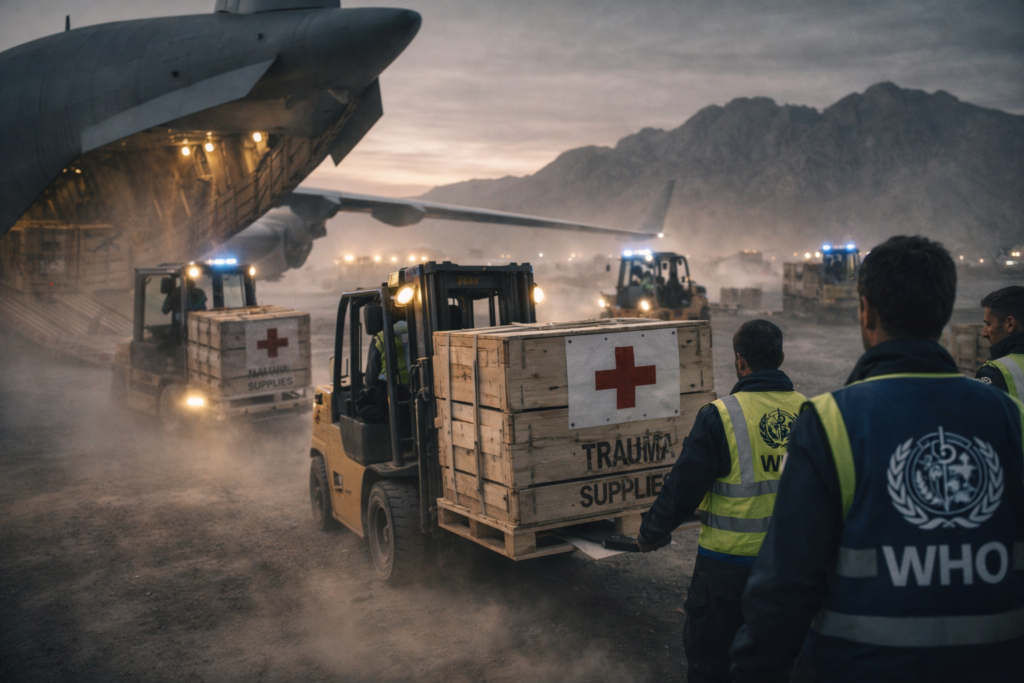
- Rapid Deployment: In acute disaster scenarios, such as the recent earthquakes in Afghanistan, the WHO has proven capable of mobilizing and delivering metric tonnes of trauma supplies within a 24-hour window.
- Infrastructure Collapse: In severe conflict zones like Sudan, an estimated 70% of hospitals (seven out of ten) have been forced to close, shifting the burden entirely to mobile clinics and international aid organizations.
- Strategic Philanthropy: The WHO Foundation, established in Geneva in 2020, allows individual and corporate donations to directly fund these emergency medical operations, with granular impacts—such as $100 funding trauma surgery for two patients.
The “Golden Hour”: Rapid Response in Afghanistan
In disaster medicine, the “golden hour” refers to the critical window immediately following trauma where medical intervention has the highest chance of preventing death. When a powerful earthquake violently struck Afghanistan, obliterating infrastructure and cutting off remote villages, the WHO’s logistical network swung into immediate action.
Within hours of the seismic event, emergency logistics teams loaded cargo aircraft with 23 metric tonnes of essential medicine, surgical tools, and trauma supplies. By the next day, these crucial supplies had bypassed destroyed roads, rubble, and landslides to reach isolated communities.
The impact of this rapid deployment cannot be overstated. Fatima, a local healthcare worker operating in the quake’s epicenter, described the desperation of the initial hours. She was forced to set up a makeshift triage clinic under nothing but a plastic tarpaulin. “We had no power, no equipment,” she recounted. “WHO arrived within 24 hours, and that made the difference between life and death.” This rapid mobilization of medical freight is a testament to the WHO’s intricate global supply chain, which relies heavily on flexible funding to charter emergency flights at a moment’s notice.
Gaza: Sustaining Life Amidst Systemic Collapse
The humanitarian crisis in Gaza represents one of the most complex medical emergencies of the 21st century. Months of relentless bombardment and severe supply blockades have left the region’s healthcare system in ruins. Hospitals are struggling to maintain even the most basic functions, operating in a perpetual state of triage.
The WHO’s intervention in Gaza has been hyper-focused on sustaining life in the most vulnerable demographics: newborns and the chronically ill. The organization has navigated immense logistical and security hurdles to deliver desperately needed fuel, medications, and surgical equipment. This aid is the only thing keeping maternity and neonatal intensive care units (NICUs) operating. Every month, thousands of babies are born in severely damaged, overcrowded facilities, tragically often without adequate lighting, sterile environments, or anesthesia for emergency cesarean sections.
Beyond immediate trauma care, the collapse of specialized healthcare is a silent killer. For patients with chronic or complex diseases, a warzone is a death sentence. When six-year-old Eleen’s hospital in Gaza was destroyed, her leukemia treatment was abruptly halted. Without chemotherapy, her prognosis was measured in weeks. The WHO intervened, utilizing its diplomatic and logistical channels to coordinate a highly complex medical evacuation, allowing Eleen to continue her cancer treatment abroad.
“It’s a miracle she could continue her treatment,” said her mother, Iman Al Majida. “Without WHO, she would not be alive.” Eleen’s story represents a fraction of the complex medical casework the WHO handles daily in blockaded territories.
Sudan: The Invisible Crisis and the Mental Health Toll
While other conflicts dominate global headlines, Sudan is currently experiencing the world’s largest displacement crisis, pushing a historically fragile health system entirely past its breaking point. The scale of the institutional collapse is staggering: seven out of ten hospitals nationwide have been shuttered due to violence, looting, or lack of staff and supplies.
In response, the WHO has had to pivot its strategy, keeping essential services running in key stable regions while simultaneously launching fleets of mobile health clinics. These mobile units are critical for reaching populations that have been displaced multiple times by the shifting frontlines of the civil war.
Crucially, the WHO has recognized that the wounds of war are not solely physical. These mobile clinics have been outfitted to provide vital mental health and psychosocial care to traumatized families. For populations subjected to extreme violence, starvation, and the loss of their homes, these clinics are often the very first point of contact for psychological triage.
“We are seeing people who have lost everything,” noted one WHO-affiliated mental health worker operating in Sudan. “Sometimes listening is the first step to healing.” This holistic approach to emergency medicine—treating chronic stress, grief, and PTSD alongside physical trauma—is a hallmark of the WHO’s modern crisis response.
Ukraine: Winterization and the Long War
As the war in Ukraine stretches past the 1,000-day mark, the nature of the medical emergency has evolved. The systematic targeting of civilian energy and heating infrastructure has created a secondary crisis, particularly during the brutal Eastern European winters. Hospitals cannot perform surgeries or keep premature infants warm in freezing wards.
The WHO’s strategy in Ukraine has heavily featured “winterization” efforts. The organization has intervened to restore care in regions where medical infrastructure has been leveled. Currently, 56 frontline hospitals have been equipped with robust, independent heating systems provided by the WHO, ensuring that operating rooms and intensive care units can function uninterrupted through the freezing months.
Furthermore, to replace hospitals that were completely destroyed, the WHO has deployed state-of-the-art prefabricated clinics. These modular health centers can be rapidly assembled to provide essential primary care to internally displaced families. In Ukraine, every restored clinic and heated hospital room represents more than just medical capacity; it is a profound commitment to rebuilding hope and resisting the systemic destruction of society.
The WHO Foundation: The Architecture of Generosity
None of these life-saving interventions happen in a vacuum. The fuel for this massive engine of global health is funding. Created in 2020 and headquartered in Geneva, Switzerland, the WHO Foundation was established to revolutionize how the World Health Organization is financed.
Historically reliant on complex, heavily earmarked funding from member states, the WHO needed a mechanism to mobilize flexible, rapid-response capital. The WHO Foundation bridges this gap, connecting “donors and doers.” It channels contributions from individual philanthropists, corporate partners, and everyday citizens directly into the WHO’s normative work—the science, research, and policy-making that fortify global health systems—as well as its urgent, on-the-ground emergency operations.
This financial agility is what allows the WHO to charter a cargo plane to Afghanistan within hours or procure specialized pediatric leukemia drugs for a child in Gaza. The Foundation transforms abstract compassion into tangible, logistical capability.
Anil Soni, Chief Executive Officer of the WHO Foundation, summarizes this synergy: “This impact is only possible because of you. Your generosity helps WHO bring health within reach for more people worldwide.”
The return on investment for global health donations is incredibly high. Due to the WHO’s massive purchasing power and economies of scale, a donation of just $100 can supply the necessary materials for trauma surgery for two critically injured patients. A gift of $250 can secure a vital course of pediatric medicines for five children. When these contributions are pooled globally, they form a financial reservoir that gives the WHO the power to act the very moment a disaster strikes, turning solidarity into science-backed action.
From the first airlift of antibiotics to the meticulous reopening of a winterized hospital ward, the work of the WHO proves that proactive preparedness saves lives. By supporting the WHO Foundation, global citizens ensure that this vital work continues in humanity’s darkest hours.
Why It Matters
A breakdown in healthcare anywhere threatens global health security everywhere. For the common man, supporting the WHO’s emergency infrastructure prevents localized crises from evolving into unmanageable global pandemics or massive refugee emergencies. Beyond pure self-interest, funding these resilient health systems fulfills our fundamental moral obligation to protect the innocent, ensuring a safer, more stable future for everyone.




Leave a Reply