Royal Betrayal? Prince Andrew Accused of Leaking “Confidential” Afghan Uranium & Gold Maps to Epstein
At Brainx, we believe…
This development highlights a catastrophic breach of trust that goes beyond mere scandal—it touches on national security and the sanctity of public service. At Brainx, we believe the allegation that Prince Andrew used his position as UK Trade Envoy to funnel confidential data about Afghanistan’s mineral wealth to a sex offender—while British soldiers were fighting and dying in the same province—represents a profound betrayal of both the armed forces and the British taxpayer. It suggests that for the elite, the lines between state duty and personal enrichment are not just blurred, but nonexistent.
The News: Secrets for Sale in the Royal Court
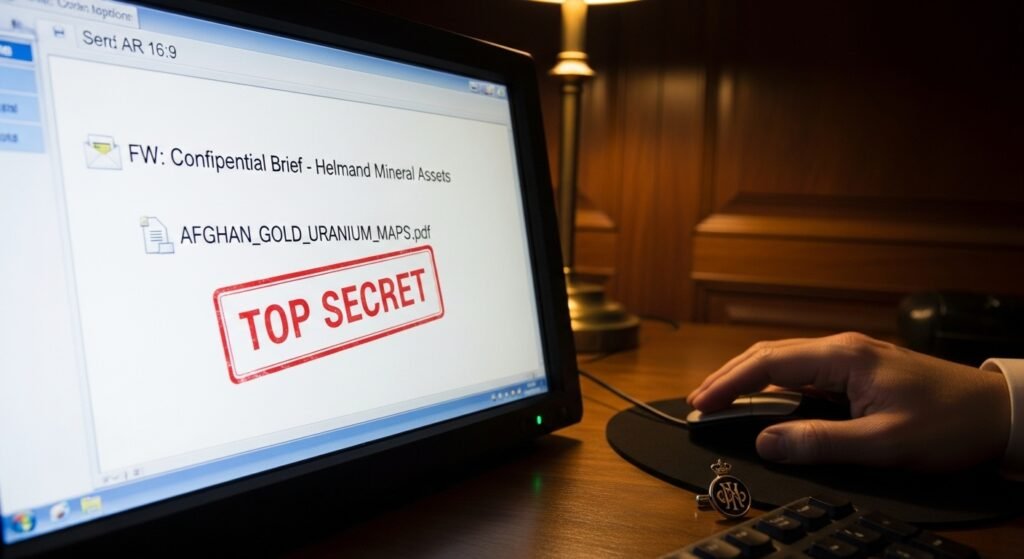
Fresh explosive documents released from the US Department of Justice have triggered a major criminal assessment in the UK, alleging that Prince Andrew (now known as Andrew Mountbatten-Windsor) leaked highly sensitive government files to convicted sex offender Jeffrey Epstein. The files in question were not merely social pleasantries; they were confidential briefings regarding the immense, untapped mineral wealth of Afghanistan—specifically gold and uranium—sent at the height of the war.
The “Christmas Eve” Leak
According to the newly released email tranche, the alleged breach occurred on December 24, 2010—Christmas Eve.
- The Email: Andrew reportedly forwarded a document to Epstein with the subject line suggesting a potential business deal.
- The Content: The attachment was a “confidential brief” produced specifically for the Duke by the Provincial Reconstruction Team (PRT) in Helmand Province.
- The Timing: This email was sent just days after Andrew had visited British troops stationed in Helmand, a region that was, at the time, one of the deadliest combat zones on earth. While soldiers were securing the ground, the Prince was allegedly packaging the region’s economic potential for his financier friend.
What Was in the Documents?
The leaked briefing provided a detailed assessment of “high value commercial opportunities” in war-torn Afghanistan. It appears the British government was mapping the country’s resources to help rebuild its economy, but Andrew saw a different opportunity.
- Strategic Minerals: The document listed deposits of gold, marble, iridium, thorium, and significantly, uranium—a material of intense geopolitical sensitivity.
- Oil and Gas: It also highlighted potential reserves of hydrocarbons.
- “Low Cost Extraction”: The briefing reportedly emphasized the potential for “low cost extraction,” a phrase that would have been music to the ears of a predatory investor like Epstein.
A Pattern of Leaks: The “Empty File” Mystery
This was not an isolated incident. The Epstein files reveal a pattern of behavior where Andrew acted as a conduit for sensitive information.
- Instant Forwarding: In one instance, Andrew forwarded official trade reports from his visits to Singapore, Hong Kong, and Vietnam to Epstein just five minutes after receiving them from his special assistant, Amit Patel.
- “Overseas Bids”: He also sent a second batch of files labeled “Overseas bids,” which appear to be compressed Zip files containing commercial tenders.
- Vince Cable’s Revelation: Sir Vince Cable, the Business Secretary at the time who eventually forced Andrew out of the envoy role, revealed a chilling detail. He stated that he had twice asked to see the official file on Andrew’s activities as trade envoy, only to find that “strangely, it is empty.” This suggests a deliberate lack of record-keeping or a purge of documents.
Police Launch “Assessment”
The revelations have forced UK law enforcement to act.
- Thames Valley Police: The force, which covers Windsor, confirmed they are “assessing” a formal complaint of misconduct in public office and breaches of the Official Secrets Act.
- The Complaint: The report was filed by Graham Smith, CEO of the anti-monarchy group Republic, who argues there is no difference between this and other cases of official corruption.
- The King’s Stance: In a move that signals the complete exile of the Duke, Buckingham Palace stated that King Charles III is “ready to support” the police investigation. The Palace emphasized that the King has “profound concern” over the allegations.
Deep Dive: The “Trillion Dollar” Sandbox
(Analysis for Brainx Ultimate Readers)
To understand the gravity of this leak, one must understand what was at stake in Afghanistan in 2010. In that same year, the US Geological Survey (USGS) and Pentagon officials stunned the world by announcing that Afghanistan was sitting on $1 trillion worth of untapped minerals. The country was dubbed the “Saudi Arabia of Lithium.”
- Helmand Province, where Andrew visited, was not just a poppy field; it was a geological treasure chest containing carbonatites rich in rare earth elements needed for modern electronics.
- The Uranium Question: The mention of uranium in the leaked brief is particularly alarming. In 2010, fears of nuclear proliferation in the region were high. Handing data about uranium deposits to a private financier with opaque global connections (Epstein) represents a staggering lack of judgment and a potential national security risk.
- The PRT Role: The “Provincial Reconstruction Team” was a military-civilian hybrid unit designed to stabilize Afghanistan. Their data was meant to help the Afghan people build an economy, not to be scalped by Western billionaires before the dust had even settled.
The “Trade Envoy” Charade
Prince Andrew served as the UK’s Special Representative for International Trade and Investment from 2001 to 2011.
- The Official Job: To promote British businesses abroad.
- The Reality: Critics long suspected the role was a cover for Andrew to fly on private jets and mix with oligarchs. The “empty file” comment by Vince Cable supports the theory that Andrew operated with zero oversight, treating the UK government’s diplomatic network as his personal rolodex.
- The Defense: Andrew’s camp has previously argued he was “promoting UK interests.” However, forwarding confidential state documents to a private US citizen (Epstein) who had already been convicted of sex offenses in 2008 violates every protocol of the Civil Service code.
Why It Matters
This story matters because it shatters the last defense of the “working royal.” For years, defenders argued that despite his personal flaws, Andrew “served his country” as a trade envoy. These documents suggest the opposite: that he sold his country’s secrets to impress a pedophile. For the common man, this is a lesson in how the global elite operate—trading sovereign wealth and classified data over email like gossip. If the police proceed with a full investigation, we could see the first member of the modern Royal Family face charges not just for sexual misconduct, but for corruption in public office.




Leave a Reply