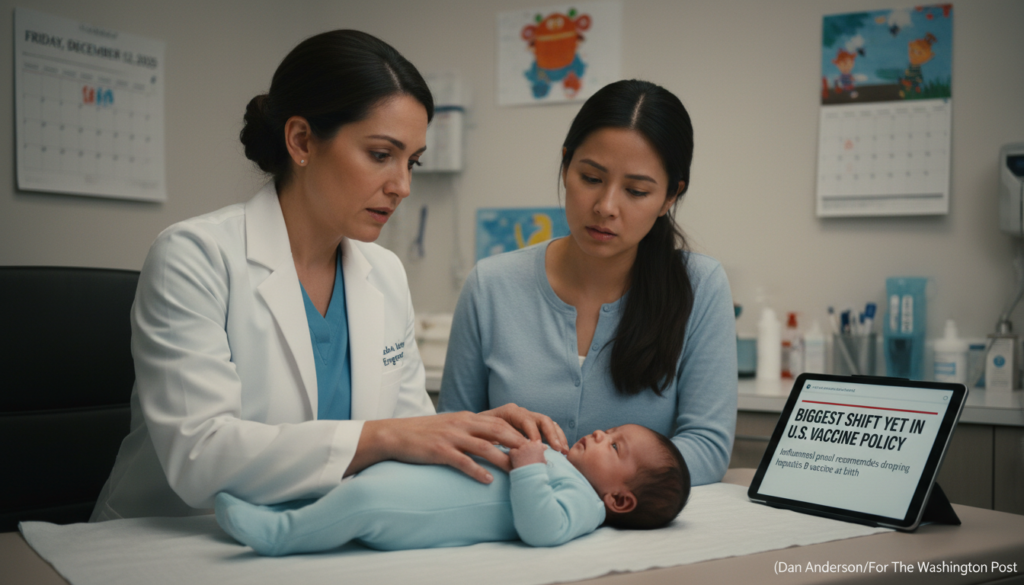
The biggest shift yet in U.S. vaccine policy
Vaccine Policy Quake: The High Stakes of Ending the Hepatitis B Birth Dose
“Brainx Perspective”
At Brainx, we believe that the recent dismantling of the universal Hepatitis B birth dose represents a perilous pivot from collective safety to individual risk management. This development highlights a widening chasm between established public health science and a new political philosophy prioritizing “choice” over “safety nets”—a shift that may inadvertently place the nation’s most vulnerable infants in the crosshairs of a preventable, silent killer.
The Shifting Landscape of Pediatric Immunization
The American public health architecture is currently enduring its most seismic structural shift in over three decades. Since 1991, the childhood immunization schedule has stood as a non-negotiable pillar of preventive medicine, a shield designed to protect newborns from the moment they enter the world. However, late 2025 marked the end of this era. Following a directive from the Trump administration’s “Make America Healthy Again” (MAHA) initiative, a federal advisory panel has formally recommended the removal of the universal birth dose of the Hepatitis B vaccine.
This decision, now rippling through hospitals and clinics nationwide, replaces a universal mandate with a “screening-based” approach. For pediatricians like Dr. Nola Jean Ernest in Enterprise, Alabama, this is not abstract policy; it is an immediate crisis unfolding in exam rooms, pitting parental intuition against hard-won epidemiological data.
The Mechanics of the Policy Reversal
The updated guidelines, finalized in December 2025, fundamentally alter the standard of care for newborns:
- The New Standard: Infants born to mothers who test negative for Hepatitis B will no longer receive the vaccine within 24 hours of birth.
- The Delay: Vaccination for these “low-risk” infants is now recommended to begin at two months of age, rather than immediately.
- The Exception: The birth dose remains recommended only for infants born to mothers who test positive for Hepatitis B or whose infection status is unknown.
- The Philosophy: Proponents argue this restores “clinical freedom,” contending that low-risk infants do not require immediate intervention and that the immune system should be spared “unnecessary” challenges in the first days of life.
The “Safety Net” Unraveled: Why the Birth Dose Existed
To understand the gravity of this change, one must analyze the failure of the system that preceded the 1991 mandate. The universal birth dose was not implemented to vaccinate low-risk babies against a disease they wouldn’t catch; it was implemented because the medical system failed to identify high-risk babies often enough to prevent tragedy.
- The Screening Failure: In the 1980s, the U.S. relied on screening mothers. However, lab errors, lost records, and lack of prenatal care meant that thousands of infants born to infected mothers slipped through the cracks.
- The “Silent” Spread: Hepatitis B is highly infectious—far more so than HIV. It can be transmitted via microscopic amounts of blood from household contacts (shared toothbrushes, diabetic lancing devices) or caregivers who are unaware they are carriers.
- The Consequence: Without the birth dose acting as a “safety net,” roughly 90% of infants infected during birth or early infancy develop chronic Hepatitis B. This is a lifelong, incurable condition often leading to cirrhosis, liver failure, or hepatocellular carcinoma (liver cancer) by early adulthood.
The “Make America Healthy Again” (MAHA) Context
This policy shift is the first major victory for the MAHA commission, spearheaded by HHS Secretary Robert F. Kennedy Jr. The initiative posits that the American childhood chronic disease epidemic is fueled by environmental toxins and “over-medication,” including an aggressive vaccine schedule.
- Reviewing the Schedule: The administration has directed a top-to-bottom review of all CDC guidelines to align them with “peer developed nations,” some of which do not mandate the Hep B birth dose (though often because they have different screening infrastructures and lower baseline disease prevalence).
- Parental Authority: The move is framed as a victory for parental rights, shifting the power of health decisions from federal mandates back to the family unit.
- Skepticism Mainstreamed: This political endorsement has validated vaccine skepticism. Parents are increasingly viewing vaccines not as essential protections but as “medical products” to be negotiated or refused based on personal research.
View from the Front Lines: The Rural Reality
In the Wiregrass region of Alabama, Dr. Nola Jean Ernest faces the brunt of this ideological war. Rural healthcare systems are often the first to break when safety nets are removed. In areas with limited access to prenatal care, the “screening-only” model is statistically destined to fail.
- The Trust Gap: Dr. Ernest notes that the “trust gap” between patients and the medical establishment has widened significantly post-pandemic. The recommendation to drop the birth dose is interpreted by many parents as proof that “doctors were wrong all along,” complicating efforts to advocate for other essential vaccines like measles or whooping cough.
- The Conversation: Discussions in her clinic have shifted from logistics (“When is the next shot?”) to philosophy (“Why does my baby need this?”). Dr. Ernest must now painstakingly explain vertical transmission and liver oncology to parents who have been told by federal officials that the shot is unnecessary.
- The “Wall of Silence”: In communities where drug use or high-risk behaviors are stigmatized, mothers may not disclose their true risk factors. The universal birth dose protected these infants without requiring the mother to admit to stigmatized behavior; the new model demands perfect honesty and perfect record-keeping.
The Future: A Fragmented Immunity Landscape
As we move deeper into 2026, the implications of this decision will become statistically visible. Medical organizations like the American Academy of Pediatrics (AAP) and the Infectious Diseases Society of America (IDSA) warn of a “fragmented” landscape where health outcomes are dictated by geography and socio-economic status.
- Inequity: Children in affluent areas with robust prenatal screening may fare okay. However, children in “healthcare deserts,” children of immigrants from high-prevalence countries, and children of mothers with disjointed prenatal care will face exponentially higher risks.
- Resurgence of Disease: Epidemiology predicts a creeping rise in acute pediatric Hepatitis B cases. More concerning is the lag time: the true cost—liver cancer deaths—will not appear in the data for 20 to 30 years, long after the current policymakers have left office.
- Financial Burden: Preventing a single case of chronic Hepatitis B saves the healthcare system hundreds of thousands of dollars in lifetime liver management and transplant costs. The removal of the birth dose is a cost-saving measure in the short term that guarantees massive expenditures in the long term.
“Why It Matters” (Conclusion)
This policy shift fundamentally alters the social contract of public health in America. By removing the “safety net” of the birth dose, the system effectively bets the lives of infants on the perfection of paperwork and screening processes—mechanisms known to be flawed. For the common family, this necessitates a new level of vigilance; for the nation, it risks the return of a preventable cancer-causing virus, proving that in public health, dismantling a fence often reveals why it was built in the first place.




Leave a Reply