Meta and YouTube Found Liable in Historic Social Media Addiction Case
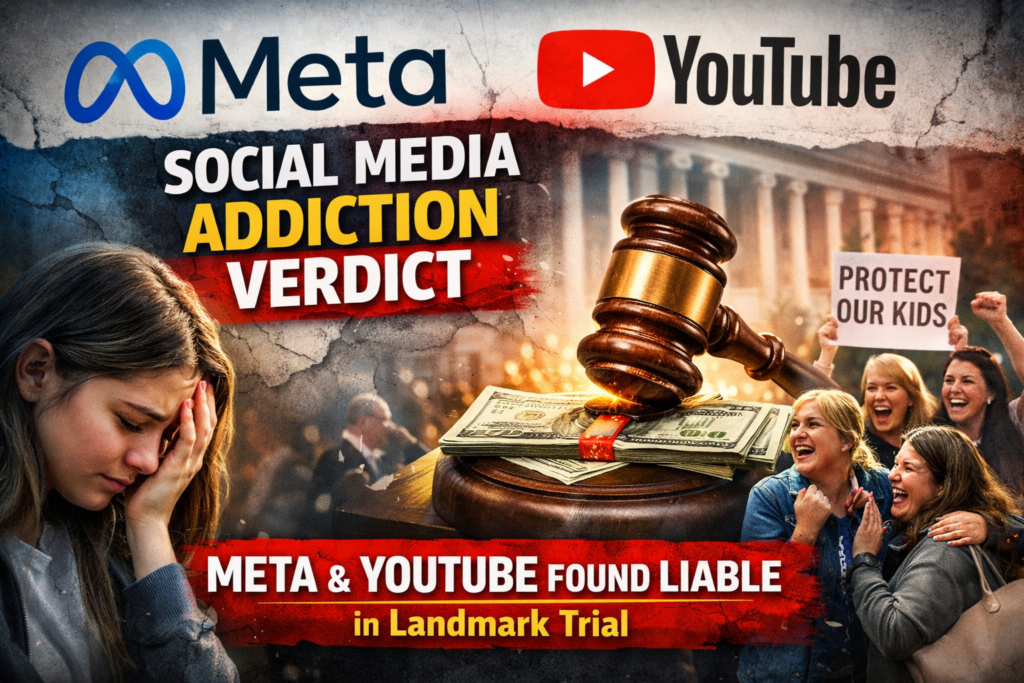
In a decision that could change the future of social media, a jury in Los Angeles has ruled against tech giants Meta and YouTube for creating platforms that contributed to a young woman’s addiction.
This landmark case is being called a turning point — not just for one person, but for millions of users around the world.
A Case That Shocked the Tech World
The case was filed by a 20-year-old woman, known as Kaley, who claimed that her mental health suffered because of excessive use of social media platforms during her childhood.
After weeks of hearings, the jury agreed with her claims.
They decided that:
- Meta and Google (YouTube’s parent company) designed their platforms in a way that encouraged addiction
- These designs negatively impacted Kaley’s mental health
As a result, she was awarded $6 million in damages.
How the Compensation Was Divided
The total compensation included:
- $3 million for emotional and mental harm
- $3 million as punishment for company behavior
The jury also decided how the responsibility would be shared:
- Meta will pay 70%
- Google will pay 30%
This shows that the court found both companies responsible, but Meta played a larger role.
What Made This Case So Important?
This is not just another lawsuit — it is a historic moment.
Experts believe this decision could:
- Influence hundreds of similar cases
- Force social media companies to rethink their designs
- Increase pressure for stricter regulations
It also highlights growing concerns about how social media affects young users.
What Did Kaley Experience?
Kaley shared her story during the trial, and it revealed some serious concerns.
She said:
- She started using Instagram at just 9 years old
- She began using YouTube at the age of 6
- There were no strong checks to stop her due to age
Over time:
- She became less connected with her family
- She spent most of her time online
- She developed anxiety and depression
The Impact on Mental Health
Kaley later received a diagnosis of:
- Anxiety
- Depression
- Body Dysmorphic Disorder
This condition caused her to become overly focused on her appearance.
She said she used filters on Instagram that:
- Made her nose smaller
- Made her eyes bigger
These changes affected how she saw herself in real life.
Claims Against Social Media Companies
Kaley’s lawyers argued that platforms were built like “addiction machines.”
They highlighted features such as:
- Infinite scrolling
- Personalized content feeds
- Continuous notifications
According to them, these features were designed to keep users engaged for as long as possible.
They also claimed that:
- Young users were specifically targeted
- Companies knew children were using their platforms
- Enough action was not taken to prevent it
Company Responses
Both Meta and Google disagreed with the verdict.
Meta stated that:
- Teen mental health is complex
- It cannot be blamed on a single app
Meanwhile, Google argued that:
- YouTube is not a social media platform in the same way
- It is a streaming service built responsibly
Both companies have confirmed that they will appeal the decision.
Public Reaction and Growing Concerns
Outside the court, many parents gathered to hear the decision.
When the verdict was announced:
- Some parents were seen celebrating
- Others were emotional and relieved
Many families believe social media has harmed their children in similar ways.
A Bigger Trend Around the World
This case is part of a larger global movement.
Countries are starting to take action:
- Australia has introduced restrictions for children
- The UK is testing a possible ban for users under 16
Experts say public opinion is changing rapidly.
People are becoming more aware of:
- Screen addiction
- Mental health risks
- The impact of online platforms on children
Key Figures Involved
During the trial, Mark Zuckerberg also appeared and defended the company.
He said:
- Meta does not allow users under 13
- The company has improved safety measures over time
However, internal documents suggested that:
- Younger users were still accessing the platforms
This raised questions about how effective these protections really are.
What Happens Next?
The legal battle is far from over.
Since Meta and Google plan to appeal:
- The case could continue for years
- Higher courts may review the decision
At the same time:
- More lawsuits are expected
- Another major case is already scheduled in California
Why This Case Matters for Everyone
This is not just about one person or one company.
It affects:
- Millions of social media users
- Parents and families
- The future of technology
The case raises important questions:
- Should social media be regulated more strictly?
- Are companies responsible for user behavior?
- How can children be better protected online?
Final Thoughts – A Turning Point?
This ruling may mark the beginning of a new era for social media.
For years, concerns about addiction and mental health were discussed — but now, courts are starting to take action.
If more cases follow the same path:
- Platforms may change their design
- Safety rules could become stricter
- User awareness will increase
For now, one thing is clear:
The relationship between social media and users is being questioned like never before.
Why You Should Pay Attention
This story matters because it directly affects:
- Your daily screen time
- Your mental health
- The future of apps you use every day
The outcome of this case could shape how social media works in the coming years.
Leave a Reply