First the Moon, Then Mars: Why NASA’s Mission Matters for the Future
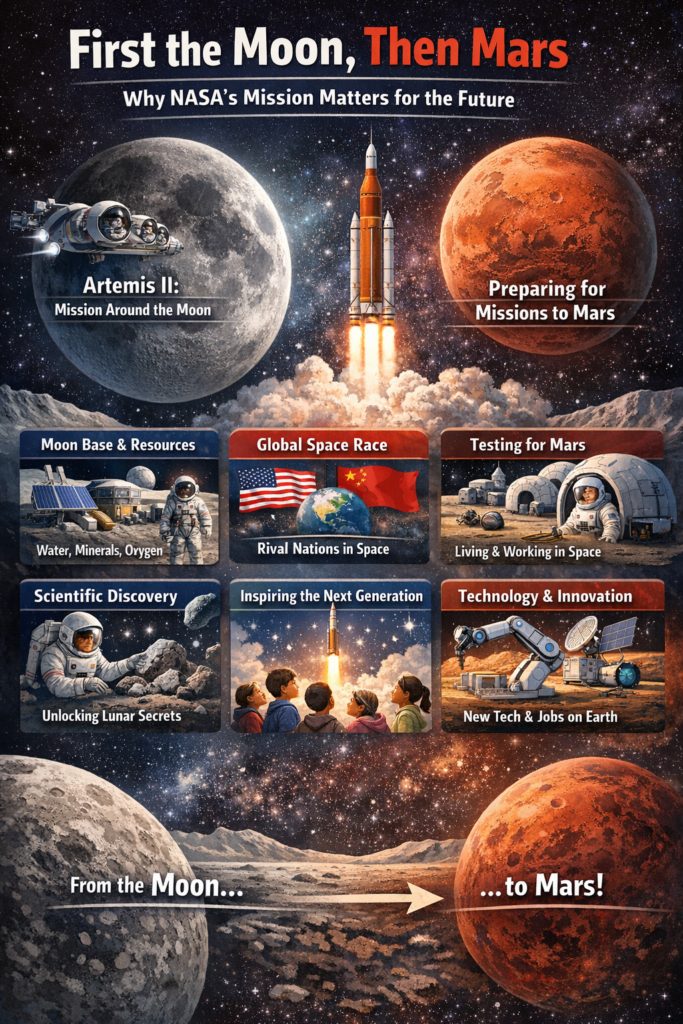
In the coming days, NASA is preparing to launch one of its most important missions in decades — Artemis II.
This mission will send astronauts around the Moon, marking a major step toward returning humans to the lunar surface. But the bigger goal goes far beyond the Moon — it’s about preparing for future missions to Mars.
So why is this mission so important? Let’s break it down in simple terms.
What Is Artemis II?
The Artemis II mission will carry four astronauts on a journey around the Moon.
Unlike earlier missions, this one is not just about exploration. It is part of a long-term plan that includes:
- Landing humans on the Moon again
- Building a sustainable Moon base
- Preparing for human missions to Mars
This program has taken years of planning and has cost billions of dollars, showing how serious the mission is.
Haven’t Humans Already Been to the Moon?
Yes — more than 50 years ago, during the Apollo missions, astronauts first landed on the Moon.
Six successful landings were completed, and many people believed the Moon had already been fully explored.
So why go back?
The answer is simple: there is still a lot we don’t know — and a lot we can use.
Hidden Resources on the Moon
The Moon may look empty, but scientists say it contains valuable resources.
These include:
- Rare elements used in technology
- Metals like iron and titanium
- Helium, used in scientific and medical equipment
But the most important resource is water.
Water has been found in frozen form, especially near the Moon’s poles.
This is important because:
- It can be used for drinking
- It can produce oxygen for breathing
- It can even be turned into fuel for rockets
This makes long-term human presence on the Moon possible.
A New Space Race
In the past, space exploration was a competition between the US and the Soviet Union.
Today, the competition is different.
Countries like China National Space Administration are making fast progress:
- Sending robots to the Moon
- Planning to send humans in the near future
Because of this, space exploration has once again become a global race.
This time, it’s not just about reaching the Moon — it’s about:
- Accessing resources
- Building bases
- Leading future space exploration
Can Countries Own the Moon?
According to international agreements, no country can own the Moon.
However:
- Countries can operate and build on its surface
- They can use resources found there
This means that being present on the Moon gives countries a big advantage.
The Bigger Goal: Mars
NASA’s ultimate goal is to send humans to Mars.
Mars is much farther and more difficult to reach than the Moon.
Challenges include:
- Extreme temperatures
- Lack of oxygen
- High radiation levels
Because of these challenges, NASA is using the Moon as a testing ground.
Why the Moon Comes First
The Moon is closer and safer compared to Mars.
By building a base there, scientists can:
- Test life-support systems
- Learn how to grow food
- Develop new technologies
If something goes wrong, astronauts can return to Earth much faster than from Mars.
This makes the Moon the perfect place to prepare for future missions.
Unlocking Scientific Mysteries
The Moon is like a time capsule.
Because it does not have weather or plate movement like Earth, it has preserved ancient history for billions of years.
Scientists believe:
- Studying Moon rocks can reveal how Earth was formed
- New samples could answer important scientific questions
Even after decades, the Moon still holds many secrets.
Inspiring the Next Generation
Space missions don’t just help scientists — they inspire people around the world.
The original Moon landings inspired millions to:
- Study science
- Become engineers
- Work in technology
Now, with modern technology and live broadcasts, the Artemis missions could inspire a whole new generation.
Economic and Technological Benefits
The money spent on space programs is not wasted.
It helps create:
- New technologies
- Jobs in engineering and science
- Innovations that can be used on Earth
Many everyday technologies today came from space research.
Leave a Reply