How did interstellar comet 3I/ATLAS capture our imagination in 2025?
Here is the rewritten and enhanced article, structured strictly according to your requirements for Brainx Ultimate.
3I/ATLAS Unveiled: How a 2025 Interstellar Visitor Ignited a War Between Hard Science and Viral Conspiracy
Brainx Perspective
At Brainx, we believe the saga of 3I/ATLAS is a critical case study for the modern age. It highlights a dangerous fragility in our information ecosystem: when institutional transparency falters—as seen during the 2025 government shutdown—sensationalism rushes in to fill the void. This event forces us to question not just what orbits our Sun, but how we distinguish scientific reality from digital fantasy.
The Galactic Traveler: A Collision of Physics and Politics
The year 2025 will be remembered by astronomers not just for a breakthrough in celestial mechanics, but for a sociological stress test that spanned the globe. When the interstellar comet 3I/ATLAS pierced the inner solar system, it brought with it a tail of gas and dust, but it left behind a trail of controversy.
Discovered in the summer of 2025, this object was the third confirmed visitor from outside our solar system, following the mysterious 1I/‘Oumuamua (2017) and the pristine 2I/Borisov (2019). However, unlike its predecessors, 3I/ATLAS arrived during a “perfect storm” of political paralysis and influencer-driven speculation. The resulting narrative became a battleground between the slow, methodical process of peer-reviewed science and the lightning-fast, algorithm-rewarding nature of social media.
The Discovery: Tracking a Stranger
On July 1, 2025, the Asteroid Terrestrial-impact Last Alert System (ATLAS) in Chile flagged an anomaly. While the vast majority of objects tracked by astronomers orbit the Sun in predictable elliptical loops, this new entity was different. It possessed a hyperbolic trajectory, moving at such high velocity that it was clearly unbound by the Sun’s gravity. It had plunged into our system from the interstellar void and was destined to leave just as quickly.
This discovery granted scientists a rare luxury: time. Unlike ‘Oumuamua, which was spotted on its way out, 3I/ATLAS was identified months before its perihelion (closest approach to the Sun). This allowed for a mobilized response involving the world’s premier observational tools:
- The James Webb Space Telescope (JWST)
- Gemini North in Hawaii
- The European Space Agency’s XMM-Newton
The Science: Anatomy of the “Normal”
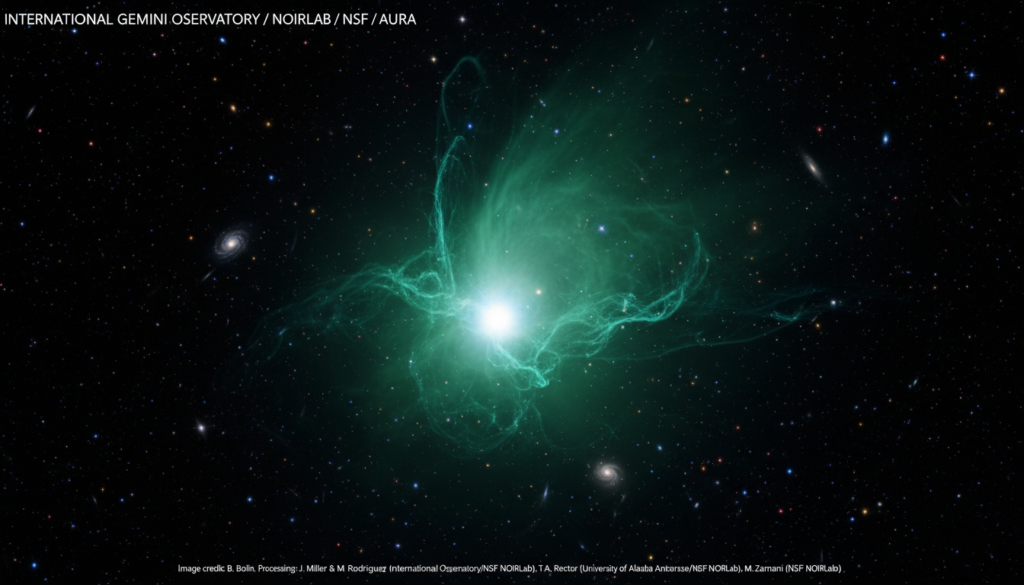
Despite the eventual media frenzy suggesting otherwise, the initial data painted a picture of cosmic familiarity. As the object approached the heat of the Sun, it began to sublimate. The frozen gases on its surface turned to vapor, creating a visible “coma” (a cloud of gas) and a tail.
Key Scientific Findings:
- Composition: Spectroscopic analysis revealed signatures of carbon monoxide and cyanogen, standard building blocks found in comets within our own Kuiper Belt.
- Structure: High-resolution imaging identified a nucleus several kilometers in diameter, composed of ice, rock, and dust.
- Behavior: The ratio of gas emission to dust production fell well within the parameters of a “typical” comet.
To the relief of the scientific community, 3I/ATLAS suggested that the chemistry of planetary formation is likely universal. The building blocks of other star systems look remarkably like our own.
The “Alien Probe” Hypothesis and the Data Vacuum
The narrative shift from “scientific curiosity” to “extraterrestrial technology” was driven by two distinct factors: the theoretical assertions of high-profile academics and a catastrophic failure of government communication.
The Harvard Connection
The catalyst for the controversy was a pre-print paper released in July 2025 by Avi Loeb, a Harvard professor known for his controversial stance on ‘Oumuamua. Loeb pointed to non-gravitational acceleration—slight deviations in the comet’s path not explained by gravity—as potential evidence of artificial propulsion.
Loeb hypothesized that if the acceleration was too smooth to be caused by chaotic gas jets, it could indicate a light sail or an ion drive. While the paper was not peer-reviewed at the time, the “Harvard” stamp of authority provided credibility. The media, hungry for engagement, stripped away the nuance, presenting the hypothesis as a probability.
The 43-Day Silence (The Shutdown)
The situation spiraled out of control between October 1 and November 12, 2025. A U.S. government shutdown furloughed non-essential federal employees, effectively paralyzing NASA’s public outreach.
- The Blackout: NASA’s press offices closed, social media accounts went dark, and official updates ceased.
- The Automated Data: NASA’s Mars Reconnaissance Orbiter (MRO) continued to capture images of the comet automatically, but there was no staff to process or release them.
- The Conspiracy: The public, accustomed to a steady stream of information, interpreted the silence as a cover-up. The narrative shifted from “NASA is closed due to a budget dispute” to “NASA is hiding the alien truth.”
By the time the government reopened and released the images on November 19, the damage was done. The photos showed a fuzzy, standard comet. To conspiracy theorists who had spent weeks analyzing “leaked” rumors on TikTok and X (formerly Twitter), the official photos looked like a sanitized lie.
Debunking the Myths: The Reality of Acceleration
The central scientific debate revolved around the comet’s movement. Non-gravitational acceleration sounds exotic to the layperson, but it is a standard feature of cometary physics.
How Nature Propels Comets:
- The Rocket Effect: As a comet heats up, jets of gas shoot out from the surface. According to Newton’s Third Law, this expulsion of gas provides a thrust that pushes the nucleus in the opposite direction.
- The Consensus: A definitive study published in Research Notes of the AAS utilized data from the Psyche spacecraft and the Mars Trace Gas Orbiter. It confirmed that the acceleration of 3I/ATLAS was mathematically consistent with the amount of water and carbon monoxide it was ejecting.
- The Conclusion: No alien thrusters were required. The comet was simply “steaming” its way through the solar system.
Advanced Tech: The X-Ray Fingerprint
While the public debated aliens, astronomers were conducting some of the most sophisticated deep-space analysis in history. Using the XRISM mission (a Japan/NASA collaboration), scientists detected X-rays emitting from the comet.
This phenomenon, known as Solar Wind Charge Exchange, occurs when highly charged particles from the Sun slam into neutral gases in the comet’s coma. This interaction creates a distinct X-ray glow.
- Why this is huge: It allowed scientists to map the density of the gas surrounding the nucleus with unprecedented precision.
- The Result: The “fingerprint” obtained via X-rays further solidified the object’s natural composition, ruling out the presence of artificial alloys or synthetic materials on the surface.
The Media Paradox: Truth in the Age of Algorithms
The 3I/ATLAS event serves as a stark illustration of the “Post-Truth” era. In late 2025, a peer-reviewed paper detailing isotopic ratios struggled to gain traction, while a podcast featuring speculation about “alien tea” garnered millions of views.
Larry Denneau, co-discoverer of the comet, noted the frustration of the scientific community. The rigorous work of calculating trajectories was drowned out by unsubstantiated predictions. The media’s desire to present “both sides”—even when one side lacked empirical evidence—created a false equivalence. A standard astronomical event was weighed equally against a sci-fi fantasy, confusing the public and eroding trust in institutions.
Why It Matters
The legacy of 3I/ATLAS extends far beyond astronomy. For the common man, this event is a reminder of the importance of media literacy. In a world where a government shutdown can spawn a global conspiracy theory, we must learn to be critical consumers of information. Furthermore, it highlights the need for consistent science communication that doesn’t rely solely on government cycles. As we look to the future, 3I/ATLAS teaches us that the universe is wondrous enough in its reality—a frozen rock from a distant star system requires no embellishment to be a miracle.
Leave a Reply