Ukraine loses embattled eastern town
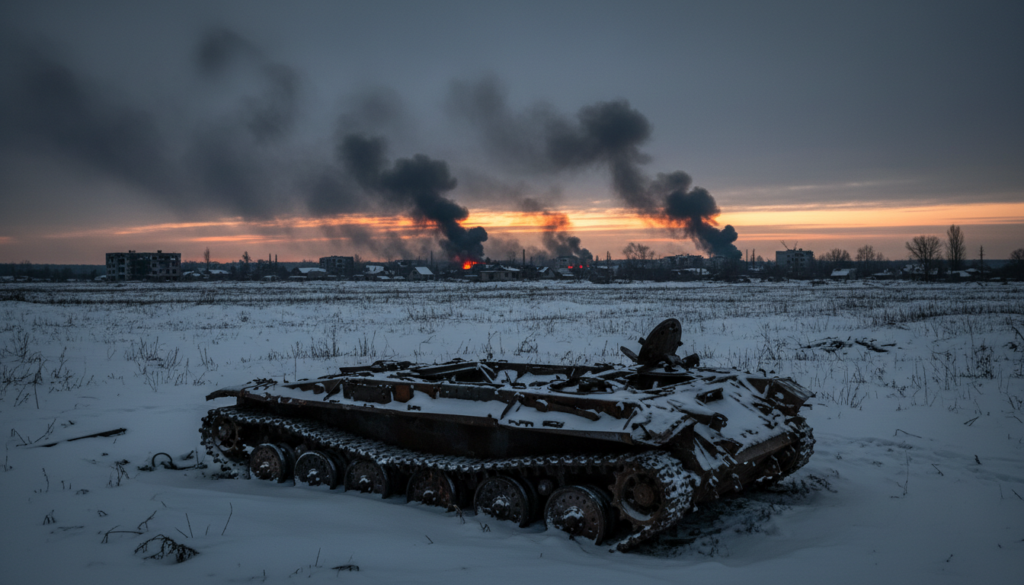
Winter’s Siege: The Fall of Siversk and the Orchestrated Collapse of Ukraine’s Energy Grid
Brainx Perspective
At Brainx, we believe the withdrawal from Siversk and the systematic dismantling of the Ukrainian power grid represent a calculated transition into a “war of attrition by darkness.” This development highlights Moscow’s strategy to leverage the brutal winter as a kinetic weapon, aiming to shatter civilian resolve where traditional front-line advances have proved agonizingly slow.
The News: A Dual-Front Crisis Escalates
As January 2026 begins, Ukraine faces its most precarious winter since the 2022 invasion. A combination of tactical retreats in the Donbas and a massive escalation in Russia’s long-range aerial campaign has pushed the nation’s infrastructure to a breaking point.
I. The Fall of Siversk: A Strategic Tactical Retreat
Following months of high-intensity urban combat and relentless artillery bombardment, the Ukrainian General Staff has confirmed the withdrawal of its forces from the town of Siversk.
- Preserving Manpower: Officials stated the retreat was necessary to “preserve the lives of our soldiers” against an adversary holding a significant numerical advantage in both infantry and armored equipment.
- Total Destruction: The town, which once housed 11,000 residents, has been reported as “virtually wiped out,” with almost no standing infrastructure remaining to provide cover for defenders.
- The Fortress Belt Threat: The loss of Siversk significantly increases pressure on the “Fortress Belt”—the last major Ukrainian-held urban centers in Donetsk: Sloviansk and Kramatorsk. These hubs are now within closer striking distance of Russian tactical groups.
II. The Ninth Wave: An Infrastructure in Collapse
Simultaneous with the ground advance, Russia has launched what military analysts describe as an “algorithmic barrage”—a massive, coordinated strike utilizing hundreds of munitions to overwhelm air defenses.
- Aerial Volley: In a single overnight operation, Russia launched 635 drones and 38 missiles. While the Ukrainian Air Force reported a high interception rate (over 620 targets), the sheer volume ensured that several critical nodes were hit.
- Grid Failure: Acting Energy Minister Artem Nekrasov confirmed that the ninth large-scale attack of the year has resulted in near-total power loss in regions including Rivne, Ternopil, and Khmelnytsky.
- Human Toll: The strikes resulted in the tragic death of a young child in the Zhytomyr region and several elderly civilians in Kyiv and Khmelnytskyy. The reach of the missiles even prompted neighboring Poland to scramble fighter jets to protect its airspace.
III. Geopolitical Deadlock and Deep Strikes
The conflict is increasingly spilling over both diplomatically and geographically.
- Washington’s Peace Plan: Reports indicate President Donald Trump is pressuring Kyiv to accept territorial concessions—specifically the Donbas region—to facilitate an immediate ceasefire. President Zelenskyy remains defiant, demanding “iron-clad security guarantees” before any talk of redrawing borders.
- Moscow Assassination: Tensions flared further following the death of Lt. Gen. Fanil Sarvarov, a high-ranking Russian officer, in a car bomb explosion in Moscow. Russia has blamed Ukrainian operatives for the hit.
- Retaliation in Stavropol: Ukrainian long-range drones successfully struck a Lukoil-owned petrochemical plant in Stavropol, over 500 kilometers from the border, demonstrating Kyiv’s intent to strike Russia’s economic heart.
IV. The “New Normal” of Darkness
For the average Ukrainian, life is now measured in “hours of light.” In cities like Zaporizhzhia, residents report a “lack of civilization,” where ten hours of electricity a day is considered a luxury. With temperatures plummeting to -10°C, the country faces a looming humanitarian disaster as heating systems fail across multiple oblasts.
Why It Matters
For the common man, the fall of Siversk is a geopolitical shift, but the loss of the energy grid is an existential threat. If the “Fortress Belt” fails and the deep freeze continues without power, 2026 will see a massive new wave of displacement and a desperate humanitarian crisis that could force a diplomatic conclusion neither side is truly ready for.
Leave a Reply