Australians brace for ‘property loss or worse’ as bushfires destroy homes
1. Catchy Headline
“Property Loss or Worse”: Australia on High Alert as Catastrophic Firestorms and 46°C Heatwave Strike
2. Brainx Perspective (Intro)
At Brainx, we believe the current “catastrophic” fire warnings in Australia serve as a chilling reminder of the escalating volatility of our climate. This unfolding crisis in Victoria and South Australia highlights a terrifying reality: extreme weather events are no longer anomalies but seasonal certainties that demand immediate, high-level vigilance and a total re-evaluation of community resilience.
3. The News (Body)
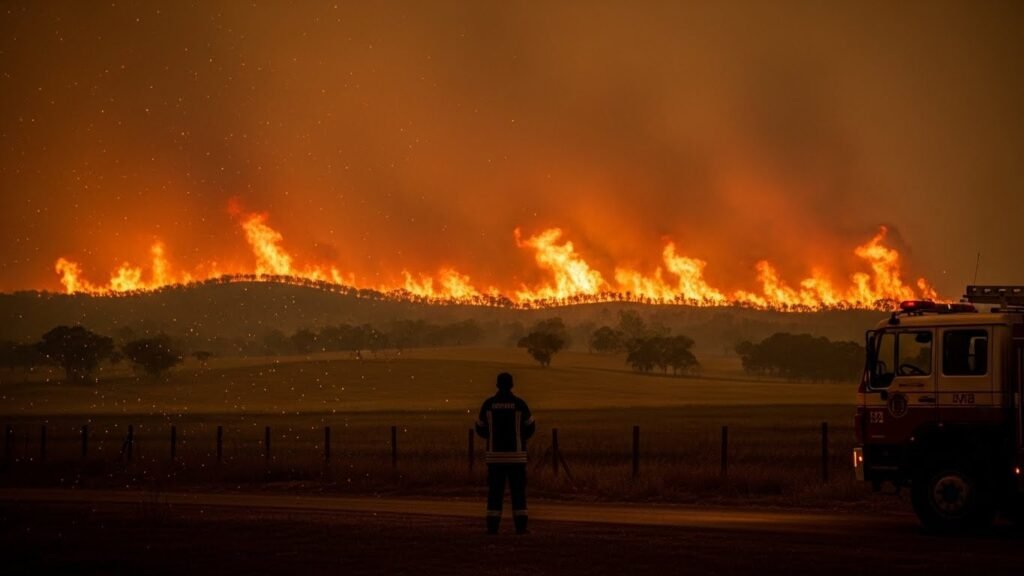
A severe national emergency is unfolding across south-eastern Australia as a punishing heatwave combines with gale-force winds to create “catastrophic” fire conditions. Authorities have issued grave warnings to residents, particularly in Victoria, stating bluntly that they should prepare for “property loss or worse.”
As temperatures soar to record-breaking highs, emergency services are already battling out-of-control blazes that have devastated small communities.
The Current Situation: A Continent on Fire
- Catastrophic Ratings: A “Total Fire Ban” is currently enforced across Victoria and the Australian Capital Territory (ACT). All regions in Victoria have been classified under “catastrophic” or “extreme” fire danger ratings—the highest levels on the warning scale.
- Record Heat: Friday and Saturday are forecast to be the peak of this heatwave.
- South Australia: Temperatures are expected to peak at a blistering 46°C in some regional areas.
- Victoria: North-western areas may reach 45°C, while Melbourne is forecast to hit 42°C.
- New South Wales: Sydney is preparing for 42°C heat on Saturday.
- Central Australia: Alice Springs is also recording 42°C.
- Wind Danger: The heat is being driven by strong northerly winds, which are fanning existing flames. A “cool change” expected later in the south-west brings its own dangers, as shifting winds can turn the long flank of a fire into a massive new fire front.
Ground Zero: The Destruction of Ruffy
The tangible impact of this crisis is already being felt in central Victoria, where a massive bushfire near Longwood has wreaked havoc.
- Scale of Damage: The fire has burnt through nearly 36,000 hectares of land.
- Community Devastation: The small town of Ruffy has been decimated. At least 20 homes have been destroyed, along with the local school.
- Eyewitness Account: George Noye, the Country Fire Authority (CFA) Captain for Ruffy, described the scene to the ABC: “The main street looks like a bomb’s gone off… Some properties have lost everything. They’ve lost their livelihoods, shearing sheds, livestock. It is absolutely devastating.”
The Human Toll: Missing Residents
Tragically, the chaos has led to fears for human safety. Victoria Police Deputy Commissioner Bob Hill confirmed a distressing development in the Longwood area.
- Unaccounted For: Three people—two adults and a child—are currently unaccounted for.
- The Timeline: Police visited their property yesterday to warn them it was too late to evacuate and urged them to seek shelter. When officials returned later, the home had burnt down, and the residents could not be located.
- Official Stance: “They may be safe, they may be alive… but we are keeping an open mind,” Commissioner Hill stated, urging the public not to speculate while searches continue.
Widespread Threats
The danger is not limited to one town.
- Walwa Fire: Another major blaze in north-east Victoria has already consumed 17,000 hectares.
- Dynamic Conditions: The State Control Centre describes the fires as “incredibly dynamic,” spreading in multiple directions simultaneously.
- Urgent Warnings: CFA Chief Officer Jason Heffernan warned that new fires are igniting constantly. “My message to Victorians is yes, we are talking about Longwood and Walwa, but we have many other fires that have started this morning… I am expecting more as the day goes on.”
4. “Why It Matters” (Conclusion)
This crisis matters because it tests the breaking point of emergency infrastructure and the human spirit. For the common man, it reinforces the brutal necessity of having a survival plan. As frequency intensifies, the cost—both economic and psychological—of living in these “catastrophic” zones may permanently alter the demographic map of Australia.
Deep Dive: The Anatomy of a “Catastrophic” Fire Event
(Extended Analysis for Context)
To fully understand the gravity of the warnings issued today, it is essential to look beyond the headlines and understand the mechanics of the threat facing Australia.
1. What Does “Catastrophic” Mean? In Australia, fire danger ratings are not just adjectives; they are calculated scientific warnings. A “Catastrophic” rating (formerly Code Red) means that if a fire starts, it will likely be uncontrollable, unpredictable, and fast-moving.
- Survivability: Homes are not built to withstand fires in these conditions. Even well-prepared properties are likely to be destroyed.
- The Advice: The only safe course of action is to leave early. By the time smoke is visible, it is often too late to flee safely.
2. The “Cool Change” Trap The article mentions a “cool change” forecast for the south-west. While a drop in temperature sounds positive, in bushfire scenarios, it is often the deadliest moment.
- Wind Shift: A cool change brings a 90-degree shift in wind direction (usually from North to South-West).
- The Flank Becomes the Front: A long, narrow fire driven by northerly winds has a thin “head” and a very long “flank” (side). When the wind swings 90 degrees, that entire long flank instantly becomes a massive, kilometres-wide fire front moving toward towns that were previously considered safe. This mechanism was responsible for many deaths during the 1983 Ash Wednesday fires and the 2009 Black Saturday fires.
3. The Economic Aftershock The destruction in Ruffy highlights a secondary crisis: the economic ruin of rural communities.
- Livelihoods Lost: The loss of shearing sheds and livestock isn’t just property damage; it is the destruction of generational income.
- Insurance Crisis: With every “catastrophic” event, insurance premiums in regional Australia skyrocket. There is a growing fear that vast swathes of the country may soon become “uninsurable,” forcing a retreat from the bush that policy-makers are not yet ready to address.
4. A Pattern of Escalation The declaration of a total fire ban in the ACT for the first time in six years signals that the “quiet years” following the 2019-2020 Black Summer are over. The vegetation that grew back during the wet La Niña years has now dried out (cured) due to El Niño conditions, creating a massive fuel load waiting for a spark.
As emergency crews battle through the night, the nation holds its breath, hoping that the three missing persons in Longwood are found safe, and that the “property loss” does not turn into a greater loss of life.
Leave a Reply