India’s astrotourism boom draws urban stargazers beyond city limits
From Smog to Stardust: The Rise of Astrotourism and India’s Quest for Dark Skies
2. “Brainx Perspective
At Brainx, we believe the surging interest in astrotourism is more than a travel trend; it is a direct response to the urbanization crisis. This development highlights a profound shift in travel priorities—where silence and darkness, once taken for granted, are now luxury commodities. It forces us to confront what we’ve lost to light pollution while celebrating the economic resilience of remote communities.
3. The News
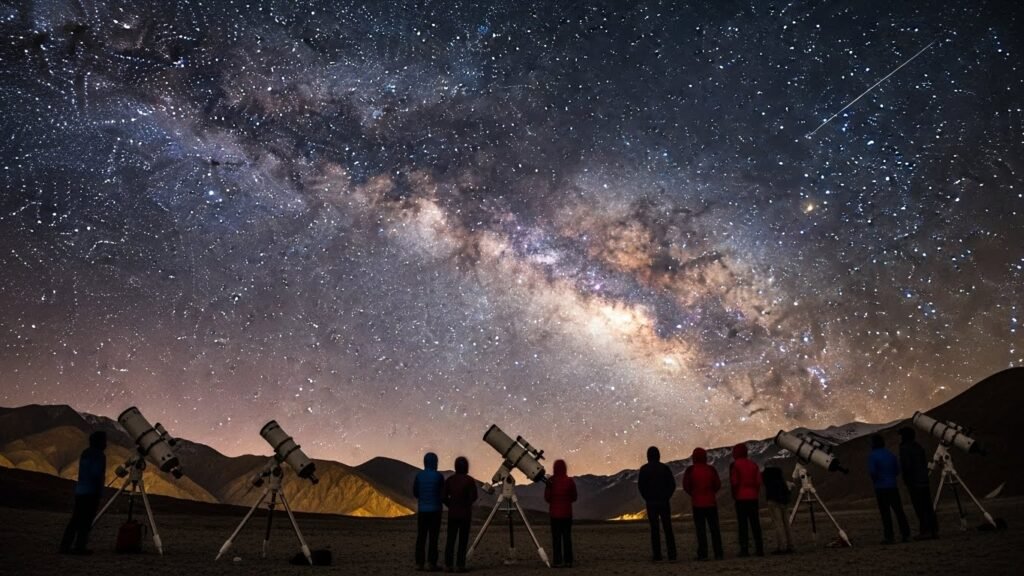
On a freezing winter night, approximately 200km from the neon haze of Delhi, a group of travelers huddles in the dark. They are not waiting for a tiger to emerge from the brush or a celebrity to take the stage. They are waiting for the lights to go out completely. As the landscape plunges into darkness, more than 150 meteors begin to streak across the sky—a celestial performance impossible to witness from India’s light-polluted megacities.
This scene is becoming increasingly common across the subcontinent. Stargazing, once the niche preserve of amateur astronomers and science clubs, is breaking into the mainstream. Driven by worsening air quality and the erasure of the night sky in urban centers, a new wave of “Astrotourism” is reshaping the travel industry.
The Driving Force: Escaping the ‘Bortle 9’
The primary catalyst for this boom is visibility—or the lack thereof.
- The Science of Visibility: Astronomers use the Bortle Dark-Sky Scale to measure the brightness of the night sky. It runs from Class 1 (perfectly dark) to Class 9 (inner-city sky).
- The Urban Reality: Cities like Delhi and Mumbai typically rank between Class 8 and 9. In these zones, artificial light is so intense that only the moon and the brightest satellites are visible.
- The Pollution Factor: When PM2.5 levels (fine particulate matter) rise above 100, they act as a veil, scattering light and obscuring deep-space objects.
- The Escape: Urban residents are now willing to travel hundreds of kilometers to high-altitude regions in Rajasthan, Himachal Pradesh, Uttarakhand, and Ladakh, where colder air pushes pollutants to the ground and skies rank as Class 1 or 2.
Hanle: The Jewel in the Crown
Nowhere is this trend more visible than in Hanle, a remote village in the Changthang region of Ladakh.
- First Dark Sky Reserve: In 2022, Hanle was designated as India’s first officially recognized Dark Sky Reserve.
- Explosive Growth: According to Dorje Angchuk, engineer-in-charge at the Indian Astronomical Observatory, visitor numbers have skyrocketed. The village, which once saw barely 5,000 visitors annually, recorded over 30,000 visitors last year.
- Dual Economy: The influx has transformed the local economy. The number of homestays has jumped from a handful to over 70 in just three years.
- Astro-Ambassadors: To manage this growth sustainably, local youth and women are being trained as “Astro-Ambassadors.” During the day, they manage hospitality; by night, they guide tourists through the constellations using high-end Dobson telescopes.
Beyond Ladakh: A Nationwide Phenomenon
While Hanle is the gold standard, the trend is spreading to more accessible locations.
- Sariska Tiger Reserve (Rajasthan): Located just a few hours from Delhi, this reserve offers Bortle Class 4 skies. On December 13, crowds gathered here to witness the Geminid meteor shower, seeing the Milky Way with the naked eye—a feat impossible in the capital.
- Pench Tiger Reserve (Maharashtra/MP): Recently designated as India’s first Dark Sky Park, Pench is proving that wildlife and astronomy can coexist. Reports suggest nearly 40% of guests now opt for stargazing sessions.
- Benital (Uttarakhand): The state government is actively developing Benital as an “Astro-Village,” investing in infrastructure to support night-sky observation.
The Business of Darkness
Private players are capitalizing on this demand. Astroport Global, a company specializing in astronomy workshops, now operates resorts in five states.
- Surging Numbers: Visitor numbers at their sites have climbed to approximately 20,000 a year, up from just a few hundred previously.
- The Cost: The experience is becoming a premium offering. A basic workshop costs around 1,200 rupees ($14), while overnight stays at specialized dark-sky resorts range from 8,000 to 12,000 rupees.
- Winter Peak: Demand spikes in winter when low humidity and cold air create the sharpest viewing conditions.
Challenges to Scaling
Despite the boom, the sector faces significant hurdles.
- Accessibility: Reaching true dark skies often requires arduous travel to high altitudes or remote jungles.
- Infrastructure: Hanle and Benital are still developing the amenities required for mass tourism.
- Light Creep: Expanding cities and unchecked infrastructure lighting threaten to “eat” into these dark zones. Experts warn that without strict light-pollution policies, these sanctuaries could disappear.
4. “Why It Matters” (Conclusion)
This trend matters because it reclaims a fundamental human right: the ability to look up and feel awe. For the common man, it offers a rare spiritual and psychological reset from the digital grind. For the future, the economic success of places like Hanle proves that conservation pays—demonstrating that preserving the dark is just as valuable as paving the roads.
Leave a Reply