Seven more countries agree to join Trump’s Board of Peace
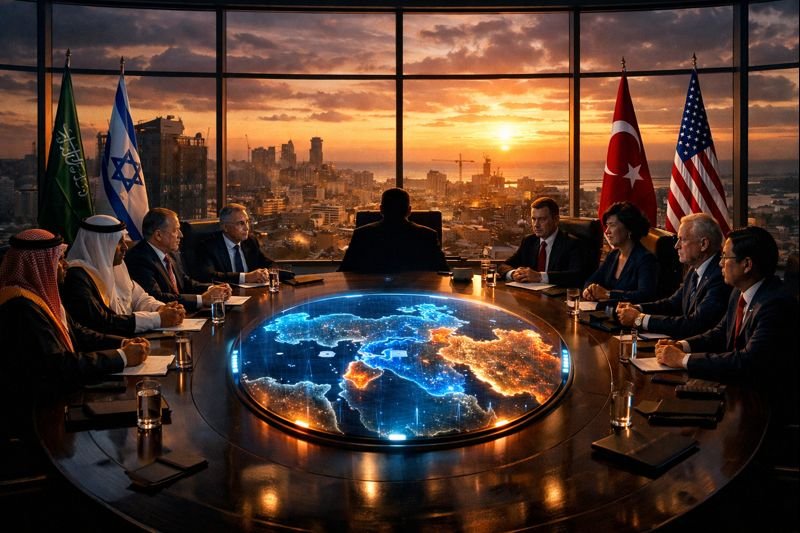
The Billion-Dollar Peace Ticket: Trump’s ‘Board of Peace’ Swells as 7 Muslim Nations Join Israel in New World Order
2. Brainx Perspective
At Brainx, we believe the sudden coalescence of Saudi Arabia, Turkey, Pakistan, and Israel under Donald Trump’s new “Board of Peace” signals a seismic shift in global governance. This development highlights a move away from the deliberative paralysis of the United Nations toward a transactional, “pay-to-play” model of diplomacy where influence is explicitly purchased, and peace is managed like a corporate acquisition.
3. The News
In a stunning geopolitical realignment that threatens to upend the post-WWII international order, seven Muslim-majority nations have officially agreed to join US President Donald Trump’s controversial “Board of Peace.” The joint statement, released on Wednesday, confirms that Saudi Arabia, Turkey, Egypt, Jordan, Indonesia, Pakistan, and Qatar will sit alongside Israel on the new body, which critics fear is designed to supplant the United Nations.
This flurry of accessions comes just days after the White House unveiled the board’s charter, which effectively privatizes global conflict resolution under American chairmanship.
The Coalition of the Willing (and Paying)
The diplomatic landscape of the Middle East has been redrawn overnight. The inclusion of heavyweights like Saudi Arabia and Pakistan alongside Israel suggests that the “Board of Peace” is rapidly becoming the de facto forum for regional power brokering, bypassing traditional institutions.
- The Muslim Bloc: The seven nations joining are pivotal players. Turkey and Qatar were key mediators in the fragile ceasefire that took effect in October 2025. Egypt controls the vital Rafah crossing. Saudi Arabia and Pakistan bring immense religious and military weight.
- Israel’s Reluctant Acceptance: Earlier on Wednesday, Israel publicly confirmed its participation. However, this acceptance came with significant friction. Prime Minister Benjamin Netanyahu’s office had previously lashed out, stating the board’s composition “was not coordinated with Israel and runs contrary to its policy,” specifically objecting to the inclusion of Turkey and Qatar.
- The Growing Roster: Beyond the Middle East, the board is gathering a disparate collection of members. Bahrain, Albania, Armenia, Azerbaijan, Belarus, Hungary, Kazakhstan, Morocco, and Vietnam have all signed on.
- The Holdouts: Not everyone is convinced. Slovenian Prime Minister Robert Golob publicly rejected the invitation, warning that the body “dangerously interferes with the broader international order.” Meanwhile, the Vatican remains cautious; Cardinal Pietro Parolin stated that Pope Leo needs time to consider the invitation.
The Billion-Dollar Charter: A Corporate Takeover of Diplomacy?
Leaked documents regarding the Board’s charter have revealed a structure that resembles a private equity firm more than a diplomatic assembly. The rules of engagement are starkly transactional:
- The Price of Power: Permanent seats on the board are available to nations that contribute $1 billion (£740m) to the body’s fund.
- Term Limits: Nations that do not pay the $1 billion entry fee are relegated to renewable three-year terms, creating a two-tier system of influence based on financial capability rather than diplomatic standing.
- Trump’s Authority: The charter explicitly names Donald Trump as Chairman, granting him sweeping powers to appoint executive board members, dissolve subsidiary bodies, and unilaterally steer the organization’s mandate.
The “Gaza Executive Board”: High-Stakes Reconstruction
While the Board’s charter frames it as a global body, its immediate test is the devastation in Gaza. The White House has established a specific “Gaza Executive Board” to oversee the reconstruction of the territory following the brutal two-year war.
The Power Players:
- Chairman: Donald Trump.
- The Inner Circle: The founding Executive Board includes US Secretary of State Marco Rubio, Middle East Envoy Steve Witkoff, Trump’s son-in-law Jared Kushner, and former UK Prime Minister Tony Blair.
- Financial Titans: Marc Rowan, CEO of Apollo Global Management, and Ajay Banga, President of the World Bank, have been appointed, signaling a heavy focus on private capital.
- On the Ground: Former UN envoy Nickolay Mladenov has been tapped as the board’s representative in Gaza for “Phase Two” of the peace plan.
The Reality on the Ground: A Fragile Ceasefire
Despite the high-level maneuvering in boardrooms, the situation in Gaza remains catastrophic. The “Board of Peace” is tasked with managing a conflict that has left deep scars.
- The Death Toll: According to the Gaza health ministry, more than 71,550 people have been killed in the territory since the war began in October 2023.
- Broken Truce: Since the ceasefire came into force, violence has continued. Hamas reports 460 Palestinians killed in ongoing strikes, while Israel has lost three soldiers to attacks during the same period.
- Phase Two Deadlock: The peace plan is currently stuck.
- Israel refuses to move to Phase Two (reconstruction) until the body of the last dead hostage is returned.
- Hamas refuses to disarm—a key requirement for Phase Two—without a guarantee of an independent Palestinian state, a condition the Board’s charter notably omits.
4. “Why It Matters” (Conclusion)
This development matters because it creates a parallel international system where financial contribution outweighs sovereign equality. For the common man—especially in Gaza—the shift from UN humanitarianism to a corporate-style “Board of Peace” could mean reconstruction comes with heavy political strings attached, potentially freezing the dream of Palestinian statehood in exchange for economic development.
Deep Dive: The End of the UN Era?
(Analysis for Context)
The creation of the “Board of Peace” is not merely a diplomatic initiative; it is an institutional coup. For decades, the United Nations has been the primary vehicle for global conflict resolution. However, its bureaucracy and the veto power of the Security Council (specifically Russia and China) have often rendered it ineffective in the eyes of critics.
Donald Trump’s initiative capitalizes on this frustration. By creating a “coalition of the willing” that bypasses the UN Security Council, the US is attempting to streamline decision-making. However, the price of this efficiency is legitimacy.
The “Pay-to-Play” Problem The $1 billion threshold for permanent membership effectively disenfranchises smaller, poorer nations that are often the victims of conflict. A board dominated by wealthy nations and private equity interests (represented by figures like Marc Rowan) is likely to prioritize stability and investment returns over human rights or self-determination. This risks turning post-war zones like Gaza into “economic zones” rather than sovereign territories.
The Israel-Turkey Tension The inclusion of both Israel and Turkey on the same board is a diplomatic tightrope. Israel views Turkey’s government as sympathetic to Hamas, while Turkey views Israel’s actions in Gaza as genocide. Trump’s ability to keep these two adversaries at the same table will be the first major stress test of his chairmanship. If Netanyahu walks away, or if Erdogan uses the platform to grandstand, the Board could collapse before it lays a single brick in Gaza.
The Missing Palestinians Most glaringly, the charter makes no mention of the Palestinian Authority or a future Palestinian state. The “National Committee for the Administration of Gaza,” led by technocrat Ali Shaath, is designed to be an administrative body, not a political one. This suggests the Board’s long-term vision for Gaza is one of indefinite trusteeship rather than independence—a vision that is likely to fuel future insurgencies even if the current war ends.
Leave a Reply