Macron urges Europe to start acting like world power
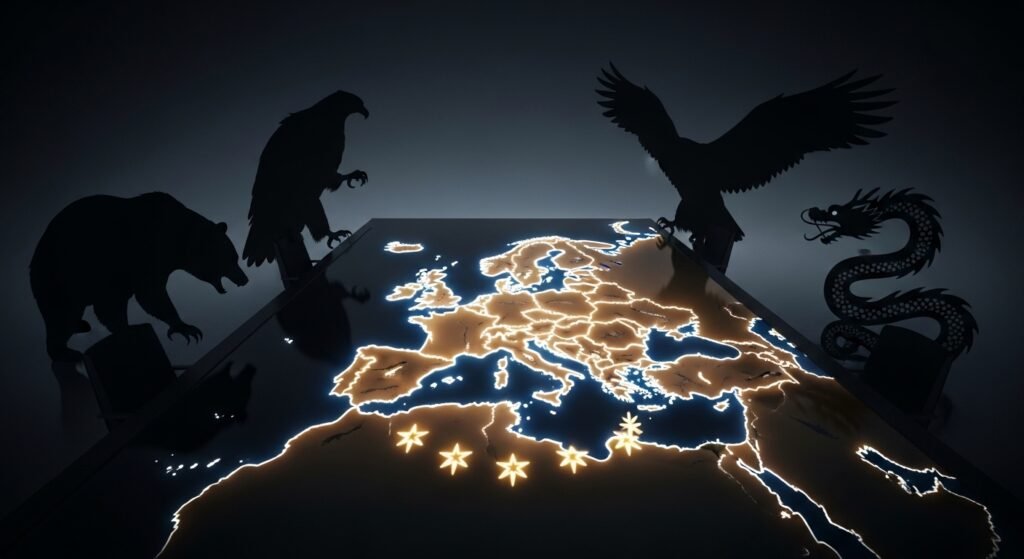
“We Are On Our Own”: Macron’s Urgent Wake-Up Call for Europe to Defy US and China
At Brainx, we believe…
President Emmanuel Macron’s blunt assessment marks the definitive end of European innocence. The era of relying on American security blankets and cheap Russian gas is dead. This development highlights that unless Europe embraces “hard power” and financial unity immediately, it risks becoming a vassal state in a world dominated by aggressive superpowers. Macron’s warning is not just rhetoric; it is a survival strategy for a continent that must choose between sovereignty and irrelevance.
The News: A Continent at the Crossroads
In a series of explosive interviews with major European newspapers published on Tuesday, French President Emmanuel Macron delivered his starkest warning yet: Europe faces a mortal threat of being “swept away” unless it rapidly transforms from a trading bloc into a geopolitical “power.”
Speaking ahead of a crucial EU summit in Brussels, Macron dismantled the long-held assumptions of European stability, arguing that the continent is facing a “wake-up call” triggered by the convergence of three existential threats: an aggressive Russia, a predatory China, and an increasingly unpredictable United States.
The “Greenland Moment”: A Crisis of Trust
One of the most revealing segments of Macron’s address focused on the recent diplomatic standoff involving US President Donald Trump and the Danish territory of Greenland.
- The Incident: President Trump recently threatened to annex Greenland, a semi-autonomous territory of Denmark, and reportedly threatened 25% tariffs on European goods if his bid was opposed.
- The “Back Down”: While Washington eventually paused the threats, Macron urged European leaders not to be fooled by this temporary reprieve.
- The Warning: “At the end of a crisis, there is a cowardly tendency to sit back and say ‘phew’. There are threats and intimidation, and then suddenly Washington gives way. And people think it’s over,” Macron said. “Don’t believe it for a single second.”
- The Reality: He used this “Greenland moment” to illustrate that the US is no longer a guaranteed protector but a transactional actor that views the EU as a competitor—or worse, a target.
The Triple Threat: Why Europe is “On Its Own”
Macron’s speech provided a grim diagnosis of the geopolitical landscape, identifying three pillars that have crumbled:
- The US Security Umbrella: “The US – which we thought would guarantee our security for ever – is no longer sure,” Macron stated. He pointed to Washington’s drift away from the “rule of law” and its “America First” protectionism as evidence that Europe can no longer outsource its defense to NATO without its own sovereign capabilities.
- Russian Energy: The President noted that the economic model of Northern Europe, built on cheap Russian gas, stopped functioning three years ago. Russia has transitioned from a partner to a permanent security threat.
- Chinese Rivalry: China is no longer just a market but a “rival that gets fiercer and fiercer.” Macron highlighted that Beijing (and Washington) heavily subsidize their industries, while Europe keeps its markets naively open. “The Chinese do it, the Americans too. Europe today is the most open market in the world,” he lamented, calling for an end to this asymmetry.
The €1.2 Trillion Solution: Eurobonds or Bust
To counter these threats, Macron proposed a radical financial overhaul of the European Union. He argued that “soft power” is useless without the financial muscle to back it up.
- The Investment Gap: Macron estimates the EU needs €1.2 trillion ($1.4 trillion) annually to invest in vital sectors:
- Security & Defense: To rebuild depleted armies and support Ukraine.
- Clean Energy: To replace Russian hydrocarbons and meet climate goals.
- Artificial Intelligence: To catch up with Silicon Valley and Shenzhen.
- Mutualised Debt (Eurobonds): The President repeated his controversial call for “EU-wide mutualised loans.” He argued that national budgets alone cannot sustain this level of spending.
- “The time has come to launch a shared debt capacity to fund our future expense – eurobonds for the future,” he declared.
- He framed this as a “Hamiltonian moment” for Europe, similar to how the US federalized debt to build a superpower.
- Market Demand: Countering fiscal hawks in Berlin and The Hague, Macron argued that global investors want a safe alternative to the US dollar. “The world markets are increasingly afraid of the American greenback. They want alternatives,” he noted, suggesting that a unified European bond would be highly attractive to investors seeking stability in a chaotic world.
The Internal Battle: North vs. South
Macron admitted that his vision faces stiff resistance from the “Frugal North”—countries like Germany, the Netherlands, and Denmark—who fear that France wants to use common debt to mask its own failure to reform.
- A Rare Admission: Macron conceded that France “has never had a balanced model, unlike certain economies of the north, which are built more on a sense of responsibility.”
- The Counter-Argument: However, he insisted that “responsibility” in 2026 means investing in survival, not just balancing ledgers. He pointed out that while Southern European nations (Portugal, Spain, Italy, Greece) made painful reforms in the 2010s that are now paying dividends, the current crisis requires a continental response, not national austerity.
The End of the “Market-Only” Europe
The core of Macron’s message was psychological. For decades, the EU viewed itself as a peace project and a single market, deliberately avoiding the dirty business of power politics.
- “We came together to stop war, we came together to build a market. But we always forbade ourselves to think of power,” Macron reflected.
- He concluded that this taboo must be broken. With 450 million citizens, Europe has the demographic weight to be a superpower, but only if it acts as one. “For me, [becoming a power] is the fulfilment of the European adventure.”
Leave a Reply