Who Is Making Decisions in Iran Amid Ongoing Tensions?
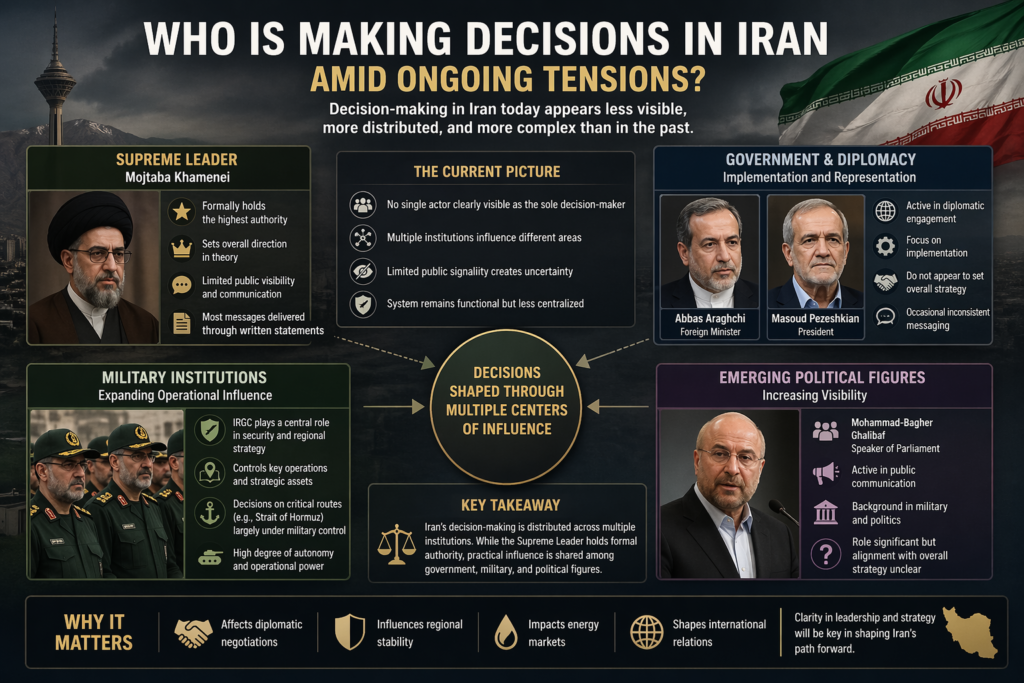
As tensions continue to shape the geopolitical landscape in the Middle East, a key question has emerged in Iran: who is currently driving the country’s decision-making at the highest level?
Following recent developments, Mojtaba Khamenei has formally assumed the position of supreme leader after the death of his father, Ali Khamenei. In Iran’s political structure, this role traditionally holds the highest authority, with responsibility over major national decisions, including foreign policy and strategic direction.
However, while the formal structure appears clear, the practical situation presents a more complex picture.
A Leadership Structure Under Scrutiny
In theory, Iran’s system of governance places significant authority in the hands of the supreme leader. This position is designed to provide centralized direction and ensure consistency across political, military, and diplomatic institutions.
At present, however, observers note that decision-making appears less visible and possibly more distributed than in previous periods. Donald Trump recently described Iran’s leadership as “fractured,” suggesting that a unified strategic direction may not be clearly communicated.
At the same time, official messaging within Iran has emphasized unity, with statements highlighting a single national direction rather than internal divisions. This contrast between external perceptions and internal messaging adds to the uncertainty surrounding the current leadership dynamic.
Limited Public Visibility of Leadership
One notable factor influencing these perceptions is the limited public presence of Mojtaba Khamenei since assuming leadership. Unlike his predecessor, who frequently communicated through speeches and public appearances, Mojtaba Khamenei has largely remained out of the public eye.
Reports indicate that he may have sustained injuries during earlier events, although details remain limited. As a result, most communication has been delivered through written statements rather than direct appearances.
In Iran’s political system, visibility plays an important role in reinforcing authority. Public speeches, official engagements, and direct messaging often serve to clarify policy direction and signal priorities to both domestic and international audiences.
The absence of these signals can create uncertainty, particularly during periods of heightened tension.
The Role of Government and Diplomacy
On the diplomatic front, Abbas Araghchi continues to represent Iran in international discussions, working under President Masoud Pezeshkian.
While these figures are actively involved in diplomatic engagement, their roles appear to focus primarily on implementation rather than setting overall strategy. This distinction is important, as it suggests that key decisions may be made elsewhere within the system.
In some instances, communication from the diplomatic side has appeared inconsistent, reflecting the broader complexity of the decision-making process. This highlights the challenges of coordinating policy across different branches of government during a rapidly evolving situation.
Expanding Influence of Military Institutions
Another important element in Iran’s current decision-making structure is the role of the military, particularly the Islamic Revolutionary Guard Corps (IRGC).
The IRGC has historically played a significant role in Iran’s security and regional strategy. In the current context, its influence appears to have expanded, especially in areas related to strategic operations and control over critical resources.
For example, decisions regarding key transit routes such as the Strait of Hormuz are believed to fall largely under the authority of military leadership. This places substantial operational power in the hands of institutions that operate with a high degree of autonomy.
While this does not indicate a breakdown of governance, it does suggest that decision-making may be more decentralized than usual, with different institutions exercising influence over specific areas.
Emerging Political Figures
In addition to formal leadership structures, certain political figures have taken on more visible roles. Among them is Mohammad-Bagher Ghalibaf, who currently serves as the speaker of parliament.
Ghalibaf has been actively involved in public communication and diplomatic engagement, positioning himself as a key figure during this period. His background in both military and political institutions provides him with a unique perspective within Iran’s leadership landscape.
However, his role remains complex. While he has taken initiative in various areas, it is not always clear how his actions align with the broader strategic direction set by the leadership.
This situation reflects a broader theme: multiple actors contributing to decision-making without a single, clearly visible authority coordinating all aspects.
Coordination and Strategic Clarity
Taken together, these developments suggest that Iran’s system of governance remains functional but may be experiencing challenges in maintaining clear and consistent strategic direction.
The supreme leader’s authority continues to exist within the formal structure, but its practical expression appears less visible. At the same time:
- The presidency supports the overall direction but does not appear to lead it independently
- Diplomatic channels remain active but are not fully decisive
- Military institutions hold significant operational influence
- Political figures are increasingly visible but operate within uncertain boundaries
This combination creates a system where actions may occur across multiple fronts, but clear coordination and communication are less evident.
Importance of Strategic Signaling
In Iran’s political model, signaling plays a crucial role in maintaining coherence. Public statements, official appearances, and coordinated messaging help align different institutions and clarify national priorities.
When such signaling is limited or inconsistent, it can lead to varying interpretations within the system itself. This does not necessarily indicate instability, but it can make it more difficult to project a unified strategy.
At present, observers note that while Iran continues to act across political, military, and diplomatic domains, the clarity of its overarching direction is less apparent than in previous periods.
System Stability and Continuity
Despite these complexities, it is important to note that Iran’s political system remains intact. Institutions continue to function, and the country maintains its ability to operate on multiple levels.
The current situation does not point to a collapse of governance. Instead, it reflects a period of adjustment, where different components of the system are adapting to changing circumstances.
This type of transition is not uncommon in political systems undergoing leadership changes, particularly during periods of external pressure.
Broader Implications
The question of who is making decisions in Iran has implications beyond the country itself. International observers, policymakers, and analysts closely monitor these dynamics to better understand potential future developments.
Clarity in leadership and strategy can influence:
- Diplomatic negotiations
- Regional stability
- Economic conditions, particularly in energy markets
- International relations and cooperation
As a result, the evolution of Iran’s internal decision-making structure will continue to be an important factor in global affairs.
Conclusion
The current situation in Iran highlights the complexity of governance during a period of transition and external pressure. While Mojtaba Khamenei formally holds the highest authority, the practical distribution of power appears more nuanced.
Government officials, military institutions, and political figures all play roles in shaping outcomes, but the absence of clear and consistent public signaling has created uncertainty about how decisions are coordinated.
Even so, the system continues to function, maintaining stability while adapting to evolving challenges. Whether greater clarity and centralization will emerge in the coming period remains an open question, but ongoing developments will likely provide further insight into the direction of Iran’s leadership.
Leave a Reply