Europe Alone? Trump’s “New World Order” Forces Historic Military Shift Amidst Greenland Crisis
At Brainx, we believe…
This development highlights the definitive collapse of the post-WWII security architecture. At Brainx, we believe the sight of weapon advertisements in downtown Munich signals that Europe has woken up to a chilling reality: the American security blanket is gone. This is no longer just about meeting NATO spending targets; it is an existential scramble for survival in a world where “allies” are now transactional partners and “security” is a commodity to be bought, not guaranteed.
The New Reality: Drones Over Munich
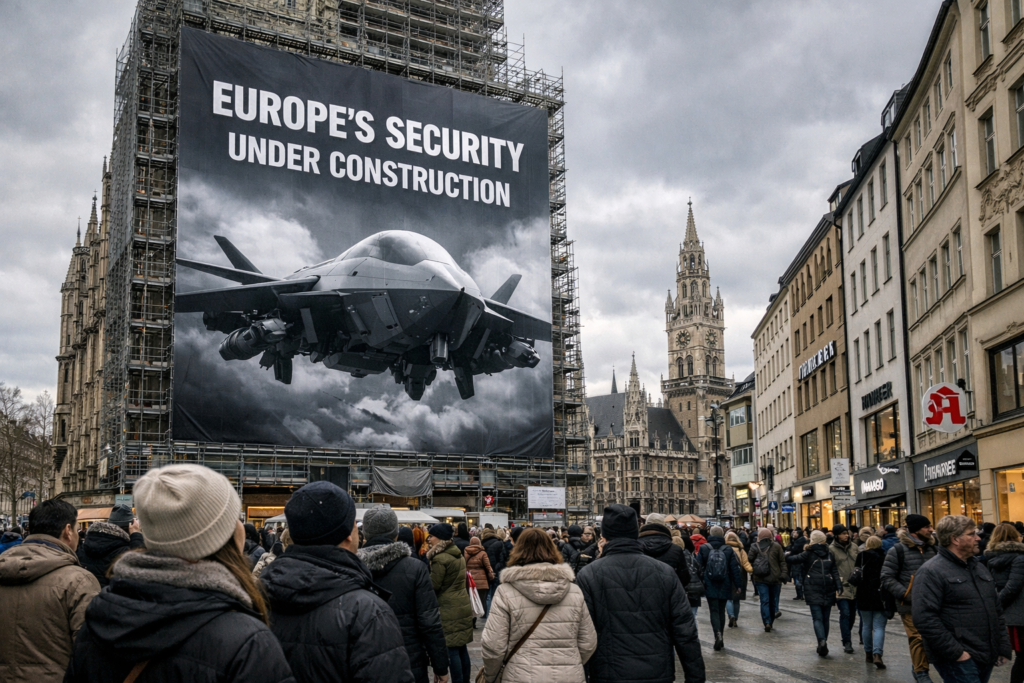
The streets of Munich, traditionally associated with luxury automobiles and high-end fashion, have undergone a startling visual transformation. In a move that would have been culturally taboo just a few years ago, the city’s pedestrian boulevards are now lined with stark, black-and-white posters advertising next-generation combat drones.
The slogan—“Europe’s security under construction”—is plastered across scaffolding on historic churches, serving as a grim marketing campaign for a continent in crisis. This public display of military muscle represents a seismic psychological shift in Germany. The southern region of Bavaria is rapidly pivoting from automotive excellence to becoming Europe’s leading defense technology hub, prioritizing Artificial Intelligence, aerospace, and unmanned systems.
This militarization of public space reflects a deeper anxiety gripping the population. According to a recent Eurobarometer poll, a staggering 68% of Europeans feel their country is under direct threat. They feel “squeezed” between three distinct pressures:
- East: An expansionist Russia.
- Far East: An economically aggressive China.
- West: An increasingly unpredictable United States under Donald Trump’s second term.
For the first time since the Cold War, Germany’s Federal Office of Civil Protection and Disaster Assistance has warned that war is no longer “unlikely.” In a chilling advisory, the government is recommending citizens stockpile food supplies to last up to ten days—”just in case.”
The 150 Billion Euro Question
The financial scale of this shift is unprecedented. Mark Rutte, the NATO Secretary General, confirmed that by 2029, Germany’s defense budget will exceed the combined defense spending of the United Kingdom and France.
- The Investment: Berlin has committed a “staggering” €150 billion to reboot its military capabilities.
- The Donor Status: With the US halting direct new aid, Germany has become the single largest donor of military aid to Ukraine.
- The Reaction: While Washington appreciates the spending, the tone from the White House remains threatening rather than congratulatory.
The Fracture: The “Greenland Crisis” and Broken Trust
The Munich Security Conference (MSC) this weekend was dominated by one overwhelming theme: the utter fragility of transatlantic relations. The diplomatic niceties of the past have evaporated.
In the twelve months since returning to the Oval Office, President Trump has dismantled decades of diplomatic protocol.
- The Greenland Ultimatum: In a shock to NATO allies, Trump recently threatened Danish sovereignty over Greenland, refusing to rule out taking the Arctic territory by force.
- Economic Coercion: The administration has levied heavy tariffs on European exports and threatened sanctions on allies like the UK, France, and Germany for obstructing US designs on Greenland.
- Intelligence Blackouts: Perhaps most alarmingly, the White House temporarily paused intelligence-sharing with Ukrainian forces last March. This move, designed to pressure Kyiv into peace talks with Moscow, left Ukrainian troops “blind on the battlefield.”
Danish Prime Minister Mette Frederiksen, speaking at the MSC, remained visibly furious, stating that despite ongoing trilateral talks, Trump’s designs on Greenland remain unchanged.
Germany’s Defense Minister, Boris Pistorius, offered a blunt assessment of the new era: “We got used to the strong support from the US; we got used to our comfort zone… This time is over, definitely over. Washington was right.”
Marco Rubio and the “Abusive Partner” Diplomacy
The most anticipated moment of the conference was the address by US Secretary of State Marco Rubio. European diplomats sat on the edge of their seats, fearing a repeat of last year’s berating by Vice President JD Vance.
Rubio’s speech was deceptively warm, invoking the “historic kinship” of the World Wars. However, analysts noted a “transactional” subtext that one European diplomat anonymously described as resembling an “abusive partner.”
- The Message: Rubio reminded Europe of how wonderful the relationship used to be, only to pivot to coercion: If you want safety, you must align with our new values.
- The “New” Values: Rubio’s speech signaled a shift away from liberal multilateralism toward a vision of a “new era of Christian western civilization”—one that is skeptical of climate action, globalization, and migration.
- Diplomatic Snub: In a telling move, Rubio’s itinerary post-Munich bypassed traditional power centers like Paris or Berlin, heading instead to Slovakia and Hungary—nations with Eurosceptic, nationalist leaders who align more closely with Trump’s ideology.
NATO 3.0: The US Pivot to the Indo-Pacific
If Rubio provided the ideology, US Undersecretary of Defense Elbridge Colby provided the cold, hard strategy. His message to NATO defense ministers in Brussels was stark: Europe is no longer the priority.
- The Priority: The Indo-Pacific and the homeland.
- The Shift: The US will reduce its physical capabilities in Europe, becoming a “more limited and focused” presence.
- The Requirement: Europe must transition from a “dependent” to a “partner.” Colby termed this “NATO 3.0”—a model where Europe handles its own conventional defense while the US provides the nuclear umbrella and high-end strategic assets only when strictly necessary.
The Continental Divide
This pressure is cracking European unity. Rachel Ellehuus, Director-General of the defense think-tank RUSI, identifies a dangerous rift:
- The North & East: Countries like Germany, the Netherlands, and the Baltic states are ramping up spending, terrified by their proximity to Russia.
- The South: Nations like Spain remain “unapologetic” about refusing to meet Trump’s defense spending demands, prioritizing domestic economies.
- The Political Cost: For France and the UK, boosting defense spending means telling voters they face higher taxes or cuts to welfare—a “political band-aid” that is proving difficult to sell during a cost-of-living crisis.
The UK’s Strategy: Starmer’s “Triangulation”
Amidst the chaos, UK Prime Minister Sir Keir Starmer attempted to carve out a unique role for Britain. Unlike the continental powers discussing “strategic autonomy” (a code word for splitting from the US), Starmer advocated for “triangulation.”
- Integration: He called for deeper defense integration between the UK and EU to cut re-armament costs.
- Loyalty: Simultaneously, he emphasized that this does not mean turning away from Washington.
- The Expert View: Sophia Gaston of King’s College London noted that Britain is trying to maintain its traditional role as the bridge between the US and Europe, pursuing diplomacy in “invisible ways” to manage the divergence.
However, the era of stable alliances is over. Europe is moving toward “a la carte coalitions”—ad-hoc groups of the “willing” (including non-European nations like Australia and Japan) formed to tackle specific security issues, bypassing the slow bureaucracy of NATO or the EU.
Why It Matters
This story matters because the “peace dividend” that allowed Europeans to enjoy generous welfare states and low defense spending for 80 years has officially expired. For the common man, this means a future of higher taxes and reduced social services as governments divert billions to the military. It signifies a volatile new world where your country’s safety is no longer guaranteed by a superpower, but by how many drones it can manufacture and how much food you have stored in your pantry.
Leave a Reply