Breaking: Scientists Successfully Turn Martian Soil Into Concrete Using Bacteria
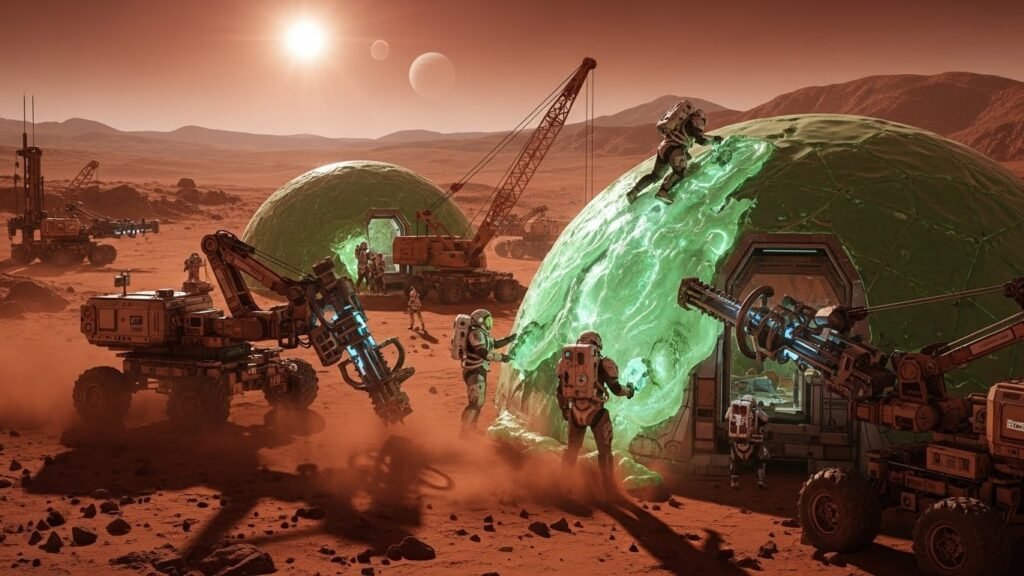
The dream of colonizing Mars has always faced one monumental problem: logistics. Transporting steel, cement, and heavy construction equipment millions of miles through space is not just expensive—it is impossible. For years, engineers have searched for a solution, but the answer wasn’t found in a high-tech lab. It was found in nature. In a groundbreaking discovery that is shaking the scientific community in 2026, researchers have successfully demonstrated how to turn Martian dust into sturdy building material using nothing but genetically modified bacteria.
The “Bio-Concrete” Breakthrough: How It Works This isn’t science fiction anymore. A collaborative team from leading space agencies has published findings on a new method dubbed “Bio-Lithification.” The process relies on a specific strain of bacteria, nicknamed “The Star Builder” (a variant of Cyanobacteria). Here is the step-by-step process that could build our first alien city:
- Harvesting Dust: Rovers collect the loose, iron-rich topsoil of Mars (known as Regolith).
- Inoculation: Astronauts mix this soil with the bacterial culture and a nutrient solution.
- Growth: Over a period of 4 to 6 days, the bacteria feed on the nutrients and produce a limestone-like substance that binds the dust particles together.
- Result: The mixture hardens into “Bio-Bricks” that have a tensile strength comparable to construction-grade concrete on Earth.
Why Humans Cannot Carry Cement to Mars To understand why this is so revolutionary, we must look at the economics of space travel. Currently, it costs approximately $10,000 to launch just one pound of payload into orbit. Sending tons of cement would bankrupt any mission before it started. This new “In-Situ Resource Utilization” (ISRU) technology means human settlers only need to bring a few grams of bacterial spores to build entire cities.
Protection From The Invisible Killer Building homes on the Red Planet isn’t just about shelter from the wind; it’s about hiding from radiation. Mars lacks a magnetic field, meaning its surface is constantly bombarded by deadly cosmic rays. Tests on these new “Bio-Bricks” have revealed a surprise benefit: because of their organic density and iron content, they are exceptionally good at shielding against radiation.
“The structures we grow will not just house us; they will keep us alive,” says Dr. Elena Rostova, a lead astrobiologist involved in the study.
Timeline: When Will We See This? While the technology is ready in the lab, field testing is the next major hurdle.
- 2026-2027: Experiments are scheduled aboard the Lunar Gateway station.
- 2029: The first robotic mission to 3D-print a bacterial test structure on the Moon.
- 2035: Projected construction of the first human habitat on Mars using this method.
Brainx Perspective: The Future is Biological At Brainx, we believe this signals a massive shift in how we view technology. For the last century, “advancement” meant mechanical engineering—steel, rockets, and microchips. But the future of space exploration seems to be Biological Engineering. We aren’t just conquering space; we are partnering with life to inhabit it. This discovery proves that the smallest organisms might be the key to our biggest giant leap.
Conclusion As we look up at the night sky in 2026, the Red Planet seems a little more welcoming. We now know that we don’t need to conquer Mars with brute force. Instead, we will gently grow our new homes, brick by brick, with the help of nature’s tiniest builders.
Frequently Asked Questions (FAQs)
3. Will the bacteria contaminate Mars? This is a major ethical concern. Planetary protection protocols ensure that these bacteria are genetically coded to die if they escape the manufacturing facility, preventing accurate contamination of the planet.
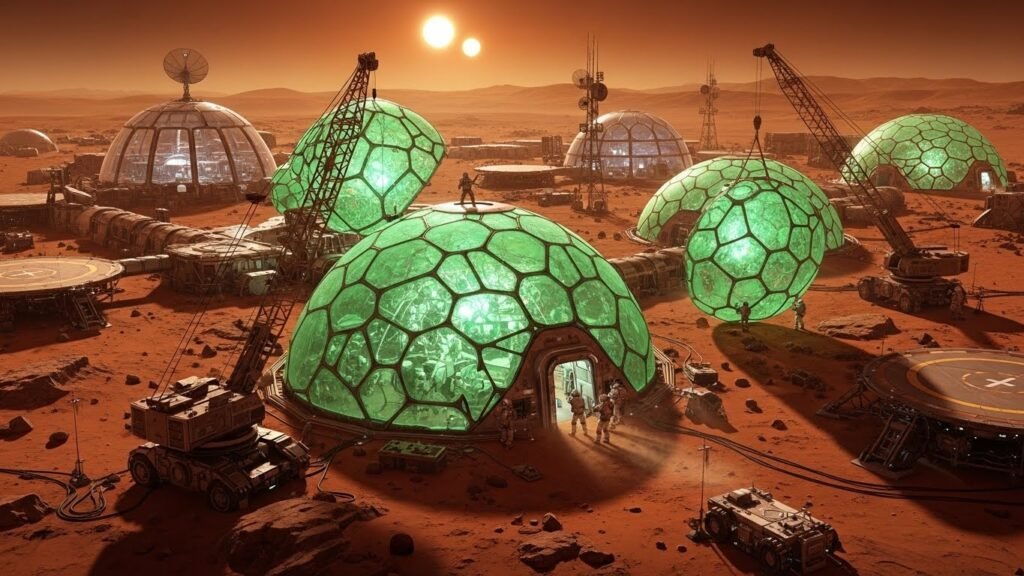
1. Can these bacteria survive on Mars surface? No, they need a controlled environment (temperature and pressure) to grow the bricks, which would likely happen inside inflated manufacturing domes.
2. Is this method stronger than steel? It is not stronger than steel, but it is comparable to concrete, which is more than enough for habitats in low-gravity environments like Mars (which has only 38% of Earth’s gravity).


Leave a Reply