Children in Gaza return to school after years without formal education
1. Catchy Headline
Gaza’s Tent Schools: A Fragile Return to Learning Amidst the Ruins of War
2. Brainx Perspective (Intro)
At Brainx, we believe the reopening of makeshift schools in Gaza is a testament to the indomitable human spirit, yet it exposes a grim reality. This development highlights that while guns may fall silent, the battle for a generation’s future has only just begun. The struggle to learn amidst rubble isn’t just about literacy; it is an urgent attempt to reclaim childhood from the clutches of trauma.
3. The News (Body)
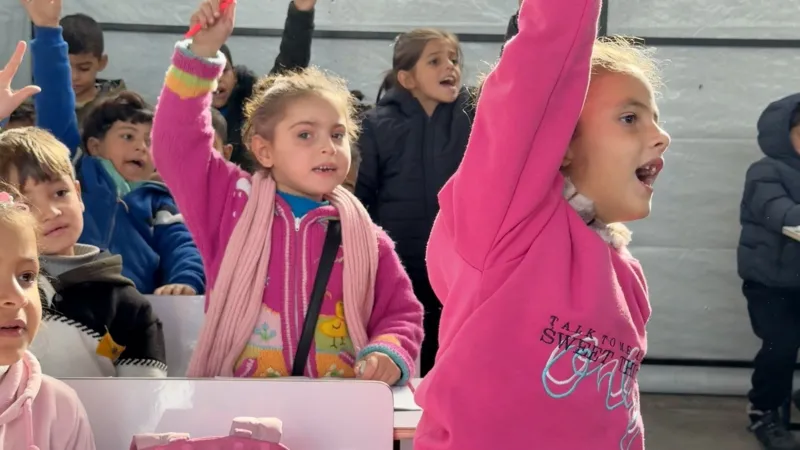
In the heart of Gaza City, a sound that has been absent for nearly two years is finally breaking the silence of the ruins: the chaotic, vibrant hum of children learning. It is not a return to normalcy, but for the residents of the Tel al-Hawa neighborhood, it is a start.
Following the Israel-Hamas ceasefire in October, the Lulwa Abdel Wahab al-Qatami School—or rather, the tents that now stand where the school once was—has opened its flaps to students. The resumption of classes marks a critical juncture in the region’s recovery, offering a glimpse of hope to a generation defined by displacement and loss.
The Atmosphere: Chaos, Noise, and Hope
The scene at the Lulwa school is a stark contrast to the silence of the last two years. The school grounds, which until recently served as a shelter for displaced families, have been repurposed for education.
- Makeshift Classrooms: Tents have replaced concrete walls. The environment is noisy and chaotic, with voices carrying through the thin canvas.
- A Return to Routine: Students walk in straight lines, arms resting on shoulders, smiling as they head into class. For many, this simple act of lining up is their first taste of structure since the war began.
- Basic Tools: Teachers point to whiteboards covered in English letters and Arabic script. There are no smartboards, no tablets, and often, not even enough chairs.
The Scale of the Catastrophe: A Generation at Risk
To understand the significance of this opening, one must look at the devastating statistics provided by UNICEF and local authorities. The educational infrastructure of the Gaza Strip has been effectively obliterated.
- 97% Destruction: According to UNICEF, nearly all schools in Gaza were damaged or destroyed during the fighting.
- Two Lost Years: Most of the Strip’s 658,000 school-aged children have had no formal education for two years.
- The “Lost Generation” Fear: Educators fear that without immediate intervention, these children will become a “lost generation,” unable to read, write, or process the trauma they have witnessed.
- Infrastructure Allegations: The IDF has repeatedly claimed that Hamas utilizes civilian infrastructure like schools for operations, justifying airstrikes. However, international bodies state that solid evidence for specific targets is often rare or disputed.
Voices from the Ground: Profiles in Resilience
The true impact of the war is best understood through the eyes of the students who have returned.
Naeem al-Asmaar (14 Years Old) Naeem, a former student of the original concrete school, returns now as an orphan.
- Loss: He lost his mother in an Israeli airstrike. “It was the hardest thing I’ve ever been through,” he says quietly.
- Displacement: His family was displaced for months, though their home in Gaza City surprisingly survived.
- Perspective: Naeem notes the stark difference: “Before the war, school was in real classrooms. Now it’s tents… The education is not the same—but being here matters. School fills all my time and I really needed that.”
Rital Alaa Harb (9th Grade) Rital dreams of becoming a dentist, a dream that was put on hold for two years.
- Impact: “Displacement affected my education completely,” she explains. “There was no time to study. No schools. I missed my friends so much—and I miss my old school.”
- Ambition: Her return to the tent classroom is a desperate bid to catch up and keep her professional dreams alive.
The Logistical Struggle: Managing the Unmanageable
Dr. Mohammed Saeed Schheiber, a veteran educator with 24 years of experience, took over the management of the site in mid-November. His task is nothing short of Herculean.
- The Shift System: The school currently serves 1,100 students but has only six classrooms (tents) available per shift. To manage this, they operate in three shifts a day, with boys and girls attending on alternating days.
- Resource Vacuum: “Before the war,” Dr. Schheiber recalls, “our students learned in fully equipped schools—science labs, computer labs, internet access… All of that is gone.”
- No Power, No Data: There is no electricity and no internet access, forcing teachers to rely on oral instruction and limited physical materials.
- Staff Shortage: There are only 24 teachers attempting to educate over a thousand students.
The Psychological Toll: A Classroom of Trauma
Perhaps the biggest challenge is not the lack of books, but the mental state of the students.
- Widespread Trauma: Dr. Schheiber estimates that every single student has been affected. More than 100 students at this specific site have lost one or both parents.
- Witnessing Death: Many children witnessed killings or the destruction of their homes firsthand.
- Psychological Support: A counselor is present to run support sessions, but the demand far exceeds the capacity. The trauma often manifests as behavioral issues, inability to focus, or extreme withdrawal.
The Economic Barrier: The Price of a Notebook
For parents, the reopening of schools brings relief but also new economic anxieties. Huda Bassam al-Dasouki, a mother of five, highlights the crushing inflation of basic goods.
- Inflation: A simple notebook that cost one shekel ($0.31) before the war now costs five shekels. For a family with five children, these costs are prohibitive.
- Regression: Huda notes that her children have regressed significantly. “My son can’t read. He can’t write. He doesn’t know how to copy from the board.”
The Aid Blockade: “Paper is Political”
UNICEF Spokesman Jonathan Crickx points out that the shortage of supplies is man-made. The restrictions on aid entering Gaza have choked off the supply of educational materials.
- Restricted Items: Basic items like paper, pens, erasers, and rulers are often blocked or delayed.
- Mental Health Kits: Crucial “psychosocial recreative kits”—toys and tools used for therapy—are also facing entry hurdles.
- The Dispute: Israel maintains it is meeting ceasefire obligations and facilitating aid. However, the UN and aid agencies dispute this, arguing that inspections and arbitrary rejections continue to throttle the flow of essential goods.
Deep Dive Analysis: The Curriculum of Survival
In this emergency setting, the curriculum has been stripped to its bare bones. The school does not teach the full Palestinian curriculum. Instead, it focuses on four pillars:
- Arabic: To restore literacy and communication.
- English: To provide a link to the outside world.
- Mathematics: To rebuild cognitive logic and problem-solving skills.
- Science: To maintain a basic understanding of the physical world.
This “Curriculum of Survival” is designed not just to educate, but to stabilize. By focusing on core subjects, educators hope to provide a scaffold upon which a full education can eventually be rebuilt.
4. “Why It Matters” (Conclusion)
This story matters because education is the only portable asset these children possess. As teacher Kholoud Habib poignantly notes, they may lose homes and money, but knowledge is the one investment that cannot be bombed away. The success or failure of these tent schools will determine whether Gaza’s next generation becomes a force for rebuilding or a casualty of perpetual conflict.

Leave a Reply