Geminid meteor shower lights up skies this weekend. Here’s how to watch it
1. Catchy Headline
The King of Meteor Showers Returns: Why the Geminids Are the Celestial Event of the Year
2. Brainx Perspective (Intro)
At Brainx, we believe that the Geminids represent more than just a light show; they are a direct engagement with our solar system’s chaotic history. Unlike typical meteor showers born from icy comets, the Geminids originate from a mysterious “rock comet,” blurring the lines between asteroid and comet. This annual spectacle reminds us that the universe is dynamic, volatile, and stunningly beautiful.
3. The News (Body)
The Celestial Spectacle: A “Night of Fireballs”
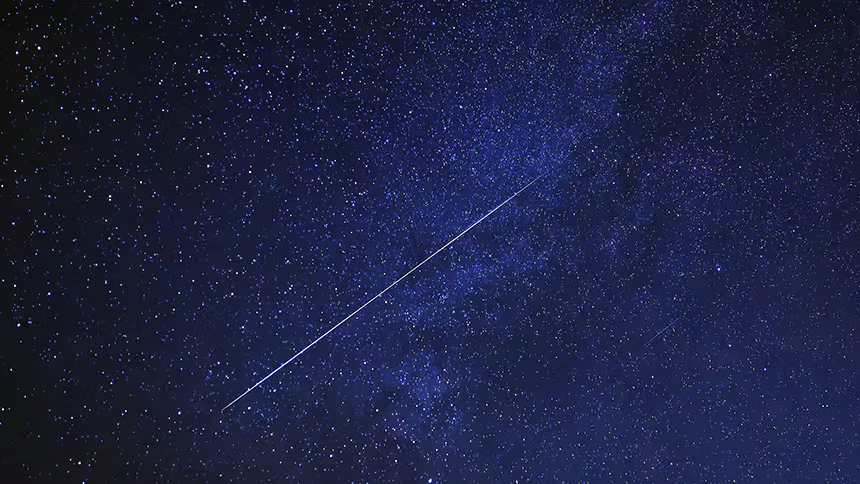
Prepare for the most reliable and explosive astronomical display of 2025. The Geminid meteor shower is set to peak this weekend, transforming the night sky into a canvas of shooting stars. Unlike the fleeting and faint meteors common to other showers, the Geminids are renowned for their intensity, often producing bright, colorful fireballs that can persist for seconds, leaving glowing “trains” of ionized gas in their wake.
Key Event Details:
- Peak Timing: The shower reaches its zenith on Saturday night into early Sunday morning (Dec 13–14).
- Ideal Viewing Window: While visible as early as 9:00 p.m., the “prime time” for viewing is after 10:00 p.m., with rates increasing significantly after midnight.
- Intensity: Under dark, clear skies, observers can expect to see up to 120 meteors per hour (ZHR).
- Urban Visibility: Due to the density and brightness of Geminid meteors, city dwellers may still catch 10–20 bright fireballs per hour, a rarity for urban astronomy.
The Science: The Mystery of 3200 Phaethon
The Geminids are unique in the astronomical calendar. While most meteor showers (like the Perseids) are caused by the dusty debris trails of icy comets, the Geminids are the offspring of 3200 Phaethon.
- The “Rock Comet”: Phaethon acts like a hybrid. It has the orbit of a comet (swinging perilously close to the Sun) but the composition of a rocky asteroid.
- Sodium Tails: Recent NASA research suggests Phaethon may be fizzing sodium gas as it heats up near the Sun, ejecting dust and debris that forms the Geminid stream.
- Material Density: Because they come from a rocky body, Geminid meteors are denser than cometary dust. This allows them to penetrate deeper into Earth’s atmosphere (down to 29 miles altitude) before burning up, creating longer, brighter streaks.
The “Technicolor” Experience
One of the most distinct features of the Geminids is their color. At Brainx, we analyze the spectral data:
- Yellow/Orange: Caused by traces of Sodium.
- Blue/Green: Indicators of Magnesium and Nickel burning in the atmosphere.
- Violet: Evidence of Calcium. This chemical cocktail makes the Geminids one of the few multi-colored showers visible to the naked eye.
Why This Year is Special
Astronomical conditions for this year’s shower are near-perfect. The Moon will be in a waning crescent phase (roughly 25% illuminated).
- What this means: The Moon will rise late and cast very little light interference.
- The Result: The sky will remain pitch-black for the majority of the night, allowing even the fainter meteors to stand out against the darkness.
Brainx Ultimate Viewing Guide
To maximize your experience, follow these scientifically backed observation protocols:
1. The “20-Minute Rule” Your eyes contain a chemical called rhodopsin (visual purple) that enables night vision. It takes 20 to 30 minutes to regenerate fully in the dark.
- Action: Put away your phone. The blue light from screens destroys rhodopsin instantly.
2. Location Strategy
- The Radiant: The meteors appear to radiate from the constellation Gemini (the Twins), specifically near the star Castor.
- Where to Look: Do not look directly at Gemini. Meteors closest to the radiant have very short trails. Instead, look 45 to 90 degrees away from the radiant to see the longest, most spectacular streaks.
- Comfort: Lie flat on your back (a reclining chair is best) to see the widest possible expanse of sky without straining your neck.
3. Thermal Preparation Astronomy is a sedentary activity. Without movement, your body heat drops rapidly.
- Layer Up: Wear double what you think you need.
- Insulate: If lying on the ground, use a yoga mat or sleeping pad to block the cold from the earth.
Bonus: Photography Tips for the Enthusiast
For those wanting to capture the event, you don’t need a telescope—just a tripod and patience.
- Camera: DSLR or Mirrorless (or a phone with “Pro/Night” mode).
- Lens: Wide-angle (14mm–24mm) to capture as much sky as possible.
- Settings:
- Focus: Manual Focus set to “Infinity.”
- Aperture: Lowest possible number (f/2.8 or f/4).
- Shutter: 15 to 30 seconds exposure.
- ISO: 1600 to 3200.
- Technique: Use a timer or remote shutter to avoid shaking the camera when pressing the button.
4. “Why It Matters” (Conclusion)
The Geminids offer a rare moment of connection between humanity and the cosmos. For the common man, it is a free, accessible reminder of our planet’s place in a moving, active solar system. In an era of digital distraction, spending a night under the stars reconnects us with the primal awe of nature—a grounding experience that puts our daily stresses into cosmic perspective.

Leave a Reply