High stakes but low expectations for Ukraine talks with Russia and US
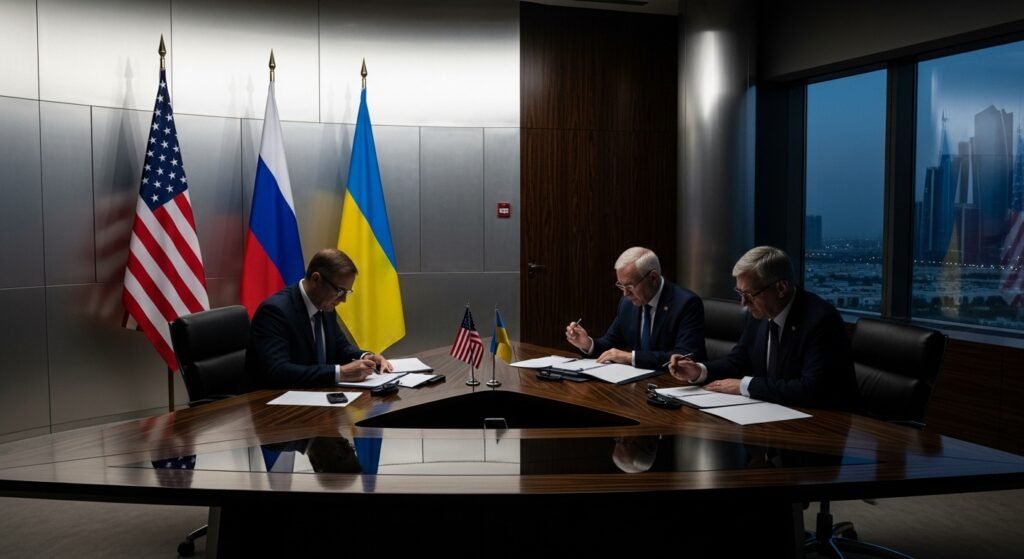
Historic Summit in Abu Dhabi: Trump’s Peace Push Meets Putin’s Red Line in First Trilateral Talks
Brainx Perspective
At Brainx, we believe this unprecedented trilateral meeting in Abu Dhabi represents the most fragile moment in modern diplomacy. While the optics suggest progress, the reality is a high-stakes poker game where the chips are human lives and sovereign borders. This development highlights a desperate race against time: can a political framework be forged before the “General Winter” and relentless infrastructure attacks break the will of a nation?
The News: A Diplomatic Breakthrough or a Mirage?
In a landmark development that has captured the attention of the geopolitical world, negotiators from the United States, Russia, and Ukraine have converged in Abu Dhabi, United Arab Emirates. According to the UAE Foreign Ministry, this marks the first time senior officials from all three nations have engaged in trilateral talks since the onset of Russia’s full-scale invasion in 2022.
While the meeting itself is a diplomatic milestone, the atmosphere remains tense. It is currently unclear whether the delegates will sit at the same table or if the UAE hosts will facilitate indirect “proximity talks.” Regardless of the format, the agenda is heavy, the stakes are existential, and the gap between the warring parties remains a chasm.
Key Developments & The “Trump Factor”
- The Trilateral Format: This is a significant deviation from previous bilateral attempts. The inclusion of the US directly alongside Russia and Ukraine signals Washington’s desire to force a conclusion to the conflict.
- Trump’s Ultimatum: US President Donald Trump, eager to deliver on his campaign promise of a “quick peace,” has ramped up pressure. He explicitly stated this week that both sides would be “stupid” not to reach an agreement, signaling his impatience with the prolonged war of attrition.
- Zelensky’s Shift: Ukrainian President Volodymyr Zelensky, often somber in interactions with the US administration, appeared unusually upbeat following meetings with Trump in Davos. He described the interactions as “really positive,” hinting at secured promises for increased air defense systems to counter Russian missile barrages.
- The Motivation: Ukraine is engaging not just for peace, but for survival. Having learned a hard lesson last year when the US briefly suspended intelligence sharing and military aid, Kyiv knows it must keep the White House engaged to survive the winter.
The “90-10” Problem: The Blood-Red Line of Donbas
While the diplomatic machinery hums in the luxury of Abu Dhabi, the core conflict remains paralyzed by what President Zelensky calls the “final 10%.” The framework for peace is reportedly 90% complete, covering prisoner exchanges, grain corridors, and nuclear safety. However, the final 10% is the hardest hurdle of all: Land.
- The Eastern Deadlock: The negotiations have hit a wall over the eastern Donbas region. Russia is demanding that Ukraine officially cede this territory—land that Russian forces have failed to fully conquer on the battlefield.
- Ukraine’s Refusal: For Kyiv, this is a non-negotiable red line. As Zelensky explained, “It’s all about the land.” This line is not just political; it is drawn in the blood of thousands of Ukrainian soldiers who have died defending every inch of that soil. Ceding it would be viewed as a betrayal of their sacrifice.
- The Kremlin’s Threat: Moscow remains uncompromising. The Kremlin has issued a stark warning: if it does not achieve its territorial ambitions at the negotiating table, it will seek to “achieve its aims on the battlefield,” signaling a potential spring offensive despite catastrophic Russian casualty rates.
The Security Guarantee Dilemma
A major pillar of the Abu Dhabi talks is the concept of “Security Guarantees.” This refers to the specific military commitments the US and its allies would make if Russia were to invade Ukraine again after a peace deal is signed.
- The “Done” Deal? Zelensky has claimed that the security agreement between the US and Ukraine is “done,” yet no specific details have been released to the public.
- The Credibility Crisis: A giant shadow hangs over these guarantees—the reliability of President Donald Trump. His recent geopolitical fixation on “acquiring” Greenland has reportedly severely undermined NATO unity and the principle of sovereignty.
- The Trust Deficit: Kyiv faces a terrifying question: Can they trust a US administration that views alliances transactionally to come to their rescue in a future crisis? Currently, they have no choice but to hope the answer is yes.
The Winter War: Freezing a Nation into Submission
While diplomats talk in the UAE, the reality on the ground in Ukraine is a humanitarian catastrophe. Russia, having failed to break the Ukrainian army, has turned its full fury on the civilian population.
- Infrastructure Blitz: Russian forces are targeting energy grids and heating plants with more deliberate, sustained ferocity than ever before. The goal is to weaponize the bitter winter cold against civilians.
- Kyiv’s Warning: The situation is so dire that Vitali Klitschko, the mayor of Kyiv, has issued a desperate plea. He has urged residents to leave the capital if they have anywhere else to go, warning that “the enemy will most likely continue to attack the critical infrastructure of the city.”
- A Fragile System: The repeated missile strikes have left the power grid in a “very fragile” state. Klitschko noted ominously, “The situation is extremely difficult and this may not be the most difficult moment yet.”
Deep Dive Analysis: Why Peace is Still Out of Reach
Despite the optimism radiating from Davos and the activity in Abu Dhabi, the fundamental drivers of the war remain unchanged. Vladimir Putin’s aims have not shifted. As Zelensky noted, “He really doesn’t want it [peace].”
The current dynamic is a stalemate of exhaustion. Ukraine is running low on manpower and infrastructure; Russia is running low on modern equipment and trained soldiers. However, Putin bets that Western patience—specifically American patience—will crack before his regime does.
The inclusion of the US in these talks is a double-edged sword. It brings the necessary weight to force a decision, but it also introduces the unpredictability of American domestic politics into the trenches of Donbas. If Trump decides the “deal” is to freeze the conflict along current lines, Ukraine may be forced to choose between losing land or losing US support—a choice that is effectively no choice at all.
As the music from military funerals drifts through the streets of Ukrainian cities, the disconnect between the air-conditioned conference rooms of the UAE and the frozen, shell-shocked muddy trenches of the front line has never been starker.
Why It Matters (Conclusion)
For the common man, this summit determines the price of heating your home and the stability of the global order. If a deal is forced that sacrifices Ukraine’s sovereignty for short-term quiet, it signals the end of the post-WWII rule of law, emboldening aggressors worldwide. Conversely, a failure to agree could lead to a total collapse of Ukraine’s infrastructure, triggering a massive new refugee wave into Europe and deepening the global economic crisis.




Leave a Reply