Holiday travel rush ramps up, causes delays on SoCal freeways
1. Catchy Headline
Hyper-Travel Crisis: 122 Million Americans Face ‘Perfect Storm’ of Gridlock, Weather, and Infrastructure Collapse
2. “Brainx Perspective” (Intro)
At Brainx, we believe the current holiday travel surge is not merely a seasonal spike but a stress test for a system on the brink. This convergence of record-breaking volume and volatile weather highlights a critical infrastructure deficit. It suggests that without a paradigm shift in how we manage mobility, “holiday chaos” will become the permanent baseline of American travel.
3. The News (Body)
The 2025-2026 holiday season has officially entered the record books as a “historic anomaly,” characterized by a brutal collision of sheer human volume, crumbling infrastructure, and unpredictable meteorological threats.
The Scale of the Migration
- Record Numbers: Data from AAA confirms a staggering 122.4 million Americans mobilized for the holidays, a 2.7 million increase from the previous year.
- The “Double Peak”: Unlike typical years, this season featured two distinct pressure points.
- Road Warriors: Saturday, December 20, marked the zenith for vehicular traffic, where holiday travelers mixed lethally with regular commuters.
- Air Travel Surge: The second wave crested on December 27, creating a “double peak” as millions attempted to return home simultaneously.
- Economic Drivers: This 3% year-over-year jump signals a psychological determination to reclaim pre-pandemic normalcy, regardless of economic headwinds.
Regional Spotlight: The Southern California Bottle-Neck The friction was most palpable in Southern California, serving as a microcosm for the national crisis.
- Mass Movement: Approximately 10.2 million residents in this region alone traveled at least 50 miles.
- Infrastructure Failure: The infamous 405 Freeway (Sepulveda Pass) became a parking lot due to ill-timed repaving projects reducing lane capacity.
- Human Cost: Families like the Petersons of Camarillo faced heartbreaking losses, missing flights to Hawaii not due to airport delays, but because the “buffer time” to reach the terminal has effectively evaporated.
The Meteorological “Force Multiplier” While volume is predictable, weather proved to be the chaotic variable that destabilized the system.
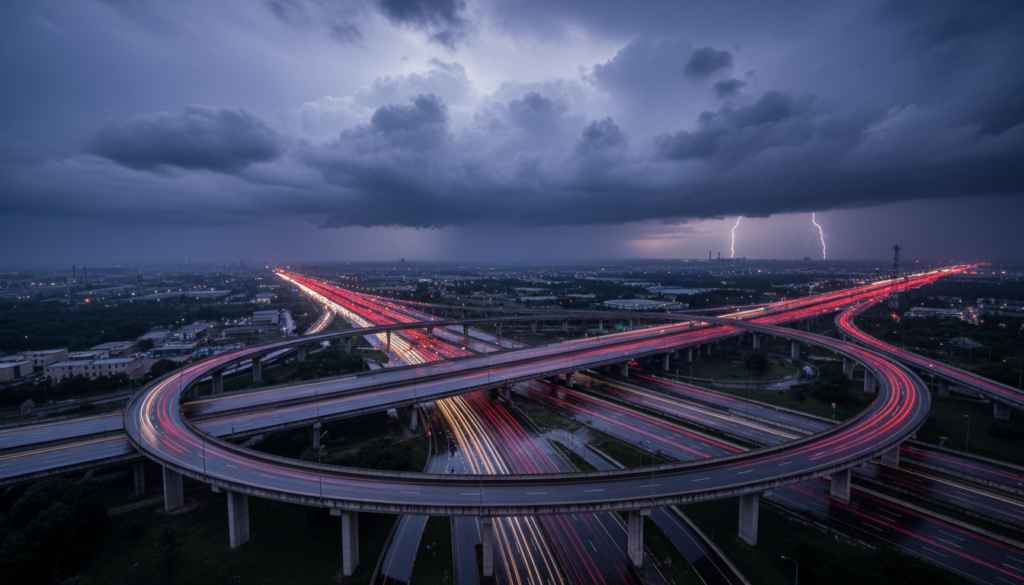
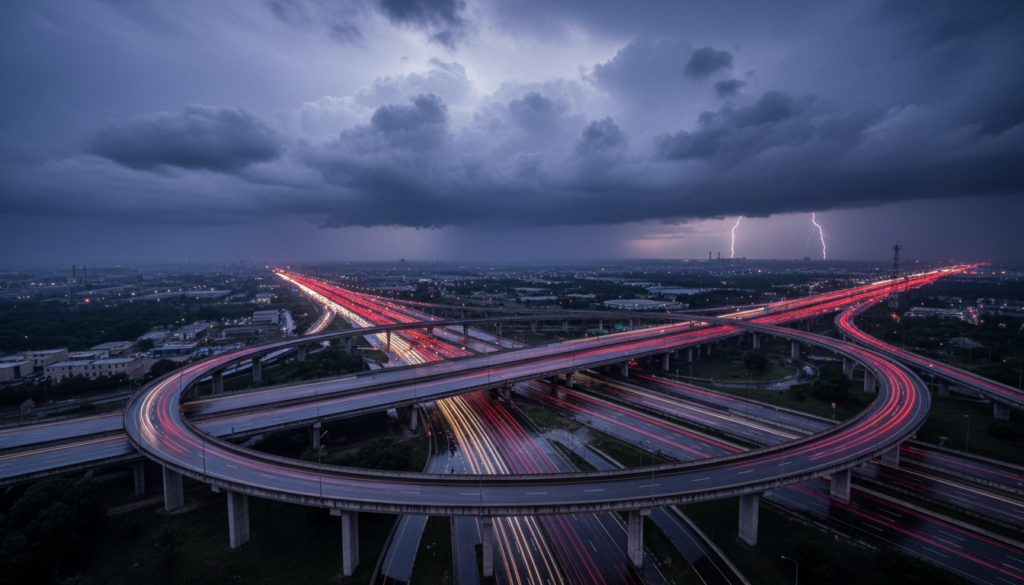
- West Coast Storms: An incoming storm system brought rare rain to Southern California, reducing traffic speeds by 20-30% and exponentially increasing accident rates.
- The Ripple Effect: Weather events are no longer local. A blizzard in Chicago or a Nor’easter in New York triggered cascading delays that grounded flights in clear-skies cities like Phoenix and Los Angeles.
- Systemic Fragility: The “delicate ballet” of aircraft rotation meant that one delayed flight in the Midwest could collapse itineraries across the entire network.
Strategic Survival for the Modern Traveler In this era of “hyper-travel,” the old rules no longer apply. Experts suggest a tactical approach:
- The “First Flight” Rule: Always book the first departure of the morning. These aircraft are typically parked overnight, insulating them from the “propagation of delay” that plagues afternoon flights.
- Digital Sovereignty: Relying on airport monitors is a mistake. Travelers must use third-party apps like FlightAware to get cancellation alerts before the gate agents announce them, providing a critical head-start on rebooking.
- Diversified Routing: For drivers, knowledge of secondary highways and frontage roads is now essential to bypass main artery gridlocks.
4. “Why It Matters” (Conclusion)
This season proves we have entered the era of Hyper-Travel, where the sociological drive to connect overrides logistical logic. For the common man, this means the “casual vacation” is dead; future travel will require the planning of a military operation, where digital literacy and meteorological awareness are the only true safeguards against a system operating at its absolute limit.



Leave a Reply