Midnight Airstrikes: Pakistan Bombs TTP Hideouts in Afghanistan as Border Tensions Explode

Brainx Perspective
At Brainx, we believe this escalation marks a dangerous tipping point in South Asian geopolitics. The collapse of the October ceasefire underscores a severe trust deficit between Islamabad and Kabul. This development highlights the persistent threat of cross-border terrorism and the grim reality that civilians ultimately bear the deadliest costs.
The News: A Dramatic Escalation in the Pak-Afghan Conflict
In a severe deterioration of bilateral relations, Pakistan has launched multiple overnight airstrikes into Afghan territory. The military operation, which Islamabad asserts was precision-targeted at militant sanctuaries, has triggered outrage from the Afghan Taliban, who claim the strikes hit civilian areas and resulted in the deaths of at least 18 people, including women and children.
This military action represents one of the most significant cross-border escalations since the Taliban regained control of Afghanistan in August 2021. The strikes threaten to unravel an already fragile security environment in a region plagued by decades of conflict.
Key Facts of the Operation and Fallout:
- The Attack: Pakistan executed intelligence-based airstrikes overnight, targeting seven alleged militant camps and hideouts near the rugged Pakistan-Afghanistan border.
- The Targets: The strikes hit locations in the Nangarhar and Paktika provinces of Afghanistan.
- The Casualties: The Afghan Taliban’s defense ministry reported that dozens were killed. In a tragic account from Girdi Kas village (Bihsud district, Nangarhar), 18 members of a single family were reportedly killed when their home was destroyed.
- The Justification: Pakistan’s Ministry of Information and Broadcasting stated the strikes were a “retributive response” against the banned Tehreek-i-Taliban Pakistan (TTP), which Islamabad refers to as “Fitna al Khawarij,” and the Islamic State-Khorasan Province (IS-K).
- The Catalyst: The airstrikes followed a surge in recent suicide bombings in Pakistan, including a devastating attack on a Shia mosque in Islamabad and several deadly incidents in the Khyber Pakhtunkhwa (KP) province during the holy month of Ramadan.
- The Diplomatic Breach: The strikes shatter a fragile ceasefire brokered in October following previous deadly border clashes.
The Official Pakistani Stance: A Retributive Strike
Pakistan has increasingly voiced its frustration over the Afghan Taliban’s alleged inaction regarding militant groups operating from Afghan soil. According to Pakistan’s Ministry of Information and Broadcasting, the overnight operation was a strictly “intelligence-based selective targeting” mission. The government maintains that it possesses “conclusive evidence” that the recent wave of terrorism in Pakistan—specifically the Ramadan attacks in Khyber Pakhtunkhwa and the capital—was orchestrated by militant leadership sheltered inside Afghanistan.
For years, Islamabad has pressured Kabul to rein in the TTP, a militant umbrella organization that shares ideological roots with the Afghan Taliban but is focused on overthrowing the Pakistani state. The presence of IS-K further complicates the security matrix, making the 1,600-mile (2,574 km) mountainous border a hotbed for transnational terrorism. By launching these strikes, Pakistan is signaling a shift from diplomatic pressure to direct kinetic action, demonstrating a zero-tolerance policy toward cross-border terrorism.
The Afghan Taliban’s Fury and Threats of Retaliation
The reaction from Kabul has been swift and deeply hostile. The Afghan Taliban’s defense ministry took to X (formerly Twitter) to vehemently condemn the airstrikes, framing them as a “blatant violation of Afghanistan’s territorial integrity” and a “clear breach of international law.”
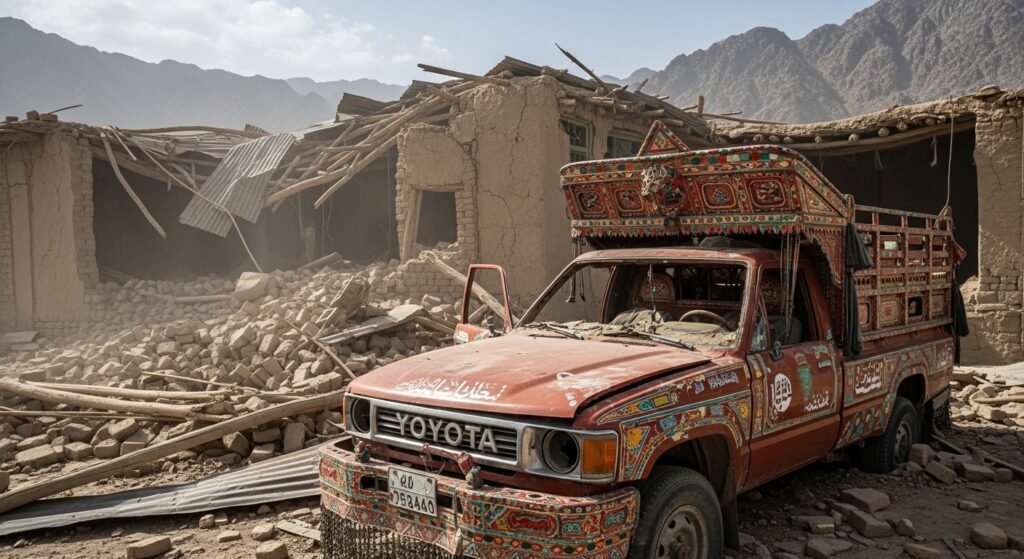
Kabul’s narrative starkly contrasts with Islamabad’s. While Pakistan claims it hit terrorist infrastructure, the Taliban insists that multiple civilian homes and a religious school were obliterated. Local officials in the Bermal and Urgun districts of Paktika province confirmed that a guesthouse and a religious school were targeted, though they noted these buildings were empty at the time. However, the human toll in Nangarhar paints a devastating picture. Shahabuddin, a resident of Girdi Kas village, reported that out of his 23 family members, only five survived the aerial bombardment.
The Afghan defense ministry issued a stark warning, stating that “an appropriate and measured response will be taken at a suitable time.” They further taunted Islamabad, declaring that “attacks on civilian targets and religious institutions indicate the failure of Pakistan’s army in intelligence and security.”
The Historical and Geopolitical Context: The October Ceasefire and Beyond
To fully understand the gravity of these airstrikes, one must look at the immediate history of the Pakistan-Afghanistan border conflict. The two nations share the Durand Line, a porous and highly contested border that has historically been a flashpoint for militant movement and military skirmishes.
Just days before these strikes, diplomatic channels appeared to be working. Saudi Arabia had successfully mediated the release of three Pakistani soldiers who had been captured in Kabul during intense border clashes the previous October. Those October clashes represented the worst fighting between the two nations since 2021 and culminated in a tentative, fragile ceasefire.
However, the ceasefire failed to address the root cause of the friction: the sanctuary of TTP militants. Pakistan’s strategic patience has clearly worn thin. The resumption of airstrikes indicates that diplomatic mediations, such as those by Saudi Arabia, are merely temporary band-aids on a deep, festering regional wound.
The Resurgence of the TTP and IS-K
The Tehreek-i-Taliban Pakistan (TTP) has been reinvigorated since the US withdrawal from Afghanistan. Emboldened by the Afghan Taliban’s victory, the TTP has escalated its insurgency against the Pakistani state, targeting military outposts, police stations, and civilian infrastructure. Pakistan’s military apparatus has suffered significant casualties, prompting intense domestic pressure to act decisively.
Simultaneously, the Islamic State-Khorasan Province (IS-K) poses a mutual threat to both Pakistan and the Afghan Taliban, though their networks often overlap in the ungoverned spaces of the border regions. Pakistan’s inclusion of IS-K in its target list highlights the complex, multi-factional nature of the militant ecosystem thriving in the region.
What This Means for South Asian Security
The ongoing Pakistan-Afghanistan border conflict is no longer a localized issue; it has profound implications for broader South Asian stability. High-searching keywords like “Pakistan Afghanistan border conflict” and “TTP hideouts” reflect a global anxiety about the resurgence of terrorism in the region. If the Afghan Taliban follow through on their threat of a “measured response,” the region could witness a sustained, low-intensity war between two heavily armed neighbors.
Furthermore, this conflict puts the international community in a difficult position. While no nation recognizes the Taliban government, regional powers like China and Russia have vested interests in Afghan stability for trade and resource extraction. A full-blown war between Pakistan and Afghanistan would destabilize the entire region, creating a new wave of refugees and providing a chaotic vacuum for global terror groups to exploit.
Why It Matters
For the common man living along the volatile Durand Line, this escalation means displacement, fear, and shattered livelihoods. It signifies a regional future where proxy conflicts and diplomatic failures dictate daily survival, threatening to drag both impoverished nations back into a devastating, full-scale cycle of inescapable war.



Leave a Reply