No power or water and -19C: Kyiv seeks relief from Russian strikes and cold
Kyiv’s Darkest Winter: Families Flee as Grid Collapses Under Relentless Russian Strikes
Brainx Perspective
At Brainx, we believe the unfolding crisis in Kyiv is more than just a weather event; it is the calculated weaponization of winter. This development highlights a grim tipping point in the conflict, where the cumulative destruction of critical infrastructure is forcing citizens to make impossible choices between displacement and freezing. It underscores the extraordinary resilience of a population entering its fourth winter of war, even as the mechanisms of daily survival begin to fracture.
The News
As Kyiv enters its fourth winter since the full-scale invasion began, the capital is facing its most severe energy crisis to date. A combination of plummeting temperatures, relentless Russian airstrikes, and accumulated infrastructure damage has left millions of residents struggling to stay warm.
The Failure of Backup Systems For many residents, the survival strategies that worked in previous years are no longer sufficient.
- Battery Limitations: While many families have invested in large batteries to keep lights and phones charged, these devices are useless for powering high-wattage heating appliances, which drain them almost instantly.
- The Only Solution: Residents like Yulia describe layering clothes on their children as the only remaining defense against the cold in their apartments.
- Forced Migration: Heeding Mayor Vitali Klitschko’s warnings, many families, including Yulia’s, are temporarily evacuating the city to stay with relatives in rural areas where wood-burning stoves or alternative heating might be available. This decision is driven not just by the cold, but by safety; Yulia notes that a recent drone strike devastated an apartment block just across the courtyard from her home.
A Grid on the Brink of Collapse The situation is statistically and visibly worse than any previous winter. Mayor Klitschko confirmed that recent Monday night strikes caused the worst electrical outage the city has ever seen, leaving over 500 residential buildings without power for extended periods.
- Cumulative Damage: The current crisis is the result of repeated attacks over years. “The most recent Russian attacks… have had a cumulative effect that is much worse than before,” reports indicate.
- The “Ice” Factor: Olena Pavlenko, president of the DiXi Group think tank, explained that recovery is becoming exponentially harder. “Everything is under ice,” she noted, stating that frozen ground and icy conditions make cable repairs “two to four times more complicated” than in warmer months.
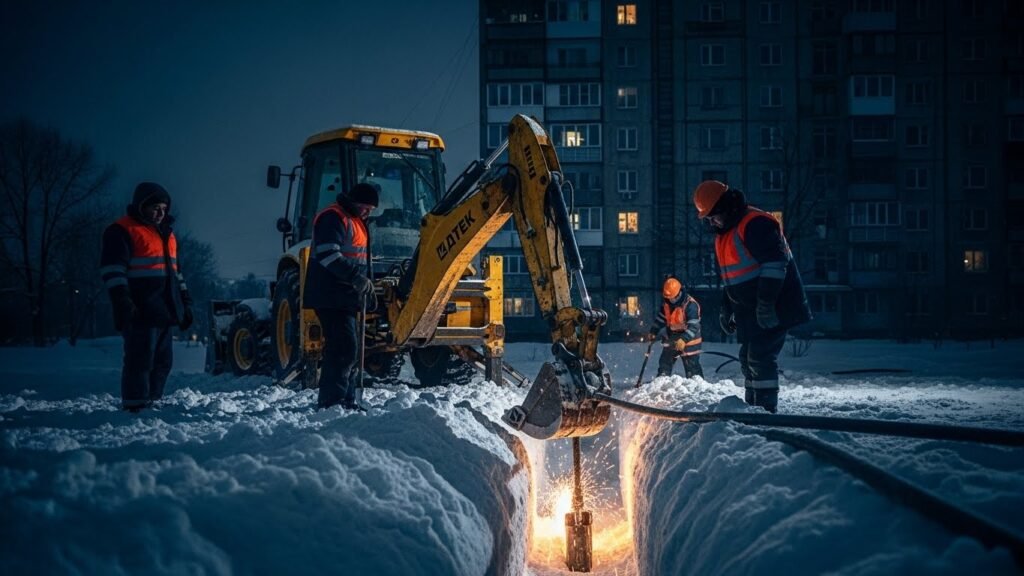
The Engineering Battle On the ground, the fight to keep the lights on is being waged by engineers from private energy company DTEK and municipal authorities.
- Emergency Mode: Andrii Sobko, a DTEK repair crew lead, admitted that current efforts are merely temporary patches. “We are currently working literally in emergency modes,” he stated, warning that the equipment is operating at critical parameters just to provide basic light. He estimates it will take “years and years” to fully restore the grid.
- The Surge Problem: A vicious cycle is hampering repairs. Authorities have pleaded with citizens not to use high-energy devices immediately after power returns. When power is restored, the sudden surge in demand often causes the weakened system to crash again, burning out the very cables engineers just fixed.
- Manual Labor: In bitter cold, engineers are often forced to work with their bare hands and mechanical diggers to locate damaged cables buried in frozen earth, particularly on the river’s east bank.
The Psychological Toll: A Generation of War The crisis is reshaping the lives of Kyiv’s youngest citizens. At the “Invincibility Train”—a mobile shelter providing warmth and power—residents gather to charge devices and find comfort.
- Stas’s Story: Eleven-year-old Stanislav (“Stas”) describes a life where he has forgotten peace. “I forget the times when there was no war… life is difficult,” he says. His family recently endured a 36-hour blackout.
- Drone Terror: For Stas, the threat has evolved. He recalls the “bright orb” of missiles from the war’s first day, but now, the slow, buzzing sound of drones is what keeps him awake. The uncertainty of whether a drone will explode or fly past is a constant source of anxiety.
- Interruptions: The reality of the war is inescapable. Even moments of respite on the train are cut short by air raid alerts, forcing the conductor to evacuate everyone to shelters kilometers away.
Conclusion of the Current Situation Despite the “extraordinarily cold” winter and the crumbling grid, the mood in Kyiv remains one of grim determination. Residents like Stas and the elderly woman on the train express a resolve to return tomorrow, putting a brave face on a crisis that most fear has no end in sight.
“Why It Matters” (Conclusion)
This crisis matters because it exposes the long-term scar tissue of modern warfare. It is not just about a cold winter; it is about the “years and years” of rebuilding required even after peace returns. For the common man, daily life has regressed to a battle for basic thermodynamics, creating a generation like Stas’s that cannot remember a world without sirens, cold, and fear.

Leave a Reply