Pilot praised after landing faulty Somali passenger plane on seashore
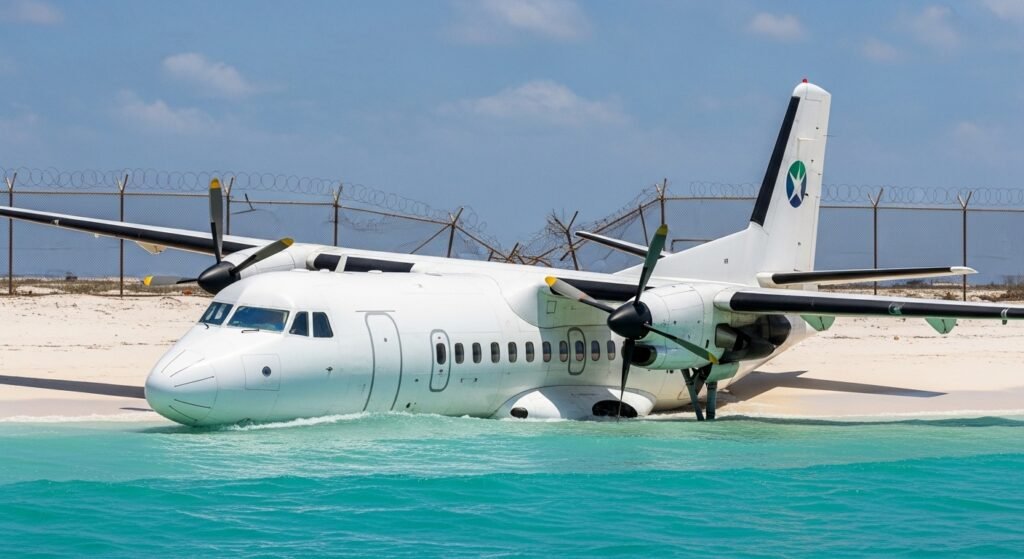
Miracle in Mogadishu: 55 Survive as Starsky Airlines Plane Crash-Lands into Indian Ocean
At Brainx, we believe…
This dramatic survival story highlights the critical importance of pilot training and rapid emergency response in aviation’s most challenging environments. At Brainx, we believe the “Miracle in Mogadishu” serves as a testament to human resilience and the robustness of legacy aircraft like the Fokker 50. While technical failures are inevitable, the safe outcome here underscores that despite Somalia’s turbulent history, its aviation sector is developing the capacity to manage crises effectively—turning a potential tragedy into a story of survival.
The News: A Narrow Escape on the Shoreline
In a heart-stopping event that has already been dubbed the “Miracle in Mogadishu,” a Starsky Airlines passenger plane carrying 55 people narrowly avoided disaster on Tuesday. The aircraft, a Fokker 50 turboprop, crash-landed onto the sandy shoreline of the Indian Ocean just moments after takeoff from Aden Adde International Airport, leaving the fuselage resting precariously in the shallow surf but miraculously sparing the lives of everyone on board.
The incident began shortly after the aircraft departed Mogadishu for a domestic route. According to the Somali Civil Aviation Authority (SCAA), the flight crew reported a critical technical fault minutes into the climb and immediately requested permission to return to the airport. What followed was a tense struggle to bring the crippled aircraft back to earth safely.
Key Facts of the Incident:
- Airline: Starsky Airlines (formerly Starsom Air).
- Aircraft Type: Fokker 50 (Turboprop).
- Passengers & Crew: 50 passengers and 5 crew members (Total: 55).
- Location: Aden Adde International Airport, Mogadishu, Somalia.
- Outcome: 0 Fatalities; minor injuries reported.
- Cause: Technical failure shortly after takeoff leading to a runway excursion.
Minute-by-Minute: The Crash Landing
Witnesses near the airport described seeing the aircraft flying unusually low, struggling to maintain altitude as it circled back toward the runway. The pilot, whose identity has not yet been publicly released but is being hailed as a hero, attempted a desperate emergency landing on Runway 05.
However, the landing did not go as planned. Reports indicate the aircraft failed to stop within the runway’s threshold. It skidded off the tarmac, tearing through the airport’s perimeter fence and careening down the embankment before coming to a rest on the Jasiira beach, with its nose partially submerged in the ocean waves.
“The plane was coming in fast and it looked like it didn’t have enough braking power,” said an airport ground worker who witnessed the event. “When it hit the sand, we feared the worst. To see people walking out alive is nothing short of a miracle.”
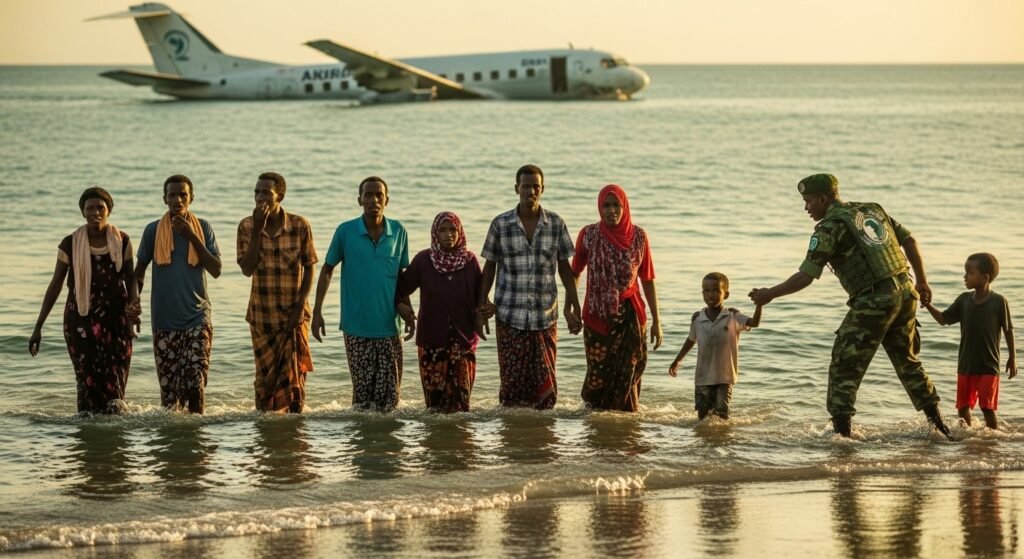
Video footage circulating on social media platform X (formerly Twitter) showed a surreal scene: passengers, some looking dazed but largely unharmed, clambering out of the broken fuselage and walking through knee-deep water toward the safety of the dry sand. The aircraft’s right wing appeared partially detached, and the cockpit section sustained significant damage.
Rescue Response and “Swift” Action
The response was immediate. The African Union Transition Mission in Somalia (ATMIS), which maintains a heavy presence at the airport due to the ongoing security situation in the country, deployed troops alongside United Nations personnel and local Somali emergency services.
- Firefighters: Were on the scene within minutes to douse potential fuel fires, though none erupted.
- Medical Teams: Triaged passengers on the beach. Remarkably, no life-threatening injuries were reported.
- Government Presence: Somalia’s Minister of Transport and Civil Aviation swiftly arrived at the crash site to oversee the rescue operations, signaling the government’s high-level concern.
Starsky Airlines spokesman Hassan Mohamed Aden confirmed the safety of all souls on board. “We are relieved to confirm that all passengers and crew are safe,” Aden said in a press statement. “The pilot’s swift and calm decision-making played a decisive role in ensuring the safety of everyone on board, and we commend him for how he handled the situation.”
The Aircraft: The Rugged Fokker 50
The aircraft involved was a Fokker 50, a Dutch-manufactured turboprop that has long been a workhorse in African aviation.
- Legacy: Production of the Fokker 50 ended in 1997, meaning the airframe involved was likely over 30 years old. Despite their age, these aircraft are prized in developing nations for their ruggedness and ability to operate on short, rough runways.
- Safety Record: While generally reliable, aging fleets in the region often face maintenance challenges. The Fokker 50 has been involved in several incidents in Somalia in recent years, including a 2022 crash where a Jubba Airways Fokker 50 flipped over on landing at the same airport—also with all passengers surviving.
The Airline: Starsky’s Rise in Somalia
Starsky Airlines is a significant player in Somalia’s post-war aviation reconstruction. Founded in 2013 as Starsom Air, the company rebranded in 2022. It prides itself on reopening air routes to remote “mini-airports” in Somalia that had been abandoned during decades of civil conflict. The airline has claimed awards for “Best Domestic Airline,” positioning itself as a leader in connecting the fragmented nation.
This incident serves as a major test for the carrier, which must now demonstrate transparency during the investigation to maintain the public trust it has built over the last decade.
The Danger Zone: Aden Adde International
The crash highlights the unique geographical and operational hazards of Aden Adde International Airport.
- The “One-Way” Runway: The airport is situated directly on the coast. Runway 05 approaches from the city, while Runway 23 approaches from the sea. Overshooting the runway almost invariably means ending up in the Indian Ocean or the surrounding concrete seawalls.
- Security Constraints: Because of the threat from militant group Al-Shabaab, flight paths are strictly controlled to avoid low-altitude exposure over the city, leaving pilots with little room for error during emergencies.
- History of Excursions: This is not the first time the sea has claimed a plane at Aden Adde. In recent years, several cargo and passenger planes have skidded off the runway into the surf, earning the airport a reputation for unforgiving margins.
Why It Matters
For the common man in Somalia and travelers across Africa, this incident matters because it reinforces confidence in the survivability of air travel, even when things go wrong. It highlights that aviation safety is not just about preventing accidents, but managing them. The survival of 55 people suggests that emergency protocols—from the pilot’s training to the evacuation procedures—worked as intended.
However, it also serves as a warning about the aging aviation infrastructure in the developing world. As Somalia rebuilds its economy, the reliance on older aircraft like the Fokker 50 will eventually need to be addressed. For now, the “Miracle in Mogadishu” stands as a powerful reminder of the skill of African pilots who operate daily in some of the world’s most demanding conditions.




Leave a Reply