Rescuers search for nine missing skiers after California avalanche
Race Against Time: 10 Missing After Massive D2.5 Avalanche Buries Guided Backcountry Tour Near Lake Tahoe
Brainx Perspective
This development highlights the extreme and unpredictable dangers of backcountry recreation during severe weather systems. While the profound allure of untouched powder draws enthusiasts to remote mountainous terrains, this tragic avalanche underscores that even guided expeditions are not immune to nature’s formidable power when compounding storm factors override human preparedness.
The News
A frantic and highly perilous search and rescue operation is currently underway in the rugged backcountry of California’s Sierra Nevada mountains after a massive avalanche swept away a guided ski tour group. The disaster, which unfolded during one of the most severe winter storms to hit the region this season, has left multiple people unaccounted for as emergency responders battle whiteout conditions and the constant threat of secondary snowslides.
Here are the key facts regarding the ongoing situation:
- The Incident: An avalanche struck the Castle Peak area near Truckee, northwest of Lake Tahoe, at approximately 11:30 a.m. PST on Tuesday, February 17, 2026.
- The Victims: A group of 16 backcountry skiers, consisting of 12 clients and four professional guides from Blackbird Mountain Guides, were caught in the massive slide.
- Current Status: As of late Tuesday evening, six survivors have been successfully rescued after sheltering in place, with two transported to a local hospital. Ten skiers remain missing and unaccounted for.
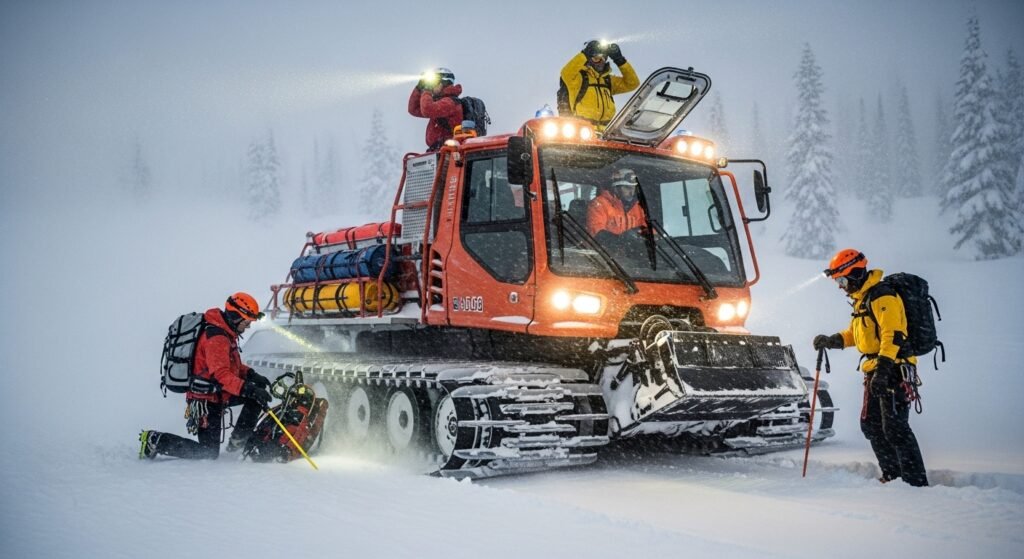
- The Response: A multi-agency emergency effort involving 46 first responders, specialized ski rescue teams, and heavy snow-grooming vehicles (snowcats) has been deployed to the remote avalanche zone.
- The Weather: The rescue is severely hampered by an intense atmospheric river storm that has dumped over 30 inches (76 cm) of fresh snow in the past 24 hours, accompanied by hurricane-force winds.
The Incident: A Three-Day Expedition Turns Tragic The ill-fated group was on the final leg of a physically demanding three-day backcountry ski touring expedition organized by the Truckee-based company Blackbird Mountain Guides. According to statements from the outfitter and local authorities, the 16 skiers had been residing at the remote Frog Lake huts since Sunday. On Tuesday morning, the group was in the process of concluding their trip, navigating a rigorous 4-mile (6.4 km) route back to the trailhead while carrying heavy packs filled with food, survival gear, and supplies.
At approximately 11:30 a.m., as the skiers traversed the steep, snow-laden slopes of Castle Peak at an elevation of roughly 8,200 feet, the mountainside gave way. The sheer force of the cascading snow engulfed the group. Survivors who managed to stay near the surface or free themselves immediately activated their emergency locator beacons and placed a 911 call. They were forced to build a rudimentary emergency shelter using tarpaulins, huddling together against the freezing blizzard conditions while awaiting a rescue that would take hours to arrive due to the treacherous terrain.
The Avalanche: Understanding a D2.5 Event Avalanche experts and forecasters have classified the Castle Peak slide as a “D2.5” on the Destructive Size scale (which ranges from D1 to D5). A D2 avalanche is defined as a slide large enough to bury, injure, or kill a person, while a D3 possesses enough kinetic energy to destroy a small building, break trees, or obliterate a car. A D2.5 rating indicates a highly lethal, sprawling slide with immense destructive potential that can extend the length of several football fields.
This catastrophe did not occur without warning. Hours before the skiers set out for the trailhead, the Sierra Avalanche Center had issued a “High” avalanche danger rating—a Level 4 on the 5-point international scale. The center explicitly warned that large, natural, and human-triggered avalanches were expected to occur across the backcountry terrain.
Brandon Schwartz, the lead avalanche forecaster for the Tahoe National Forest, explained that the conditions were a perfect recipe for disaster. Rapidly accumulating snowfall from the storm system was piling heavily onto older, highly fragile snowpack layers. When combined with gale-force winds that mechanically load snow onto leeward slopes, the structural integrity of the mountainside was critically compromised. Experts noted that in such volatile conditions, avalanches can easily be triggered remotely from below or run deeply into treed areas typically thought to be safe from slides.
The Mechanics of Backcountry Survival and Search When a skier is buried in an avalanche, survival is governed by a ruthless ticking clock. Statistics show that if a victim is extracted within the first 15 minutes, their chance of survival is over 90%. However, after 30 minutes, survival rates plummet to roughly 30% due to asphyxiation and severe hypothermia. Backcountry skiers are strictly advised to carry an “avalanche trinity” of safety gear: a transceiver (beacon), a collapsible probe, and a specialized snow shovel.
In a professionally guided scenario, it is standard protocol for all clients and guides to wear transmitting beacons. When the snow settles, survivors switch their beacons to “receive” mode to sweep the debris field for the electronic pulses of their buried companions. Once a signal is pinpointed, long probes are pushed into the snow to strike the victim, followed by strategic, frantic shoveling. However, the sheer volume of a D2.5 avalanche—which can bury victims beneath concrete-hard, compacted snow debris several meters deep—often renders self-rescue within the group impossible, especially if the surviving members are injured, disoriented, or suffering from the extreme cold.
The psychological and physical toll on the 46 emergency responders currently navigating Castle Peak cannot be overstated. Operating in sub-zero temperatures with driving winds, these rescuers are methodically probing a vast, unstable debris field. Every step they take is calculated to avoid triggering a secondary slide that could bury the rescue party itself.
The Rescue: Battling a Ferocious Sierra Storm The response to the 911 call triggered an immediate, all-hands-on-deck emergency operation coordinated by the Nevada County Sheriff’s Office. Capt. Russell Greene of the sheriff’s office described the operation as a “slow, tedious process,” primarily because the rescuers must constantly evaluate their own exposure to avalanche hazards.
Over 46 emergency personnel from multiple jurisdictions, including Placer County, Washoe County, and the California Department of Forestry and Fire Protection, joined the effort. Highly skilled ski rescue teams were deployed from the nearby Boreal Mountain Ski Resort and Tahoe Donner’s Alder Creek Adventure Center. Due to the deep, unconsolidated powder and zero-visibility whiteout conditions, traditional rescue helicopters were entirely grounded. Instead, teams had to rely on skis, snowmobiles, and snowcats—heavy, treaded vehicles normally used for grooming ski resort runs—to carve a cautious path up the mountain.
By 10:40 p.m. on Tuesday night, the six known survivors were finally reached and extracted from the freezing wilderness, bringing a brief moment of relief to the grueling operation. Yet, as the hours tick by and the storm continues to rage, the window for finding the remaining ten skiers alive grows increasingly narrow.
The Broader Context: A Deadly California Winter The Castle Peak disaster is unfolding against the backdrop of one of the most ferocious winter storms to strike Northern California this season. The weather system has brought travel to a complete standstill, forcing the closure of major transportation arteries, including Interstate 80 over Donner Summit and Highway 50. Several ski resorts in the Greater Lake Tahoe area completely shuttered their operations on Tuesday, acknowledging that even their highly managed avalanche mitigation systems could not guarantee safety in such extreme weather.
The tragedy has also sparked a debate regarding the ethics and decision-making of commercial backcountry guiding during severe weather warnings. While backcountry skiing inherently involves accepting a degree of risk, leading a dozen paying clients into known avalanche terrain during a Level 4 warning has drawn intense public scrutiny. As Capt. Greene frankly noted during a press briefing, “I don’t think it was a wise choice, but we don’t know all the details yet.”
Furthermore, the Donner Summit and Castle Peak region carries a dark historical and recent legacy. Named for the infamous Donner Party pioneers who became trapped in the winter of 1846, the area is notoriously unforgiving. Just weeks prior, in January 2026, an avalanche in the exact same region claimed the life of a snowmobiler, highlighting the persistent lethality of the Sierra Nevada slopes. As the search pushes into Wednesday, the Lake Tahoe community holds its breath, hoping for a miracle amidst the relentless snowfall.
Why It Matters
This tragic event matters because it exposes the fine line between outdoor adventure and life-threatening danger. For the common man, it serves as a deeply sobering reminder to respect nature’s warnings. As extreme weather patterns intensify globally, prioritizing expert advisories over recreational ambitions will become increasingly vital for public safety.



Leave a Reply