Trump says progress made in Ukraine talks but ‘thorny issues’ remain
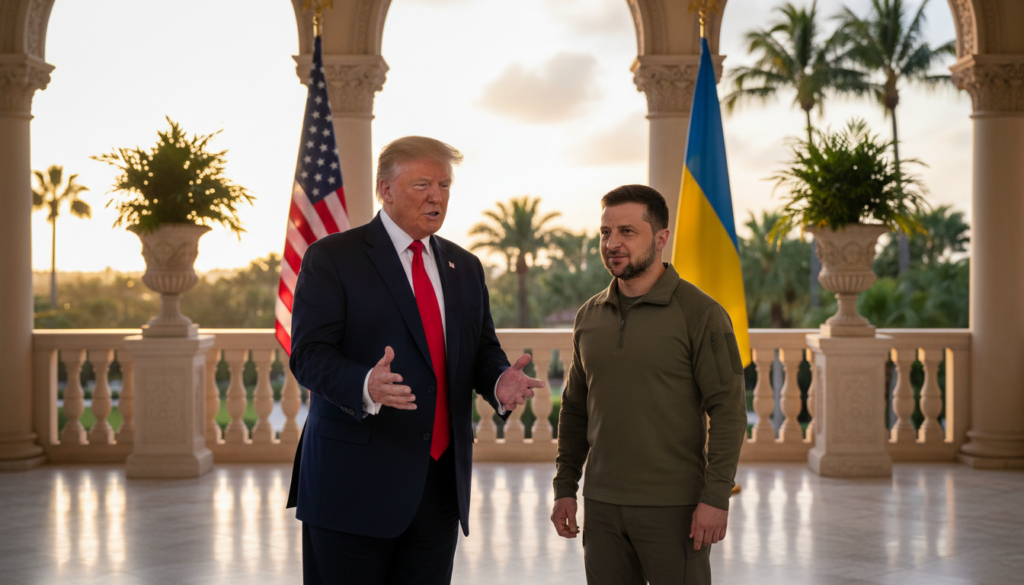
The Florida Breakthrough: Trump and Zelensky Signal a 90% Peace Deal—But Is the Donbas “Thorny Issue” a Dealbreaker?
Brainx Perspective
At Brainx, we believe the Mar-a-Lago summit marks the most consequential diplomatic pivot since the war’s inception. This development highlights a high-stakes gamble: trading territorial “grey zones” for ironclad Western security. While the 90% consensus is historic, the remaining 10%—the soul of the Donbas—will determine if this is a lasting peace or a temporary freeze.
The News: Inside the Mar-a-Lago Peace Framework
In a weekend characterized by intense “shuttle diplomacy,” President Donald Trump and Ukrainian President Volodymyr Zelensky met at the Mar-a-Lago resort in Florida to hammer out a definitive end to the Russo-Ukrainian war. The meeting, which follows months of back-channel negotiations involving U.S., Ukrainian, and European teams, resulted in an unprecedented level of public optimism. Both leaders signaled that they are closer than ever to a signed agreement, though the “ghost of the Donbas” continues to haunt the final stages of the draft.
I. The “90% Factor”: A 20-Point Plan for Stability
President Zelensky announced that the delegations have reached a consensus on roughly 90% of a revised 20-point peace plan. This framework, which has seen multiple iterations throughout late 2025, aims to move beyond a simple ceasefire toward a structured, long-term security and prosperity pact.
Key Pillars of the Consensus:
- The Peacetime Military Cap: Ukraine has agreed to cap its permanent Armed Forces at 800,000 troops. While this is a reduction from current wartime levels, it ensures Ukraine remains the most formidable standing army in Europe, serving as a deterrent against future aggression.
- “Article 5-Like” Security Guarantees: Trump stated that security guarantees are “almost 95% complete.” The current draft proposes that the U.S., NATO, and a “Coalition of the Willing” would provide protections analogous to NATO’s Article 5. If Russia violates the peace, a military response and the immediate reinstatement of global sanctions would be triggered.
- The $800 Billion Recovery Fund: A massive global development package is being finalized to rebuild Ukraine’s infrastructure. This includes gas infrastructure projects, mineral extraction partnerships, and a dedicated reconstruction fund, largely financed by immobilizing Russian assets and private Western investment.
- Nuclear Neutrality and Energy: Ukraine reaffirms its status as a non-nuclear state. A breakthrough was reported regarding the Zaporizhzhia Nuclear Power Plant, with a proposal for a joint venture involving U.S. management to ensure safety and 50/50 energy distribution.
- EU Integration: The plan includes a “clearly defined timeframe” for Ukraine’s entry into the European Union, with the EU providing short-term preferential market access to jumpstart the Ukrainian economy.
II. The Donbas Dilemma: The Unresolved 10%
Despite the high percentage of agreement, the status of the Donbas (Donetsk and Luhansk regions) remains the most volatile point of contention. Currently, Russian forces control approximately 99% of Luhansk and 75% of Donetsk. Trump candidly referred to this as the “unresolved” and “thorny” issue.
- The Demilitarized Zone (DMZ) Proposal: To bridge the gap, the U.S. has proposed a “free economic zone” in the Donbas. This would involve a total withdrawal of Russian heavy weaponry, with the area monitored by international or Ukrainian-policed forces.
- The Territorial Stance: Moscow continues to demand a full Ukrainian withdrawal from the small pockets of Donbas still under Kyiv’s control. Conversely, Zelensky insists that any territorial concessions must be ratified by the Ukrainian people via a national referendum, a demand that Putin has so far rejected.
- Trump’s “Realist” Outlook: Trump noted that much of the land is already “taken” and argued that a deal now might prevent further loss over the coming months. He emphasized that while the borders are “unresolved,” the trajectory is “moving in the right direction.”
III. The Putin Connection: A Pre-Summit Phone Call
Crucially, Trump held a lengthy phone call with Russian President Vladimir Putin just hours before receiving Zelensky. The Kremlin’s readout of the call suggested a “toughening” of Russia’s stance, particularly regarding NATO expansion and the demilitarization of the East.
- Ushakov’s Warning: Russian foreign policy adviser Yuri Ushakov cautioned that U.S. proposals had been “worsened” by Ukrainian and European amendments. Moscow is reportedly seeking the removal of all Western sanctions and guarantees that NATO will never expand eastward.
- Trump’s Intuition: Following the call, Trump expressed a belief that Putin “wants Ukraine to succeed” in the context of a stable, non-aligned neighbor, though he acknowledged that the Russian leader remains deeply skeptical of the “Article 5-like” security guarantees being offered to Kyiv.
IV. The Role of Europe: The “Coalition of the Willing”
European leaders, including European Commission President Ursula von der Leyen and French President Emmanuel Macron, have been integral to the ” prosperity plan” aspect of the deal.
- Ironclad Guarantees: Von der Leyen praised the Mar-a-Lago progress but reiterated that security guarantees must be “ironclad.” Europe is prepared to cover two-thirds of Ukraine’s financing needs—approximately €90 billion—over the next two years.
- The January Summit: The momentum now shifts toward the White House. Trump has agreed to host a multilateral meeting in January 2026, involving Zelensky and the “Coalition of the Willing” leaders to finalize the security and economic dimensions of the pact.
V. Domestic Pressure: The Referendum Hurdle
For Zelensky, the “90% agreement” is only half the battle. Any deal that involves a “freeze” of current battle lines or a change in territorial status must survive the scrutiny of the Ukrainian Parliament and, potentially, a referendum.
- Public Sentiment: Many Ukrainians remain wary of a “Minsk 3” scenario—a deal that gives Russia time to re-arm. Zelensky’s insistence on a referendum is a defensive measure to ensure that the peace deal has the “legitimacy of the people,” even if it requires difficult compromises.
- Economic Stakes: The promise of the $800 billion fund and EU membership are the primary “carrots” being used to make a potential territorial freeze palatable to a war-weary population.
Why It Matters
For the common man, this summit offers the first tangible hope for an end to global inflationary pressures and energy instability. If finalized, this deal would not only stop the bloodshed but also create a new security architecture for Europe. The future now hinges on whether diplomacy can solve what the battlefield could not: the fate of the Donbas.


Leave a Reply