Ursid meteor shower 2025: When and where to see ‘shooting stars’ on the longest night of the year
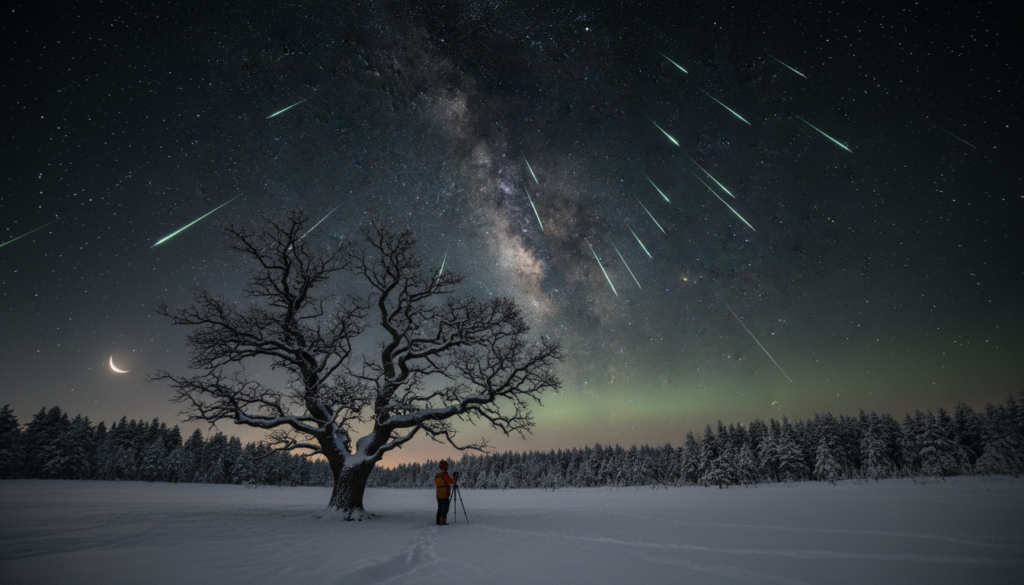
The Final Celestial Spectacle of 2024: A Comprehensive Guide to the Solstice Ursid Meteor Shower
Brainx Perspective
At Brainx, we believe the convergence of the 2024 Winter Solstice with a moonless Ursid meteor shower offers more than just a scientific curiosity; it presents a rare moment of cosmic clarity. While the Geminids often steal the spotlight with volume, the Ursids offer quality and solitude. This development highlights a perfect alignment of astronomical conditions, reminding us that even in the darkest, coldest nights of the year, the universe remains active, vibrant, and profoundly beautiful.
The News: The 2024 Ursid Meteor Shower
As 2024 concludes, the Northern Hemisphere prepares for a unique astronomical “double feature.” The annual Ursid meteor shower is set to peak in perfect synchronization with the winter solstice, offering stargazers a final, dazzling display before the new year. Unlike previous years where moonlight obscured the view, the 2024 event promises “profound darkness,” creating the ideal canvas for observing cometary debris interacting with Earth’s atmosphere.
Below is a detailed breakdown of the event, the science behind it, and the strategies required to witness it.
1. The Perfect Timing: Solstice and Lunar Alignment
The timing of this year’s shower is historically significant for observers. The peak activity is forecasted for the late-night hours of December 21 through the pre-dawn hours of December 22.
- The Solstice Connection: The shower peaks exactly when the Northern Hemisphere is tilted furthest from the sun (Winter Solstice occurs at 10:03 a.m. EST on Dec 21). This provides the longest night of the year—up to 15 hours of darkness in northern latitudes—maximizing the viewing window.
- The “New Moon” Advantage: Perhaps the most critical factor for 2024 is the lunar phase. A New Moon occurs on December 19. By the peak night, the moon will be a thin, 2% illuminated crescent that sets early in the evening. This absence of “natural light pollution” means the sky will be pitch black, allowing even the fainter meteors (which are usually washed out) to be visible to the naked eye.
2. The Science of the “Little Bear”
To understand what you are seeing, you must understand the mechanics of the solar system. Meteor showers are essentially Earth passing through a dusty trail left by a comet.
- Parent Body: The Ursids originate from debris shed by Comet 8P/Tuttle. This comet orbits the sun every 13.5 years.
- Debris Mechanics: As Comet Tuttle approaches the sun, heat causes it to sublimate (turn from ice to gas), releasing dust and rocky grit. When Earth intersects this stream, particles hit our atmosphere at roughly 20 miles per second (33 km/s).
- Ablation: The friction with the atmosphere causes these particles—most no larger than a grain of sand—to vaporize. This process, called ablation, creates the ionization trails we see as streaks of light.
- The Radiant Point: Perspective makes the meteors appear to radiate from the constellation Ursa Minor (The Little Bear), specifically near the star Kochab. Because Ursa Minor is “circumpolar” (it never sets) for northern observers, the shower is technically visible all night long.
3. What to Expect: Rates and Visibility
The Ursids are classified as a “minor” shower, but they are known for their reliability and potential for surprises.
- Standard Rates: Under ideal conditions, observers can expect 5 to 10 meteors per hour.
- Historical Outbursts: The Ursids are scientifically unpredictable. The stream of debris is often clumpy. In the past (notably 1945 and 1986), the shower has “outbursted” to nearly 100 meteors per hour. While no outburst is guaranteed for 2024, the dark skies make it the best year to watch for unexpected activity.
- Geographic Exclusivity: This is strictly a Northern Hemisphere event. The radiant point is too far north for observers in the Southern Hemisphere (Africa, Australia, South America) to see significant activity.
4. The Art of Observation: A Strategic Guide
Observing a meteor shower in deep winter is an extreme sport for amateur astronomers. Success requires preparation against the elements and light pollution.
Key Observation Protocols:
- Escape Light Pollution: Urban lights are the enemy. Drive 30–50 miles away from city centers. Look for “Dark Sky Parks” or areas with a clear northern horizon.
- The 30-Minute Rule: Your eyes require 20 to 30 minutes to chemically adapt to the dark (a process involving the regeneration of rhodopsin). Avoid looking at smartphones or white flashlights, as blue light instantly resets your night vision. Use red-filtered lights only.
- Scanning Technique: Do not stare directly at the radiant (Ursa Minor). Meteors closer to the radiant have short trails. Look about 45 degrees away from the North Star to see longer, more dramatic streaks.
5. Winter Survival for Stargazers
Since the best viewing occurs between 1:00 AM and 5:00 AM, temperatures will be at their daily minimum. Hypothermia is a genuine risk for stationary observers.
- Layering System: Wear a moisture-wicking base layer, a heavy insulating middle layer (wool/fleece), and a windproof shell.
- Extremities: 40% of body heat can be lost through the head; wear a heavy beanie. Use chemical hand and toe warmers.
- Equipment: Do not stand. Use a reclining lawn chair to save your neck. Place a sleeping bag or foam pad under you on the chair to insulate your back from the cold ground/air.
6. Astrophotography: Capturing the Ursids
The Ursids are an excellent target for photographers because the shower is less chaotic than the Geminids, allowing for better composition planning.
Technical Setup:
- Camera: DSLR or Mirrorless with manual mode capability.
- Lens: Wide-angle (14mm to 24mm) with a wide aperture (f/2.8 or lower).
- Settings: High ISO (1600–3200) and long exposure (15–25 seconds).
- The “500 Rule”: To prevent stars from trailing due to Earth’s rotation, divide 500 by your lens focal length. (e.g., 500 / 20mm = 25 seconds max exposure).
- Focus: Set to Manual Focus and adjust to “Infinity.” Use the Live View screen to zoom in on a bright star and ensure it is a sharp pinprick of light.
7. Citizen Science: Contributing to Data
You can be more than a spectator. The International Meteor Organization (IMO) and American Meteor Society (AMS) rely on “citizen scientists” to refine their models of Comet 8P/Tuttle’s debris stream.
- What to Report: Log the time, magnitude (brightness), color, and duration of the meteors you see.
- Fireballs: If you see a meteor brighter than Venus (potentially casting a shadow), report it immediately. These reports help scientists track larger debris that may survive atmospheric entry.
Why It Matters
This event transcends simple stargazing; it is a grounding exercise in cosmic perspective. In an era dominated by digital noise and artificial light, the 2024 Ursids offer a rare opportunity to reconnect with the natural universe. For the common man, it serves as a reminder of the Earth’s dynamic journey through the solar system. Watching ancient comet dust burn up in the atmosphere during the longest night of the year symbolizes the cycle of renewal—a poetic and powerful conclusion to 2024.


Leave a Reply