US military strikes Islamic State group targets in Syria, officials say
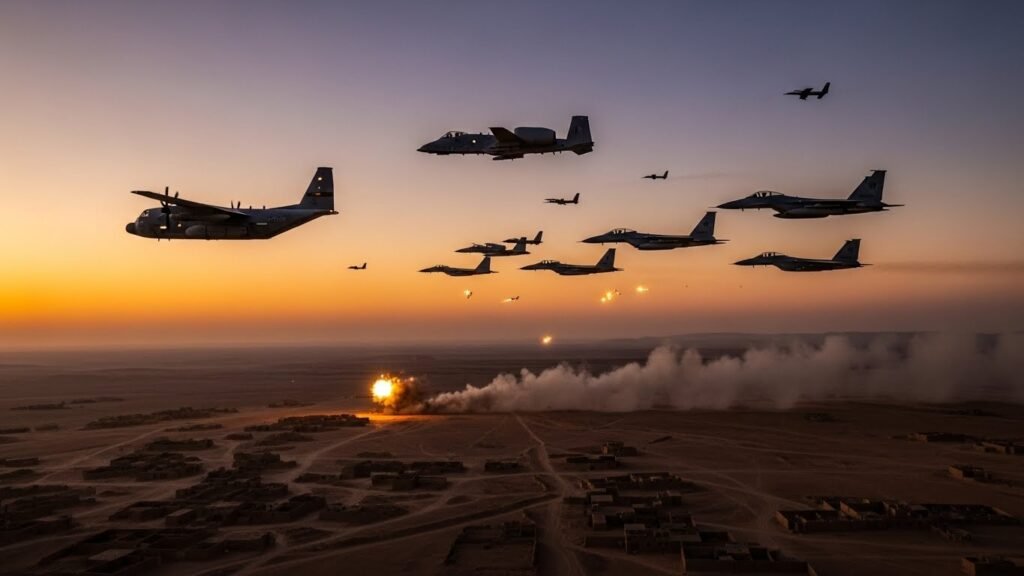
Operation Hawkeye Strike: US and Jordan Unleash Massive “Vengeance” Blitz on ISIS in Post-Assad Syria
2. Brainx Perspective
At Brainx, we believe “Operation Hawkeye Strike” represents a definitive shift in American military doctrine under the Trump administration—moving from containment to punitive annihilation. This massive aerial campaign highlights a new reality: while the Syrian civil war may have officially ended with Assad’s fall, the war on terror has evolved into a high-stakes hunt where “vengeance” is now stated policy, and the skies over Syria remain as volatile as ever.
3. The News
In a dramatic escalation of hostilities in the Middle East, the United States, in coordination with partner forces, has executed a large-scale aerial offensive against Islamic State (IS) targets in central Syria. The operation, explicitly directed by President Donald Trump, marks the latest and most ferocious phase of “Operation Hawkeye Strike.”
According to US Central Command (Centcom), the strikes were a direct retaliation for a deadly ambush earlier in December that claimed the lives of American personnel. The message from the Pentagon is clear: the United States is no longer just “degrading” the enemy; it is hunting them down.
The Saturday Blitz: “We Will Find You”
On Saturday, the skies over central Syria were filled with a coalition of airpower rarely seen in recent years. Centcom confirmed that the operation was designed to combat terrorism and protect US and partner forces in the volatile region.
Key Operational Details:
- The Directive: The strikes were personally ordered by President Donald Trump as a continuation of his administration’s aggressive stance against threats to US troops.
- The Scale: A coalition fleet of over 20 aircraft unleashed more than 90 precision-guided munitions.
- The Targets: The barrage struck more than 35 specific IS targets, dismantling infrastructure, weapons depots, and hideouts.
- The Warning: Centcom issued a chilling statement on social media platform X: “Our message remains strong: if you harm our warfighters, we will find you and kill you anywhere in the world, no matter how hard you try to evade justice.”
The Arsenal of Retaliation
A US official speaking to CBS News provided a detailed look at the impressive array of hardware deployed for this mission. The mix of aircraft suggests a tactical approach designed to obliterate ground targets while maintaining total air superiority.
- AC-130J Ghostriders: Heavily armed ground-attack gunships capable of unleashing withering fire on concentrated enemy positions.
- A-10 Thunderbolt IIs (“Warthogs”): legendary close-air support jets designed to destroy tanks and fortified bunkers.
- F-15E Strike Eagles: Dual-role fighters capable of high-speed precision bombing.
- MQ-9 Reapers: Unmanned drones used for surveillance and surgical strikes.
- Jordanian F-16s: Crucially, the operation involved Jordanian Air Force fighters, underscoring the regional commitment to eradicating the IS resurgence.
Context: The “Declaration of Vengeance”
To understand the ferocity of Saturday’s strikes, one must look at the catalyst. Operation Hawkeye Strike was launched in response to a tragic incident on December 13, when an IS gunman ambushed US forces in Palmyra, central Syria.
- The Casualties: The ambush resulted in the deaths of two US soldiers and a US civilian interpreter.
- The Doctrine: Following the attack, Defense Secretary Pete Hegseth did not mince words, framing the US response not as a standard military operation, but as a punitive campaign. “This is not the beginning of a war – it is a declaration of vengeance,” Hegseth stated. “The United States of America, under President Trump’s leadership, will never hesitate and never relent to defend our people.”
- Ongoing Pressure: Saturday’s mission was not an isolated event. Between December 20 and December 29, US forces conducted 11 separate missions, killing or capturing nearly 25 IS operatives. An earlier massive strike on December 19 involved striking over 70 targets with 100 munitions.
The Geopolitical Landscape: Syria in 2026
This military activity takes place against a backdrop of profound political change in Syria. The region remains fragile following the historic collapse of Bashar al-Assad’s regime in December 2024, which ended 13 years of brutal civil war.
- New Leadership: The country is currently led by Ahmed al-Sharaa (formerly known as Abu Mohammed al-Jolani), whose rebel coalition ousted Assad and is attempting to solidify control.
- The Vacuum: Despite the change in government, security vacuums persist. The Islamic State, though territorially defeated years ago, has exploited the transition period to regroup in the central deserts, launching sporadic attacks against Kurdish-led forces and now, American troops.
4. “Why It Matters”
This operation matters because it establishes a new “red line” for US engagement in the Middle East. It proves that despite political shifts in Damascus, Washington remains the ultimate arbiter of security in the region. For the common man, it signals that the specter of ISIS is far from exorcised, and the US military machine is shifting into a higher, more violent gear to ensure its suppression.
Deep Dive: The Strategic Anatomy of “Operation Hawkeye Strike”
(Detailed Analysis for context)
1. The Return of the “Warthog” and the Gunship The specific inclusion of A-10 Warthogs and AC-130J Ghostriders is significant. These are not high-altitude bombers; they are low-and-slow platforms designed for psychological terror and total ground suppression. Using such assets implies that US intelligence had pinpointed large concentrations of IS fighters in open or semi-fortified areas where sustained fire was needed, rather than just dropping a bomb and leaving. It signals a desire to completely erase the target area.
2. The Jordanian Connection The involvement of Jordanian F-16s is a critical geopolitical maneuver. It provides the US with regional legitimacy, framing the operation not as “Western imperialism” but as a coalition effort against a mutual threat. Jordan, sharing a border with Syria, has a vested interest in preventing IS from regaining a foothold that could spill over its borders.
3. The Definition of “Vengeance” In military diplomacy, words matter. Secretary Hegseth’s use of the word “vengeance” marks a departure from standard NATO-style language of “deterrence” or “degradation.” It suggests a more personal, visceral policy under the Trump administration—one that prioritizes retribution as a primary form of deterrence. The logic is simple: make the cost of killing an American so disproportionately high that the enemy cannot sustain the price.
4. The Challenge for Ahmed al-Sharaa For Syria’s new president, Ahmed al-Sharaa, these strikes are a double-edged sword. On one hand, the US is destroying his enemies (IS). On the other, the US is conducting massive military operations inside his sovereign territory with impunity. This highlights the fragility of the new Syrian state; it cannot yet police its own borders or internal threats, leaving it reliant on—or at the mercy of—foreign airpower.
5. The Future of the Mission With “Operation Hawkeye Strike” in full swing, we can expect a sustained period of high-tempo operations. The US has signaled it will “never relent,” suggesting that this air campaign will continue until intelligence assessments show that the specific IS cell responsible for the Palmyra ambush has been completely liquidated. The risk, however, remains “mission creep”—where a retaliatory campaign evolves into a long-term occupation role that the US administration had previously vowed to avoid.
As the dust settles in central Syria, the world watches to see if this “vengeance” brings silence to the desert, or merely fans the flames of a new insurgency.



Leave a Reply