Eight People Killed After B-52 Bomber Crash at California Air Force Base
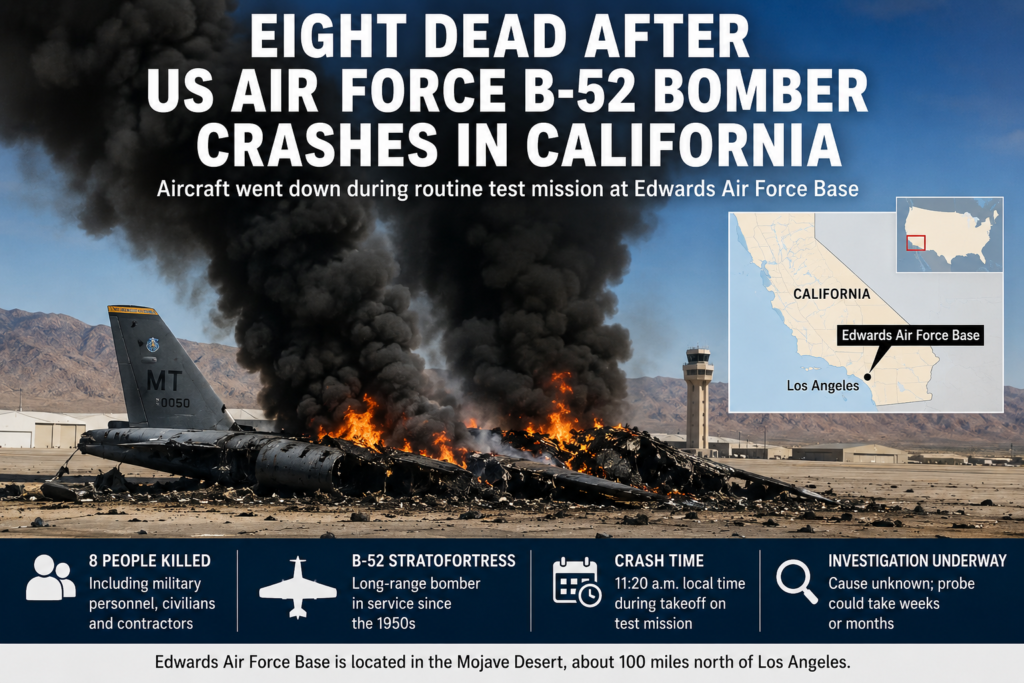
A tragic aviation accident at Edwards Air Force Base in California has claimed the lives of eight people after a U.S. Air Force B-52 Stratofortress aircraft crashed shortly after takeoff during what officials described as a routine test mission.
The incident occurred on Monday morning at approximately 11:20 a.m. local time. The aircraft had just departed from Edwards Air Force Base when it crashed within the installation’s boundaries, producing a large plume of smoke visible from miles away.
Military officials later confirmed that all eight individuals onboard the aircraft lost their lives. The victims included military personnel, government civilians, and contractors supporting the mission. Boeing also confirmed that two of its employees were among those onboard.
The accident has prompted a major investigation and renewed attention to aviation safety, military testing operations, and the continued service of one of the world’s most recognizable military aircraft.
A Devastating Day at Edwards Air Force Base
Speaking during a press briefing following the incident, Colonel James Hayes described the crash as a heartbreaking tragedy for the Air Force community.
According to officials, emergency response teams were dispatched immediately after the crash occurred. Firefighters, medical personnel, security forces, and specialized recovery teams quickly secured the area and began emergency operations.
Despite the rapid response, early assessments indicated that the crash was catastrophic. Officials later confirmed there were no survivors.
The identities of the victims have not yet been publicly released as authorities continue the process of notifying family members and loved ones.
Military leaders emphasized that supporting the families affected by the tragedy remains their highest priority.
The loss has deeply impacted personnel stationed at Edwards Air Force Base, where many service members, civilian employees, and contractors work closely together on aviation and testing programs.
What Happened?
At this stage, officials have released only limited information regarding the sequence of events leading up to the crash.
The aircraft was participating in a routine test mission connected to programs operating at Edwards Air Force Base. Shortly after becoming airborne, the B-52 reportedly experienced difficulties and crashed within the base perimeter.
Investigators have not yet determined whether mechanical failure, environmental conditions, human factors, or another issue contributed to the accident.
Military officials stressed that it would be inappropriate to speculate before the investigation is complete.
Aviation accident investigations are highly detailed and often require months of analysis before a final report is issued.
Experts will examine flight records, aircraft maintenance history, communications data, operational procedures, and physical evidence recovered from the crash site.
Investigation Begins
The U.S. Air Force has launched a comprehensive investigation to determine the cause of the accident.
Investigative teams will include aviation specialists, engineers, safety experts, maintenance personnel, and operational analysts.
Their goal is to establish a complete understanding of what occurred before, during, and after the flight.
The investigation will likely focus on several key questions:
- Was the aircraft functioning normally before takeoff?
- Did the crew report any technical issues?
- Were weather conditions a factor?
- Did any mechanical components fail?
- Were there operational challenges during the mission?
Military officials noted that a preliminary review may take several weeks, while a complete investigation could take several months.
Such investigations are designed not only to identify the cause of an accident but also to improve safety procedures and prevent future incidents.
Boeing Confirms Employee Losses
Boeing, the manufacturer of the B-52 Stratofortress, confirmed that two company employees were onboard the aircraft at the time of the crash.
In a statement, the aerospace company expressed condolences to the families affected by the tragedy and stated that it is cooperating fully with investigators.
The company did not provide details regarding the specific roles of the employees involved.
The loss represents a significant moment for Boeing, which has maintained a relationship with the B-52 program for decades through upgrades, modernization projects, and technical support initiatives.
Industry observers noted that Boeing personnel often participate in testing and evaluation activities associated with aircraft modernization programs.
Community Response
News of the crash quickly spread across California and throughout the military community.
Public officials, military leaders, and community members expressed condolences to the victims’ families.
California Governor Gavin Newsom described the incident as a tragic event and offered support to those affected.
Several members of Congress also issued statements honoring the individuals who lost their lives and thanking first responders for their efforts.
Messages of support appeared across social media platforms from veterans, military families, aviation enthusiasts, and community organizations.
For many people connected to Edwards Air Force Base, the accident serves as a reminder of the risks associated with military aviation and flight testing operations.
The Legacy of the B-52 Stratofortress
The aircraft involved in the accident was a B-52 Stratofortress, one of the most recognizable military aircraft ever built.
Originally introduced during the 1950s, the B-52 has remained in service for more than seven decades.
Few aircraft in aviation history have demonstrated such longevity.
The bomber was designed during the early years of the Cold War and became a key component of America’s strategic defense capabilities.
Over time, the aircraft has undergone numerous upgrades and modernization efforts, allowing it to remain operational despite its age.
Today, the B-52 continues to perform a variety of missions including long-range operations, strategic deterrence, surveillance support, and military exercises.
Military planners have repeatedly emphasized the aircraft’s flexibility and reliability, which have helped extend its service life far beyond what many originally expected.
Why the B-52 Remains Important
Despite being one of the oldest aircraft still operating in active military service, the B-52 continues to play an important role in national defense.
Its ability to travel long distances, carry substantial payloads, and operate in diverse environments makes it a valuable asset.
Modernization programs have introduced updated electronics, communication systems, navigation technologies, and operational enhancements.
The Air Force has invested significantly in extending the aircraft’s lifespan, with some projections suggesting the platform could remain operational for decades to come.
This continued investment reflects confidence in the aircraft’s capabilities and strategic value.
However, incidents such as this crash also highlight the importance of ongoing maintenance, safety oversight, and technological upgrades.
Edwards Air Force Base: A Historic Aviation Center
The crash occurred at Edwards Air Force Base, one of the most important aviation testing facilities in the United States.
Located in California’s Mojave Desert, approximately 100 miles north of Los Angeles, the base has played a central role in aerospace innovation for generations.
Many historic aircraft have been tested at Edwards, including experimental planes, military jets, and advanced aerospace technologies.
The base is widely recognized for its contributions to aviation research, flight testing, and aerospace development.
Because of its large testing areas and favorable weather conditions, Edwards has long served as a critical location for evaluating new aircraft and systems.
The installation supports military operations, scientific research, and partnerships with aerospace companies.
Risks of Flight Testing
While aviation technology has become increasingly sophisticated, flight testing remains a complex and inherently challenging activity.
Testing missions often involve evaluating systems, equipment, procedures, and operational performance under controlled conditions.
These missions play an essential role in improving aircraft safety and effectiveness.
However, aviation experts note that testing environments can present unique challenges that require extensive preparation and oversight.
Military organizations around the world invest heavily in training, maintenance, engineering support, and safety programs to minimize risks.
When accidents occur, investigations often lead to valuable lessons that improve future operations and strengthen safety standards across the aviation industry.
Impact on Operations
Following the accident, Edwards Air Force Base temporarily adjusted its operations to focus on emergency response and investigative activities.
Officials stated that certain flight activities were paused while recovery efforts continued.
Inbound aircraft were redirected as emergency teams worked within the affected area.
Military leaders emphasized that safety remains the top priority and that operational decisions will be guided by findings from the investigation.
The Air Force routinely reviews procedures after major incidents to ensure that appropriate safety measures remain in place.
Supporting the Families
Beyond the technical investigation, significant attention is being devoted to supporting the families of those who died.
Military support programs provide assistance to families dealing with the loss of loved ones in service-related incidents.
Counseling services, family support resources, and community assistance programs are often activated following major tragedies.
Officials stated that family members would continue receiving support throughout the investigation process.
The Air Force community has a long tradition of honoring those who serve and ensuring that families are not left to face difficult circumstances alone.
Looking Forward
As investigators work to determine the cause of the crash, many questions remain unanswered.
The coming months will likely provide greater insight into the events that led to the accident and whether changes are needed to improve future safety procedures.
For now, the focus remains on remembering the eight individuals who lost their lives and supporting the families, colleagues, and communities affected by the tragedy.
The accident serves as a sobering reminder of the dedication and risks involved in military aviation operations. It also highlights the importance of thorough investigations, continuous safety improvements, and ongoing support for those who serve in aviation and aerospace programs.
While the investigation may take time, its findings will play a critical role in helping military leaders, engineers, and aviation experts strengthen safety measures and reduce the likelihood of similar incidents in the future.
For Edwards Air Force Base, the U.S. Air Force, Boeing, and the families involved, the tragedy marks a difficult chapter. Yet it also reinforces the aviation community’s commitment to learning from every incident and striving for safer skies in the years ahead.
Leave a Reply