Trump Signals Future India Visit as US-India Relations Enter a New Phase
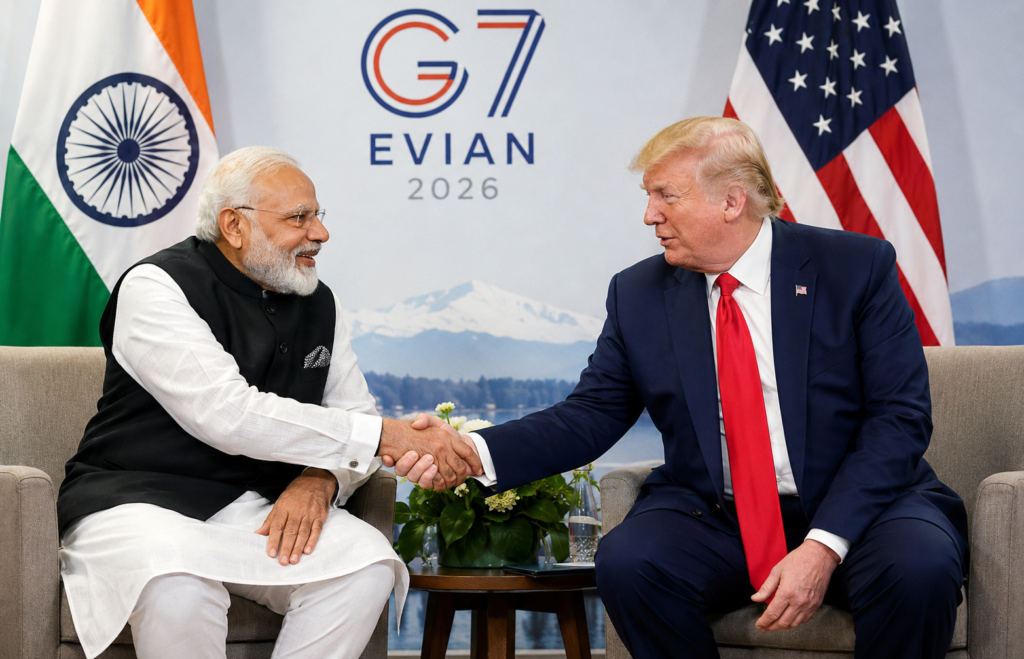
Relations between the United States and India appear to be entering a more positive chapter after US President Donald Trump indicated that he plans to visit India in the future. The announcement came during a bilateral meeting with Indian Prime Minister Narendra Modi on the sidelines of the G7 Summit in France, where the two leaders discussed trade, security, energy, and broader strategic cooperation.
The meeting attracted international attention because it represented the first scheduled face-to-face interaction between the two leaders since Modi’s visit to Washington in 2025. While the relationship between the two countries has experienced moments of disagreement over the past year, the latest discussions suggest that both sides are committed to strengthening ties and expanding cooperation across multiple sectors.
A Positive Message from the G7 Summit
Speaking to reporters after the meeting, President Trump expressed optimism about the future of US-India relations. He praised Prime Minister Modi’s negotiating skills and suggested that he would travel to India at a later date.
Although no official timeline was announced, Trump’s comments were widely interpreted as a sign of improving diplomatic relations. A future presidential visit would provide an opportunity for both countries to advance discussions on trade, investment, technology, defense cooperation, and regional stability.
The G7 Summit provided an important setting for the two leaders to engage in direct dialogue. As global economic and security challenges continue to evolve, cooperation between major democracies remains an important part of international diplomacy.
Trade Talks Continue to Move Forward
One of the most important topics discussed during the meeting was trade. The United States and India have been engaged in negotiations aimed at expanding economic cooperation and resolving outstanding trade issues.
Trade between the two countries has grown significantly over the past decade. The United States is one of India’s largest trading partners, while India represents an increasingly important market for American goods, services, and investments.
Officials from both countries have been working to finalize a broader trade framework that could strengthen commercial ties and create new opportunities for businesses. According to recent statements from government representatives, negotiators are focused on addressing remaining issues and finding solutions that benefit both economies.
A successful agreement could encourage greater investment, support job creation, and improve market access for businesses operating in both countries. Economists believe that deeper economic cooperation could contribute to long-term growth and stability.
While challenges remain, the positive tone of the recent discussions suggests that both governments are interested in reaching a mutually beneficial outcome.
Energy Security Remains a Key Concern
Another major subject discussed during the meeting was energy security. This issue has become increasingly important as global markets continue to experience uncertainty caused by geopolitical tensions and disruptions in international trade routes.
India is one of the world’s largest energy consumers and relies heavily on imported oil and natural gas. Any disruption to global supply chains can have a significant impact on energy prices and economic activity.
Leaders discussed the importance of maintaining stable energy supplies and ensuring the uninterrupted flow of international trade. Secure shipping routes play a critical role in transporting energy resources across the world, making maritime security an important priority for many nations.
Experts note that stable energy markets are essential not only for economic growth but also for inflation control and industrial development. Continued cooperation between major economies can help support global energy stability and reduce uncertainty for businesses and consumers.
Focus on Maritime Safety
The safety of civilian maritime workers was also an important topic during the discussions. Recent incidents involving commercial vessels operating in international waters have highlighted the risks faced by sailors working in some of the world’s busiest shipping corridors.
Prime Minister Modi emphasized the importance of protecting civilian maritime personnel and ensuring that international shipping routes remain safe and secure. Maritime workers play a critical role in global trade, helping transport goods, energy resources, and essential supplies across continents.
The discussion reflected broader international concerns about maintaining freedom of navigation and reducing risks to commercial shipping operations. As global trade continues to depend heavily on maritime transportation, the safety of crews and vessels remains a priority for governments around the world.
A Strategic Partnership with Global Importance
The United States and India share one of the most significant strategic partnerships in the world today. As two major democracies with large economies and growing technological capabilities, both countries play important roles in shaping global developments.
Over the years, cooperation between Washington and New Delhi has expanded beyond trade to include defense, technology, education, healthcare, climate initiatives, and scientific research.
The relationship has become particularly important in the Indo-Pacific region, where both countries support economic development, regional stability, and international cooperation.
Analysts often describe the US-India partnership as one of the most important bilateral relationships of the 21st century. Continued engagement between the two governments is expected to influence economic and security developments across Asia and beyond.
Defense and Security Cooperation
Defense cooperation remains a major pillar of the relationship. Over the past decade, the United States and India have increased military cooperation through joint exercises, technology sharing, training programs, and defense agreements.
The two countries regularly participate in military exercises designed to improve coordination and interoperability. These activities help strengthen mutual understanding and contribute to regional security efforts.
Security cooperation also extends to areas such as cybersecurity, counterterrorism, intelligence sharing, and disaster response. As new security challenges emerge, continued collaboration is expected to remain an important aspect of the partnership.
During the recent discussions, both leaders reaffirmed the value of maintaining strong communication and cooperation on security-related issues.
Technology and Innovation Driving Future Growth
Technology is becoming an increasingly important component of US-India relations. Both countries are home to thriving innovation ecosystems and rapidly growing technology sectors.
American and Indian companies collaborate in areas such as artificial intelligence, cloud computing, semiconductor manufacturing, biotechnology, telecommunications, and digital services.
India’s expanding digital economy and large talent pool have attracted significant international investment. At the same time, American technology companies continue to view India as a major growth market.
Experts believe that future cooperation in advanced technologies could generate substantial economic benefits while helping both countries remain competitive in a rapidly changing global economy.
Joint initiatives in research, development, and innovation may become even more important in the years ahead.
Educational and Cultural Connections
Beyond government relations, people-to-people ties continue to strengthen the partnership between the two nations.
Thousands of Indian students pursue higher education in the United States each year, contributing to academic research, innovation, and cultural exchange. Many graduates go on to become entrepreneurs, scientists, engineers, and business leaders.
Indian-American communities have also played a significant role in building stronger cultural and economic connections between the two countries. Their contributions have helped promote collaboration across industries ranging from technology and healthcare to finance and education.
These human connections create a strong foundation that supports long-term cooperation and mutual understanding.
Looking Ahead
The meeting between President Trump and Prime Minister Modi has generated optimism about the future direction of US-India relations. While differences may still exist on certain issues, both leaders emphasized dialogue, cooperation, and shared interests.
Trade negotiations are expected to continue in the coming weeks, with officials working toward finalizing agreements that could strengthen economic ties. Discussions on energy security, technology, defense cooperation, and regional stability are also likely to remain high priorities.
A future visit by President Trump to India would provide another opportunity for both governments to advance their partnership and demonstrate their commitment to cooperation.
As the global landscape continues to evolve, strong relationships between major economies will remain essential for promoting growth, innovation, and stability. The latest meeting between the two leaders suggests that Washington and New Delhi are seeking to build on their existing partnership and create new opportunities for collaboration.
For businesses, investors, and policymakers around the world, the future of US-India relations will be an important story to watch. The decisions made by both countries could have far-reaching implications for trade, technology, energy, and international cooperation in the years ahead.
With negotiations ongoing and diplomatic engagement continuing, the relationship appears poised to enter a new phase characterized by closer dialogue, shared priorities, and a renewed focus on partnership.
Leave a Reply