US pursuing third oil tanker linked to Venezuela, official says
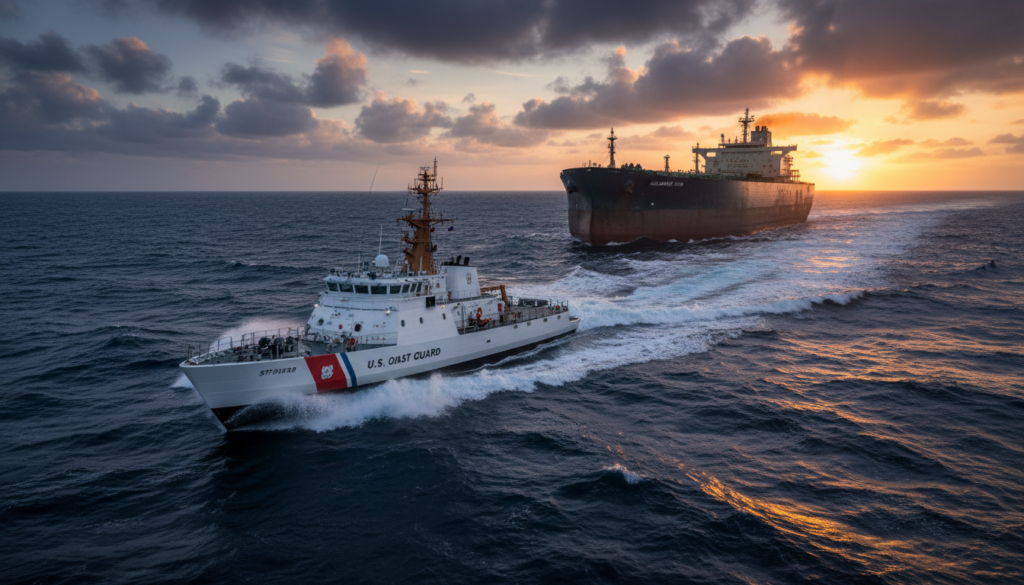
High Seas Manhunt: US Intensifies Crackdown on Venezuela’s “Dark Fleet”
Brainx Perspective
At Brainx, we believe this escalation on the high seas represents more than just a maritime dispute; it signals a pivotal shift in how economic sanctions are enforced globally. This aggressive strategy against the “Dark Fleet” underscores a new era where economic warfare transitions into physical interdiction, fundamentally reshaping the geopolitical landscape of the Western Hemisphere and setting a volatile precedent for international maritime law.
The News: Escalation in the Atlantic
The Atlantic Ocean has transformed into a high-stakes geopolitical theater. In a move that signals a dramatic hardening of US foreign policy, the United States Coast Guard (USCG) has launched an aggressive campaign against the so-called “Shadow Fleet”—a network of vessels accused of bypassing international sanctions.
The latest flashpoint involves the active pursuit of the supertanker Bella 1 and the seizure of two other vessels, the Skipper and the Centuries. These incidents mark a departure from passive observation to direct intervention, aiming to sever the economic lifelines of the Venezuelan government.
1. The Pursuit of the Bella 1
The conflict reached a fever pitch this weekend with the USCG’s interception attempts of the Bella 1.
- The Vessel: Identified as a Very Large Crude Carrier (VLCC), the Bella 1 is a maritime giant capable of transporting up to 2 million barrels of oil. Intelligence suggests it was en route to Venezuela to load crude oil, a critical resource for the Maduro administration.
- The Connection: The US Treasury had previously sanctioned this vessel for alleged links to Iran’s Islamic Revolutionary Guard Corps (IRGC), suggesting a deepening alliance between Caracas and Tehran.
- The Chase:
- Detection: Distress signals were first noted on December 21, roughly 461km northeast of Antigua and Barbuda.
- Evasion: Ignoring requests to board, the vessel fled toward the deeper Atlantic.
- Tactics: Analysts noted the ship is traveling at a sluggish 10 knots (approx. 11.5 mph). This slow pace may indicate mechanical failure or a strategic attempt to wait out US forces in international waters.
- Legal Status: US officials claim the ship is flying a “false flag”—claiming registration from a country that has not certified it—rendering it stateless and legally vulnerable to seizure.
2. Anatomy of the “Dark Fleet”
The “Dark” or “Shadow Fleet” refers to an armada of aging tankers operating outside standard regulatory frameworks to move sanctioned oil.
- AIS Spoofing: These vessels frequently disable or manipulate their Automatic Identification System (AIS) transponders to broadcast false locations, making them “ghosts” on maritime radar.
- Flag Hopping: Ships rapidly change their registration to “flags of convenience” (jurisdictions with lax oversight) to confuse authorities.
- Ship-to-Ship (STS) Transfers: To hide the origin of the oil, crude is often transferred between ships in the middle of the ocean, “laundering” the cargo before it reaches buyers.
3. A Systematic Blockade: The Skipper and Centuries
The pursuit of the Bella 1 follows two other major seizures, indicating a systematic “blockade” strategy.
- The Skipper (Seized Dec 10): Identified by US Attorney General Pam Bondi as a key conduit between Venezuela and Iran. This route is vital for a barter system where Venezuelan heavy crude is swapped for Iranian condensate—essential for diluting Venezuela’s thick oil. The vessel is now in Galveston, Texas, for judicial processing.
- The Centuries: A controversial seizure justified by the White House through its cargo’s link to PDVSA (Venezuela’s state-run oil company). This action suggests a total maritime embargo, where any vessel carrying Venezuelan state oil is a target, regardless of its prior sanctions status.
4. The Geopolitical Divide
- The US Stance: The administration has designated the Maduro government a Foreign Terrorist Organization (FTO). By framing the oil trade as financing for “narcoterrorism,” the US legally categorizes these seizures as national security operations, akin to interdicting drug cartels.
- The Venezuelan & Global Response: President Nicolás Maduro has labeled these acts as “piracy” and illegal aggression against Venezuelan sovereignty. China has also voiced strong opposition, with foreign ministry spokespersons defending Venezuela’s right to independent trade and condemning unilateral US sanctions.
Why It Matters
This development has profound implications for the global energy market and the common man. By removing “Shadow Fleet” supply, the US is effectively tightening the availability of heavy crude, which could spike insurance premiums for shippers and ripple into higher global energy costs. Furthermore, it establishes a precarious diplomatic reality where high-seas interdictions become the new norm, increasing the risk of accidental military conflict in the Caribbean.
Leave a Reply