Historic East Coast Blizzard Paralyzes US: 5,600+ Flights Grounded as Rhode Island Shatters 1978 Snow Record
Brainx Perspective
At Brainx, we believe this historic snowstorm highlights the severe vulnerability of modern infrastructure to extreme weather events. As record-breaking blizzards cripple major aviation hubs and shatter 1978 snowfall records, the immediate paralysis of the US East Coast underscores an urgent need to climate-proof our power grids and transportation networks.
The News
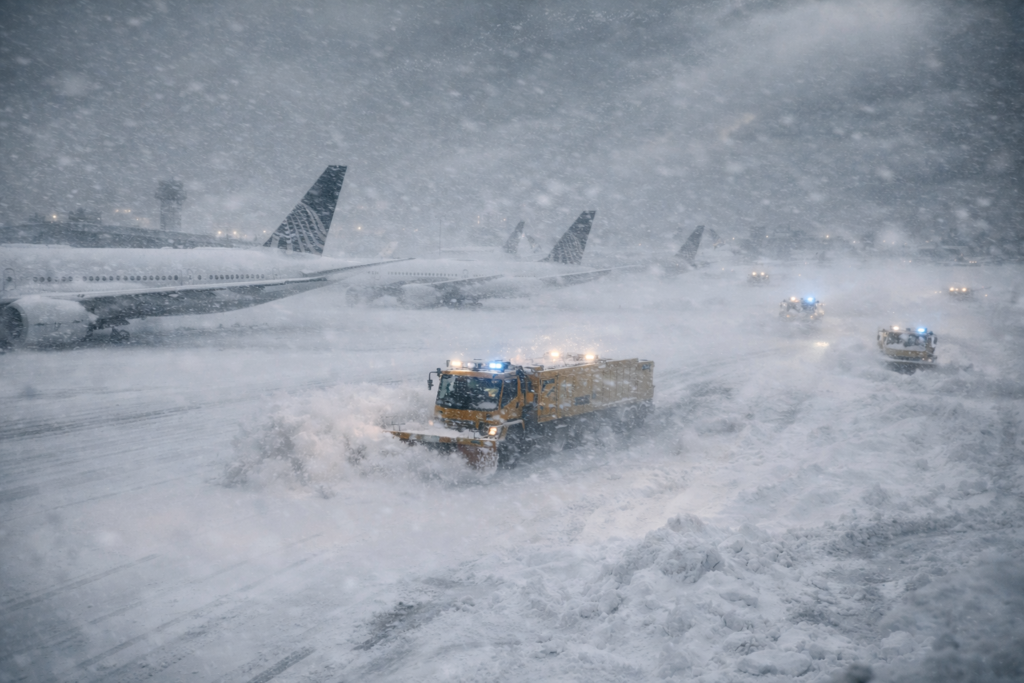
A catastrophic winter storm has battered the United States East Coast, delivering punishing, record-breaking snowfall that has brought millions of lives to an abrupt standstill. From severe aviation grounding to widespread grid failures, the blizzard has triggered a state of emergency across multiple states, transforming bustling metropolitan hubs into paralyzed, snow-covered landscapes.
The National Weather Service (NWS) issued extensive winter storm warnings stretching from North Carolina all the way to northern Maine, with the severe weather system’s impact spilling over into parts of eastern Canada. The relentless snowfall, characterized by perilous whiteout conditions and rapid accumulation, has overwhelmed municipal resources, stranded motorists, and severed power to hundreds of thousands of residents facing freezing temperatures.
Key Facts at a Glance
- Aviation Standstill: More than 5,675 domestic and international flights were abruptly canceled, with New York and Boston airports experiencing near-total shutdowns.
- Historical Snowfall: Providence, Rhode Island, recorded a staggering 33 inches (83cm) of snow, utterly obliterating its previous all-time historical record of 28.6 inches set during the infamous blizzard of February 1978.
- Grid Failure: Over 600,000 homes and commercial businesses along the East Coast suffered sweeping power outages, with New Jersey and Massachusetts bearing the brunt of the electrical grid failures.
- Travel Bans Imposed: Strict bans on non-essential travel were rapidly implemented across Rhode Island, Connecticut, Massachusetts, and temporarily in New York City, as road conditions became fundamentally impassable.
- Urban Impact: Central Park in New York City received an astonishing 19 inches of snow, while Cape Cod (Barnstable County) saw 85% of its utility customers plunged into darkness.
The Aviation Sector: A Total Logistical Collapse
The ripple effects of this monumental winter storm have been most visibly felt in the global and domestic aviation sector. According to the premier flight tracking data site, FlightAware, the sheer volume of disrupted itineraries is staggering. By Monday afternoon, the number of canceled flights within, into, or out of the United States had skyrocketed past the 5,675 mark.
The granular data paints a picture of near-total operational collapse at some of the world’s busiest transit hubs. In New York, where approximately 15 inches (38cm) of snow accumulated on the tarmacs, LaGuardia Airport (LGA) was forced to cancel an unprecedented 98% of all outgoing flights. Its counterpart, John F. Kennedy International Airport (JFK), followed closely behind with a 91% cancellation rate.
The aviation paralysis extended firmly up and down the eastern seaboard. In Massachusetts, Boston’s Logan International Airport cut 92% of its scheduled outbound flights. Similarly, New Jersey’s Newark Liberty International Airport (EWR) saw a 92% cancellation rate, while Philadelphia International Airport was forced to ground 81% of its departures. This level of synchronized cancellation creates a logistical nightmare for airlines, resulting in displaced flight crews, stranded aircraft, and a backlog of hundreds of thousands of passengers that will likely take the better part of a week to fully resolve, causing severe economic ripple effects throughout the hospitality and travel industries.
Shattering Meteorological History: The Rhode Island Phenomenon
While the entire Northeast corridor faced immense challenges, the meteorological epicenter of this extreme weather event appeared to hover directly over America’s smallest state. Rhode Island absorbed a punishing blow that has rewritten the local climate history books.
Providence, the state capital, found itself buried under an astonishing 33 inches (83cm) of snow. This staggering accumulation completely smashed the city’s previous single greatest snowstorm record—a benchmark of 28.6 inches that had stood unchallenged since the legendary blizzard of February 1978.
The sheer volume and intensity of the precipitation caught even seasoned meteorological veterans off guard. “It completely smashed it,” Candice Hrencecin, a respected meteorologist with the National Weather Service in Boston, remarked in a statement to the New York Times regarding the 1978 record. “We were just as shocked as everyone else.”
The persistent nature of the storm meant that conditions continued to deteriorate throughout Monday. The National Weather Service maintained an aggressive forecasting posture, warning that specific vulnerable areas hugging the northeast coastline were fully expected to receive cumulative totals ranging from 1 foot to 2 feet (30cm to 61cm) of snow by the time Tuesday morning arrived, prolonging the crisis for municipal snow removal teams.
The Power Grid Buckles Under Pressure
Beyond the sheer volume of snow, the heavy, wet nature of the precipitation, combined with high winds, proved disastrous for the region’s above-ground electrical infrastructure. Across the affected eastern states, a state agency warned of “near impossible” travel conditions, but for many, the primary concern was staying warm inside their own homes.
More than 600,000 residential homes and commercial businesses endured terrifying power outages at the height of the storm. The electrical infrastructure in New Jersey and Massachusetts was the worst hit by the plunging temperatures and falling debris. In Connecticut and New Jersey, emergency management officials voiced grave, continuous concerns that falling trees, collapsing under the immense weight of the snow, and snapping branches would not only lead to highly dangerous, obstructed road conditions but would trigger rolling, localized blackout events.
The situation in Massachusetts was particularly dire. According to data aggregation site poweroutage.us, nearly 300,000 customers in the state were left without electricity. The blackout disproportionately targeted Barnstable County—a region that encompasses the entirety of Cape Cod—where a staggering 85% of all utility customers found themselves plunged into darkness and freezing conditions, prompting local authorities to scramble to set up emergency warming shelters.
Ground Zero: Travel Bans and Emergency Responses
As whiteout conditions severely limited visibility to near-zero, state and local governments were forced to take draconian measures to keep citizens off the perilous roads. The sheer rate of snowfall rendered standard plowing operations virtually ineffective during the storm’s peak hours.
In response, comprehensive bans on all non-essential travel were swiftly enacted in Rhode Island and its neighboring state, Connecticut. Later in the day, as the storm’s trajectory shifted, Massachusetts Governor Maura Healey imposed a similar, highly restrictive travel ban.
“I’m issuing a travel ban on all non-essential driving in Southeastern Massachusetts — and reducing the speed limit on the Pike to 40mph (25kmh),” Governor Healey announced in a stark online post, referencing the Massachusetts Turnpike, a vital commercial and commuter highway artery. Healey’s messaging was direct and urgent: “Whiteout conditions are making travel extremely dangerous. If you get stuck, help will have a hard time reaching you… I strongly urge everyone to stay off the roads no matter where you live.”
In New York, a heavily enforced travel ban brought the bustling metropolis of over 8 million residents to an eerie, unprecedented standstill. The normally gridlocked streets of Manhattan and the outer boroughs lay quiet under a blanket of white until the ban was officially lifted at noon local time, allowing sanitation crews to begin the monumental task of clearing the urban grid.
The severity of the driving conditions was starkly illustrated in Providence. Initially, city officials attempted to maintain order by penalizing those who hindered snow removal efforts. A city spokesman informed The Providence Journal that municipal authorities had towed more than 300 vehicles for parking in the direct path of industrial snowplows. However, as the afternoon progressed and the sheer volume of snow deepened, the strategy had to change. The conditions became so objectively hazardous that standard tow operations were entirely suspended. Instead, the tow truck operators and emergency personnel were forced to pivot their operations entirely, dedicating their heavy machinery to rescuing desperate drivers whose vehicles had become hopelessly entrenched in the rising snowdrifts.
The Road to Recovery
As the US East Coast begins the arduous process of digging out from under this historic weather anomaly, the focus shifts from immediate survival and emergency response to infrastructural recovery and economic assessment. The record-breaking nature of the snowfall, particularly the shattering of the 1978 Providence record, will undoubtedly fuel ongoing conversations regarding extreme weather preparedness, the resilience of the commercial aviation network, and the urgent necessity of modernizing the electrical grid to withstand the increasingly volatile weather patterns of the 21st century.
Why It Matters
This historic winter storm matters because it exposes the fragility of daily life against extreme weather. For the common man, widespread power outages and paralyzed transit mean lost wages, safety risks, and disrupted supply chains. It serves as a stark warning that future climate resilience requires immediate, substantial infrastructural investment.
Leave a Reply