Alcaraz vs. History: The 11-Year Window to Smash Djokovic’s ‘Impossible’ Double Slam Record
At Brainx, we believe…
This development highlights a statistical anomaly that threatens to rewrite the entire history of tennis. At Brainx, we believe Carlos Alcaraz’s trajectory is not merely impressive; it is unprecedented. The fact that a 22-year-old has an 11-year buffer to break a longevity record set by the greatest players of all time suggests we are witnessing the dawn of an era that could statistically dwarf the “Big Three.” This is not just about winning; it is about redefining the boundaries of precocity in modern sport.
The News: A Decade of Dominance Awaits
As of February 1, 2026, the tennis world is grappling with a statistic that puts the greatness of Carlos Alcaraz into terrifying perspective. Following the conclusion of the Australian Open, data analysis reveals that the Spanish prodigy sits on the verge of a historic milestone that took legends decades to achieve: the Double Career Slam.
While the “Career Slam” (winning all four majors: Australian Open, Roland Garros, Wimbledon, and US Open) is the hallmark of a legend, the “Double Career Slam” (winning each of the four majors at least twice) is the hallmark of immortality. Only two men in the history of the sport have achieved this feat, and they did so in the twilight of their careers.
However, Carlos Alcaraz is positioned to shatter this record with over a decade to spare.
Key Facts and The Timeline:
- The Current Record Holders: Only Rafael Nadal and Novak Djokovic have won every Grand Slam tournament at least twice.
- Novak Djokovic holds the current record for the youngest to achieve this, completing his second set at Roland Garros 2021 at the age of 34.
- Rafael Nadal achieved his double set at the Australian Open 2022 at the age of 35.
- The Alcaraz Anomaly: Carlos Alcaraz, currently 22 years old (in 2026), is positioned to challenge this record.
- The 11-Year Margin: Calculations show that Alcaraz has an 11-year margin to beat Djokovic’s age record.
- The Target: If Alcaraz wins his second Australian Open title at any point before the year 2033, he will become the youngest player in history to secure the Double Career Slam.
- The Immediate Opportunity: Reports suggest Alcaraz could potentially target this historic feat as early as the 2027 Australian Open, at the age of 23—a full 11 years younger than Djokovic was when he achieved the milestone.
Historical Context: The Difficulty of the “Double”
To understand the magnitude of this potential achievement, one must look at the giants who failed to reach it.
- Roger Federer: despite his 20 Grand Slam titles, never achieved the Double Career Slam. While he dominated Wimbledon, the US Open, and the Australian Open, he won Roland Garros only once (2009).
- The “Big Three” Struggle: It took Djokovic and Nadal their entire careers, battling injuries and each other, to round out their trophy cabinets a second time. The fact that Alcaraz is discussing this possibility in his early 20s highlights his unique versatility across all surfaces—grass, clay, and hard court—at a much younger age than his predecessors.
The Versatility Factor
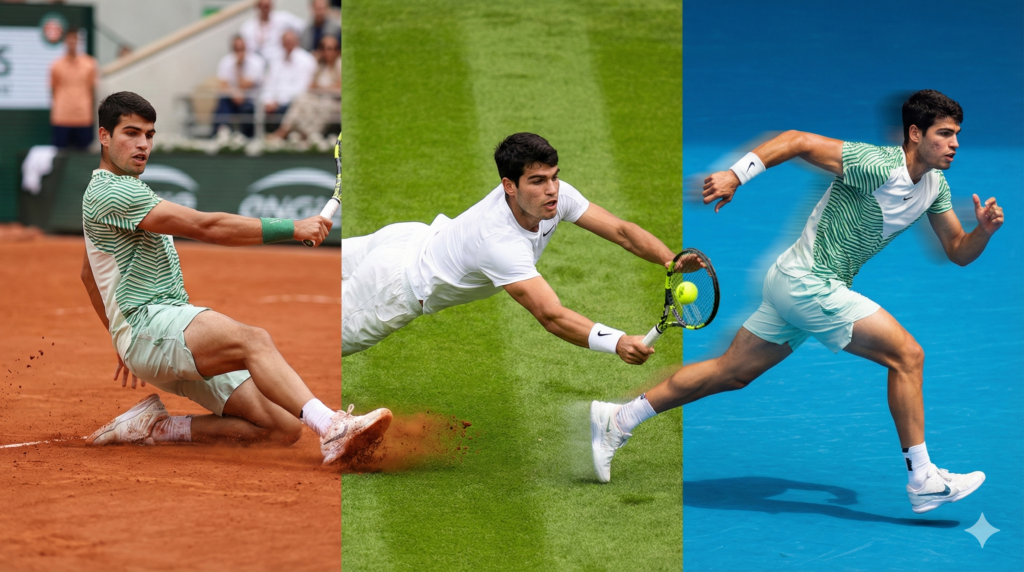
The core reason Alcaraz is in this position is his adaptability. Unlike many Spanish players who historically specialized in clay, or American players who focused on hard courts, Alcaraz has proven to be a “polymath” of tennis surfaces.
- Clay: His natural habitat, where he is already dominant.
- Grass: He conquered Wimbledon early in his career, defeating Djokovic in a passing-of-the-torch moment.
- Hard Court: His US Open success and hard-court prowess make the Australian Open a natural target for his “Double” bid.
The Road to 2033
While the headline is the 11-year margin, the reality is that Alcaraz likely won’t need that long. With the “Big Three” era effectively concluding, Alcaraz faces a field of competitors (like Jannik Sinner and Holger Rune) who are talented but have yet to show the same historical consistency across all surfaces. This power vacuum in the multi-surface dominance category leaves the door wide open for Alcaraz to stockpile majors in Melbourne, Paris, London, and New York.
Why It Matters
This matters because it fundamentally shifts the “GOAT” (Greatest of All Time) debate from a conversation about the past to a projection of the future. For the common tennis fan, witnessing Alcaraz is no longer just about enjoying a match; it is about watching a live assault on the history books. If Alcaraz breaks this record with a decade to spare, he sets a trajectory that could see him surpass the total Grand Slam counts of Nadal and Djokovic, potentially becoming the statistically greatest athlete the sport has ever seen. We are not just watching a star; we are watching a statistical inevitability.




Leave a Reply