Global Flashpoints: Trump’s Make-or-Break State of the Union and Pakistan’s Retaliatory Airstrikes in Afghanistan
Brainx Perspective
This development highlights a world grappling with severe instability on two distinct fronts. In Washington, a highly polarized America awaits a definitive presidential address capable of altering legislative history. Simultaneously, retaliatory military airstrikes across the Afghan border threaten to ignite wider regional conflicts, reshaping international security and domestic economic realities.
The News: A Tale of Two Global Crises
In an unprecedented convergence of global headlines, the world watches two massive geopolitical events unfold. In the United States, President Donald Trump faces a critical inflection point in his second term as he prepares to deliver a high-stakes State of the Union address. Halfway across the globe, tensions in South Asia have exploded into kinetic military action, with Pakistan launching intelligence-based airstrikes deep into Afghan territory targeting militant strongholds.
Here is the comprehensive breakdown of these breaking developments.
Part 1: The Washington Divide – Trump’s Pivotal State of the Union
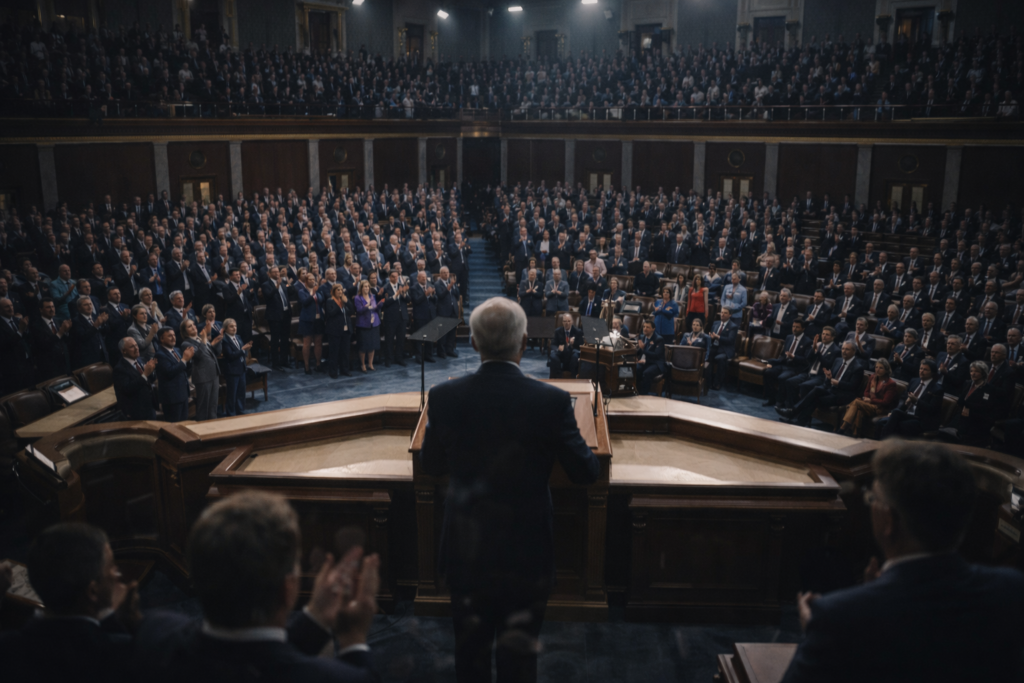
President Donald Trump is set to address a profoundly changed America. Over the past year, his administration has pushed the boundaries of executive power, achieving major domestic and foreign policy shifts that have deeply divided the nation. As he steps up to the podium, the stakes could not be higher.
Key Facts on the US Political Landscape:
- Approval Deficit: Recent polling indicates a souring public mood. A CNN poll shows the President’s approval rating at just 36%, while a Washington Post survey reflects a similarly low 39%.
- The Midterm Threat: In just eight months, American voters will head to the polls for the November midterm elections. The outcome will determine if Republicans maintain their congressional majority or if Democrats seize power—a shift that Trump himself warned could lead to “aggressive oversight” and a renewed push for impeachment.
- Immigration Crackdown: Trump has effectively sealed the US border and surged federal immigration agents into cities like Minneapolis. While popular with his core base, who championed “mass deportations now!” at the 2024 Republican National Convention, these moves have sparked nationwide “No Kings” protests and widespread public backlash.
- Economic and Trade Turmoil: Despite stock indexes hovering near record highs and unemployment remaining low, broader economic growth has fallen below expectations. Furthermore, the US Supreme Court recently ruled that many of the President’s imposed trade duties were illegal. In response, Trump has doubled down, imposing new tariffs that have created intense uncertainty around consumer prices and inflation.
The Rhetorical Strategy According to Robert Rowland, a University of Kansas professor and expert on presidential rhetoric, Trump’s speeches typically focus on boasting about accomplishments and attacking critics. However, Rowland warns that a standard Trump speech may backfire at this “critical moment.”
State of the Union addresses traditionally serve to broaden a president’s appeal and clearly map out a legislative agenda. Yet, much of Trump’s second-term energy has been strictly directed at his political base. Tuesday night represents his final major, unfiltered opportunity to persuade an audience of millions to back his vision before the November elections decide his legislative fate.
“We have a country that’s now doing well, we have the greatest economy we’ve ever had,” Trump stated in a preview of the address, promising a “long speech” to cover his administration’s sweeping maneuvers.
Part 2: South Asian Escalation – Pakistan Strikes Afghanistan
While the US navigates political gridlock, South Asia is witnessing a dangerous military escalation. Pakistan has officially launched “intelligence-based selective targeting” against terrorist camps situated inside Afghanistan, marking a severe deterioration in relations between Islamabad and the Afghan Taliban regime in Kabul.
Key Facts on the Military Escalation:
- The Targets: The Pakistani Ministry of Information and Broadcasting confirmed the airstrikes targeted seven hideouts belonging to the banned Tehreek-i-Taliban Pakistan (TTP)—referred to by Islamabad as “Fitna al Khawarij”—along with affiliates of the Islamic State-Khorasan Province (ISKP).
- The Catalyst: The strikes were described as a direct “retributive response” to a recent wave of devastating suicide bombings inside Pakistan. These included a horrific attack on a Shia mosque in the capital, Islamabad, and multiple deadly assaults in the north-western Khyber Pakhtunkhwa (KP) province coinciding with the start of the holy month of Ramadan.
- The Accusations: Pakistan claims to possess “conclusive evidence” that these attacks were orchestrated by militant leadership sheltered safely within Afghanistan. Islamabad has repeatedly accused the Afghan Taliban of turning a blind eye to—and thereby facilitating—cross-border terrorism.
- The Destruction: Independent reports and footage from AFP confirm the severity of the strikes. Houses and compounds were heavily destroyed in areas such as Balish village in the Urgun district of Afghanistan’s Paktika province, leaving buildings completely collapsed and reduced to rubble.
The Diplomatic and Regional Fallout The Afghan Taliban’s defense ministry reacted furiously, taking to X (formerly Twitter) to condemn the Pakistani airstrikes as a “blatant violation of Afghanistan’s territorial integrity” and a “clear breach of international law.” In a chilling warning, Kabul stated that an “appropriate and measured response will be taken at a suitable time,” mocking the Pakistani military’s intelligence failures regarding domestic security.
This military confrontation shatters the fragile peace that had been tenuously held since last October. During that period, fierce border clashes—the worst since the Taliban retook power in 2021—were only halted by a tentative ceasefire. Just days prior to these new airstrikes, Saudi Arabia successfully mediated the release of three Pakistani soldiers captured by Afghan forces during those October skirmishes.
With Pakistan and Afghanistan sharing a highly porous, mountainous 1,600-mile (2,574 km) border known as the Durand Line, the risk of a prolonged, grueling conflict involving state actors and hardened insurgent groups has never been higher.
Why It Matters
For the common man, these dual crises dictate economic survival and daily physical security. While controversial United States trade policies directly impact global markets and consumer inflation, escalating border conflicts in South Asia threaten wider regional wars. Ultimately, shifting political power and militant insurgencies guarantee citizens face unprecedented global uncertainty.


Leave a Reply