How maths can help you wrap your presents better
1. Catchy Headline
The Science of Wrapping: How Math Can Save Your Paper and Your Sanity This Holiday
2. Brainx Perspective (Intro)
At Brainx, we believe that efficiency shouldn’t stop at the office door; it belongs under the holiday tree, too. This scientific approach to gift wrapping highlights a fascinating intersection of geometry and daily life, proving that a little mathematical precision can transform a chaotic chore into an elegant, waste-free art form.
3. The News (Body)
For many, the festive season brings a familiar dread: the wrapping paper battle. It is a time of messy corners, wasted rolls of paper, and the frustrating realization that you have cut a piece just slightly too short. However, researchers have found that the secret to the perfect present isn’t artistic talent—it is geometry.
By applying simple mathematical formulas, you can eliminate guesswork, significantly reduce waste, and achieve a professional finish that rivals department store wrapping services.
The Problem with Traditional Wrapping
The “eyeball and cut” method is inherently flawed. It relies on estimation, which often leads to two outcomes:
- Excess Waste: Large trimmings that are thrown away or awkwardly folded under, creating bulky, unattractive packages.
- Shortages: Cutting paper that is mere millimeters too short, requiring “patchwork” taping that ruins the aesthetic.
The Mathematical Solution: Sara Santos’s Diagonal Method
Sara Santos, a mathematician at King’s College London, has developed a formula that guarantees a perfect fit for square and rectangular boxes (cuboids). Her method utilizes the geometry of the square and diagonal placement to minimize surface area usage.
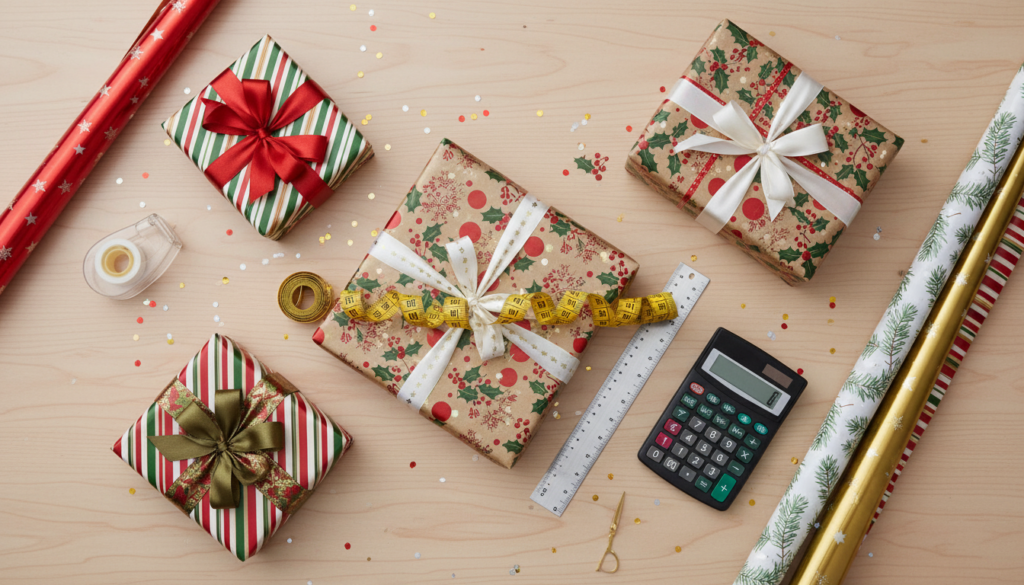
Essential Tools for Precision
To execute this method, you need to treat your wrapping station like a workshop.
- Ruler or Measuring Tape: Precision is key; guessing the inches will break the formula.
- Calculator: For a quick calculation of the paper size.
- Sharp Scissors/Craft Knife: To ensure clean edges that align perfectly.
- Double-Sided Tape: For a seamless, “invisible” finish.
The Golden Formula
To determine the exact size of the square piece of paper needed, you must measure the box first.
- Measure Height ($h$): The vertical height of the box.
- Measure Diagonal ($d$): The distance from one corner to the opposite corner on the largest face of the box.
The formula for the side length of your square paper is:
$$\text{Side Length} = (1.5 \times h) + d$$
Step-by-Step Execution
- Calculate & Cut: Plug your measurements into the formula and cut a perfect square of wrapping paper.
- Rotate the Box: This is the critical step. Do not place the box parallel to the paper edges. Instead, place the box in the exact center of the paper, rotated 45 degrees so it sits diagonally (like a diamond shape relative to the box).
- Fold the Corners: Bring the four corners of the paper up to the center of the box.
- Tuck the Flaps: As you fold, small triangular “tabs” will form at the corners of the box. Tuck these neatly under the main flaps.
- Secure: You will find that you only need three small pieces of tape to secure the entire package—one at the center and one on two seams.
Why The Diagonal Method Wins
- Pattern Alignment: If you are using striped or geometric paper, the diagonal fold often aligns the patterns perfectly at the seams, creating a continuous flow.
- Reduced Bulk: Traditional wrapping creates thick, multi-layered ends. The diagonal method distributes the paper evenly, resulting in a flat, crisp finish.
- Eco-Friendly: By calculating the exact area needed, you reduce paper consumption, saving money and reducing landfill waste.
4. “Why It Matters” (Conclusion)
This method is more than just a party trick; it represents a shift towards sustainable living through logic. By reducing paper waste and eliminating frustration, mathematical wrapping offers a practical way for the common man to save money and the environment, one perfectly wrapped gift at a time.

Leave a Reply