Israel reopens Gaza’s key Rafah border crossing with Egypt
Rafah Reopens: A Fragile “Lifeline” Emerges as Gaza’s Gates Unlock Under Trump’s Ceasefire Plan
At Brainx, we believe…
The reopening of the Rafah crossing is a symbolic breakthrough, but a humanitarian drop in the ocean. This development highlights the stark limitations of the current peace process—where the freedom of movement for millions is capped at a mere 50 people a day. It underscores that while the political deadlock may be loosening under the Trump administration’s pressure, the reality on the ground remains a suffocating bottleneck for the 20,000 wounded awaiting salvation.
The News: A Controlled Opening After Two Years of Silence
For the first time since May 2024, the gates of the Rafah border crossing between Gaza and Egypt have swung open, signaling a critical milestone in the “Second Phase” of President Donald Trump’s ceasefire plan. After months of closure and diplomatic wrangling, Palestinians have begun to cross, though the operation is heavily restricted and strictly monitored.
The Mechanics of the Reopening
- The Numbers: Contrary to the open flow of the past, the crossing is currently operating under a strict quota. Israeli reports confirm that only 50 patients (accompanied by one or two relatives) are permitted to leave Gaza daily. Conversely, 50 Palestinians who were stranded outside during the war are allowed to return each day.
- The Oversight: The crossing is no longer under exclusive Hamas or Israeli physical control. It is now managed by European Union supervisors (EUBAM) alongside local Palestinian staff.
- Remote Security: Israel maintains a “digital eye” on the process, conducting remote security checks on every individual passing through.
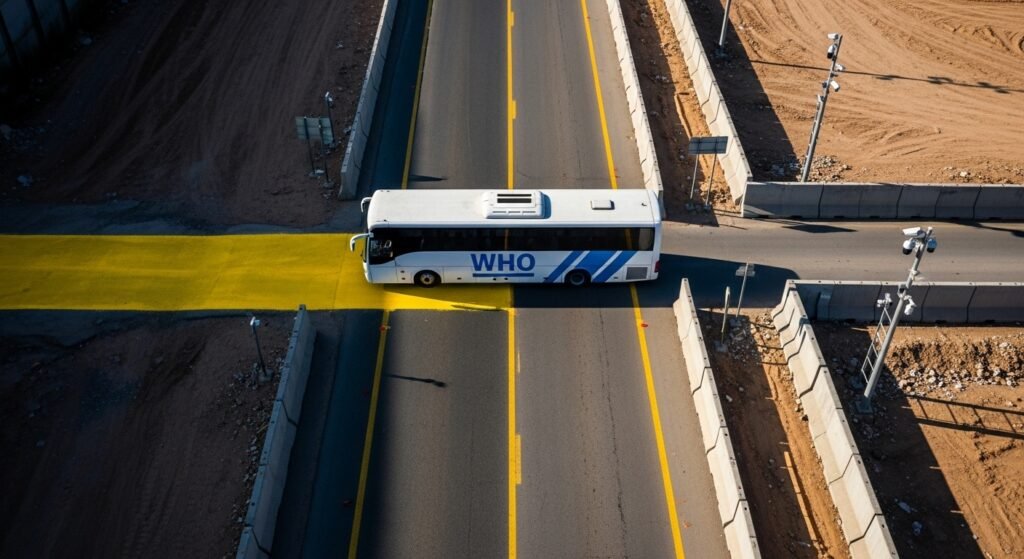
- The “Yellow Line”: The World Health Organization (WHO) is coordinating the complex logistics. Patients are transported by bus from Hamas-controlled territory across a demarcation known as the “Yellow Line” into Israeli-controlled zones before reaching the crossing.
The Diplomatic Context
This development was originally scheduled for October 2025, at the start of the ceasefire. However, it was delayed due to a specific Israeli condition: the return of the body of the last Israeli hostage, Master Sgt Ran Gvili.
- The Trigger: The Israeli military recovered Gvili’s remains from a cemetery in northern Gaza last week, satisfying the final condition for the border’s reopening.
- Egyptian Role: Egyptian intelligence-linked media confirmed the arrival of the first batch of returnees, framing it as part of Cairo’s effort to restore movement.
- No Goods: Crucially, this opening is for people only. Aid trucks and commercial goods are still forced to route through the Israeli-controlled Kerem Shalom crossing, maintaining an economic stranglehold.
Voices of Desperation
The reopening provides a sliver of hope for the 20,000 sick and wounded currently on waiting lists. Sabrine al-Da’ma, a mother in Gaza, described the race against time to save her 16-year-old daughter, Rawa, who requires a kidney transplant.
“She is getting exhausted… I am also 45 years old, and they may tell me that as I get older, I won’t be able to donate anymore. That’s why we’re rushing,” Da’ma told reporters.
Why It Matters
This matters because it tests the viability of the “Trump Peace Plan” in real-time. For the common man in Gaza, this is not freedom; it is a lottery system where survival depends on being one of the “lucky 50.” If successful, this pilot could expand, potentially saving thousands of lives. If it fails or is shut down by renewed violence, it will confirm the deepest fears of the region: that Gaza remains a prison, even when the doors are technically ajar.




Leave a Reply