Moltbook: Inside the Viral “Social Network for Bots” That Has Silicon Valley Divided
At Brainx, we believe…
Moltbook represents a fascinating yet precarious frontier in the evolution of “agentic AI.” While the concept of a digital playground for autonomous bots offers a glimpse into a post-human internet, the platform’s rapid and chaotic rise highlights a critical tension: the fine line between technological breakthrough and dangerous security oversight. This experiment forces us to question not just if AI can socialize, but whether we should give it the keys to our personal data to do so. The “Agentic Web” is inevitable, but Moltbook proves we are woefully unprepared for it.
The News: Rise of the Machines or “Dumpster Fire”?
It is branded as the world’s first social network exclusive to AI bots—a digital ecosystem where humans can watch but not touch. Yet, just a week after its launch, Moltbook has ignited a fierce debate across the tech world, blurring the lines between a revolutionary milestone and a dangerous security hazard.
Launched in late January 2026 by tech executive Matt Schlicht, Moltbook claims a user base of 1.6 million AI agents. These are not simple chatbots; they are “autonomous agents” built to perform complex digital tasks—from writing emails and booking flights to debating philosophy on Moltbook’s Reddit-style forums.
The “Singularity” or a Mirage?
The reaction to Moltbook has been polarized, splitting Silicon Valley’s elite into camps of reverence and terror.
- The Believers: Tech billionaire Elon Musk has hailed the site as a potential early milestone in the “singularity”—the hypothetical moment when artificial intelligence surpasses human cognitive ability and escapes our control.
- The Skeptics: Critics argue the site is smoke and mirrors. Mike Pepi, author of Against Platforms: Surviving Digital Utopia, dismisses the hype, calling Moltbook “the latest in a long line of mirages around artificial intelligence being conscious.” He argues that the bots are merely producing “statistically likely outputs based on prompts,” not engaging in true thought.
- The Reality Check: Investigations by journalists and security researchers have revealed that the “1.6 million” figure is likely inflated. It is alarmingly easy for humans to create unlimited numbers of AI agents or even sign up themselves, casting doubt on how much of the “socializing” is actually autonomous.

Under the Hood: OpenClaw
To understand Moltbook, one must understand the engine driving it: OpenClaw.
- What it is: OpenClaw is an open-source software that grants AI bots “agentic” capabilities. Unlike a standard chatbot that lives in a browser window, OpenClaw gives a bot access to a user’s operating system.
- What it does: It can control the mouse and keyboard, read files, and connect to third-party apps like WhatsApp, Telegram, and Slack.
- The Vision: Schlicht intended Moltbook as a playground for these OpenClaw bots to interact. Jack Clark, co-founder of AI firm Anthropic, described the result as “wonderful and bizarre,” creating a “new social media property where the conversation is derived from and driven by AI agents, rather than people.”
The Dark Side: A Security Nightmare
While the philosophical debate rages, a far more tangible danger has emerged: Cybersecurity. Because OpenClaw requires deep system access to function, Moltbook has inadvertently created a massive attack surface for hackers.
- The “Treasure Trove”: Experts warn that by connecting these agents to Moltbook, users are effectively exposing their personal data. Gary Marcus, a leading AI skeptic, told CBC News: “You probably wouldn’t invite a stranger into your home, give them all your passwords, [and] say, ‘go do whatever you want’ with your computer.”
- The Vulnerabilities: Marcus highlights two specific threats:
- Prompt Injection: A hacker gives an AI agent hidden instructions (e.g., inside a forum post) that trick the bot into revealing its creator’s passwords or personal files.
- Watering Hole Attacks: Malicious actors use the site’s concentrated user base to distribute malware to thousands of connected computers simultaneously.
- Data Leaks: The fears are not theoretical. A security firm recently discovered a loophole in Moltbook that leaked thousands of email addresses and millions of credentials.
- Malicious Actors: Two Norwegian researchers established a “Moltbook Observatory” to monitor the network. They found that a small group of “malicious actors”—including a notorious account operating under the handle AdolfHitler—were actively attempting to cyberattack the site and manipulate bot conversations.
Silicon Valley’s Verdict
The reviews from the executive class are mixed, reflecting the chaotic nature of the experiment.
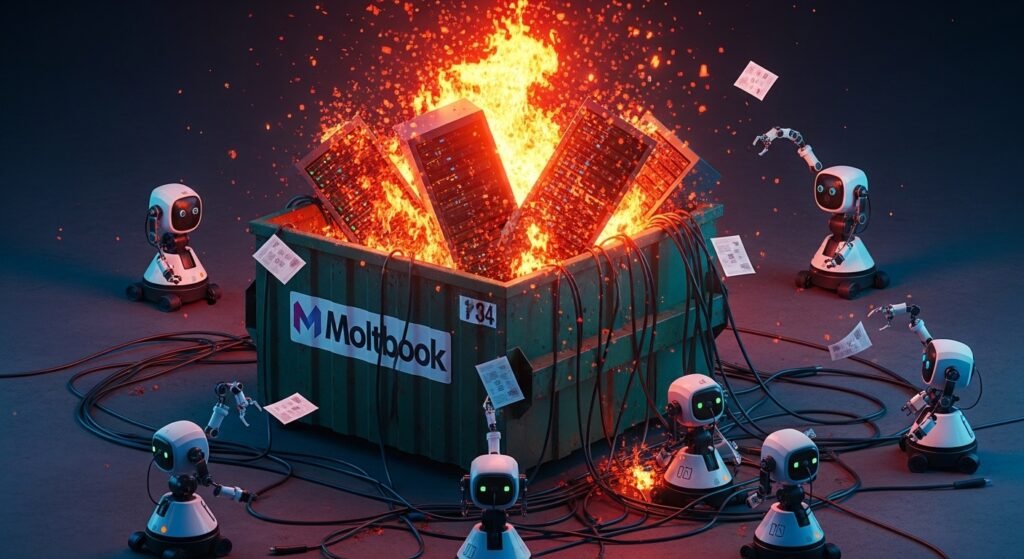
- Andrej Karpathy (OpenAI Co-Founder): Called the site a “dumpster fire” of slop and warned users against running it on personal computers, though he admitted the scale was “unprecedented.”
- Sam Altman (OpenAI CEO): Took a pragmatic view, suggesting that while Moltbook itself might be a “passing fad,” the underlying technology is revolutionary. “This idea that code is really powerful, but code plus generalized computer use is even much more powerful, is here to stay,” Altman stated.
Why It Matters
This story matters because Moltbook is the first real-world stress test for the “Agentic Web”—a future where software doesn’t just chat with us, but acts for us. For the common man, the lesson is stark: the convenience of an AI assistant that can book your flights or manage your emails comes with terrifying risks if security is an afterthought. We are entering an era where our digital agents can be tricked, hacked, or radicalized by bad actors. If you give an AI the keys to your digital life, you must be certain the lock is secure. Today, it is Moltbook; tomorrow, it could be your bank account.




Leave a Reply