Year Five: The Staggering Human Toll of the Ukraine War as Global Leaders Clamor for an Elusive Peace
Brainx Perspective
At Brainx, we believe the transition into the fifth year of the Ukraine war marks a grim milestone that tests global endurance. This development highlights not just the staggering human cost, but the precarious geopolitical tightrope world leaders must walk as US policy shifts under a newly re-elected Donald Trump.
The News
It has been four devastating years since the Russian Federation launched its full-scale invasion of Ukraine, plunging Eastern Europe into the most significant and deadliest military conflict the continent has seen since the Second World War. As the war officially crosses the threshold into its fifth year, the nation of Ukraine remains locked in a desperate struggle for survival, sovereignty, and statehood. Despite profound military losses and the relentless bombardment of civilian infrastructure, the Ukrainian resolve remains unbroken, though the path to a lasting peace appears more complicated—and distant—than ever before.
Key Facts of the Conflict at Year Five
- Territorial Control: Russia currently occupies just under 20% of Ukrainian sovereign territory, but fierce Ukrainian resistance has successfully prevented the total capture of the strategic eastern Donbas region.
- Devastating Human Cost: Estimates suggest staggering losses. The UK Ministry of Defence approximates 1.25 million total Russian casualties, while Ukrainian fatalities are estimated to range between 55,000 (official figures) and up to 200,000.
- Geopolitical Shifts: A joint G7 declaration—the first since US President Donald Trump’s re-election—reaffirmed unwavering support for Ukraine, despite Trump’s visible impatience and pressure for a negotiated settlement.
- The “Coalition of the Willing”: A 35-nation alliance led by the UK and France convened to discuss future security guarantees, with some nations signaling a willingness to deploy troops to enforce any potential future ceasefire.
- Critical Ammunition Shortages: Following intense aerial bombardments in January and February, Ukraine faces a severe depletion of US-made Patriot interceptor missiles, leaving its cities vulnerable to winter strikes.
A Nation Pauses to Remember
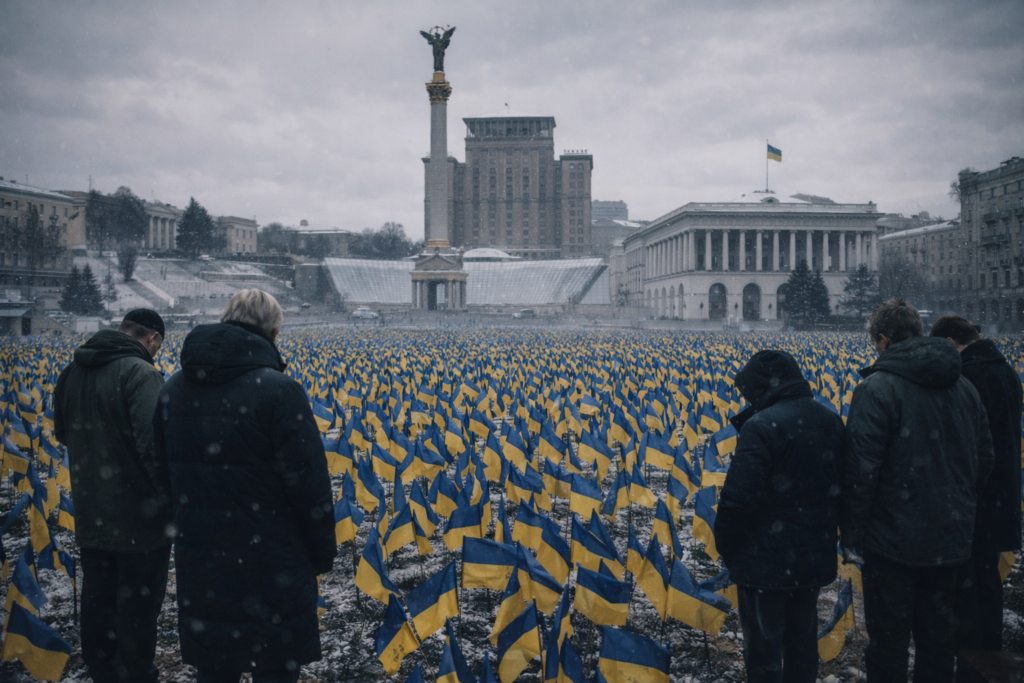
The solemnity of the four-year anniversary was palpable across Ukraine. At exactly 10:00 AM local time, a minute of silence brought the bustling capital of Kyiv—and the rest of the nation—to a complete standstill. In Kyiv’s historic Maidan square, an ever-expanding sea of national flags fluttering in the winter wind served as a poignant, visual representation of the lives lost to the conflict. Citizens gathered with lowered heads, reflecting on the profound sacrifices made by both military personnel and civilians.
Outside the capital, in the town of Bucha—a site internationally recognized for the harrowing atrocities and war crimes uncovered in the spring of 2022—mourners formed a steady procession. Families and surviving comrades laid flowers against the cold black granite headstones of fallen soldiers. “The war has taken a lot of lives,” stated Valentyn, a Ukrainian citizen visiting the graves of his former brothers-in-arms. “Unfortunately for us it’s too many. No one thought it would last this long.”
Zelensky’s Churchillian Resilience
On this grim anniversary, Ukrainian President Volodymyr Zelensky delivered a lengthy morning video address that immediately drew historical parallels to Winston Churchill’s wartime leadership during the Blitz. Broadcasting from the subterranean, heavily fortified corridors of the presidential palace in central Kyiv—a labyrinth of pipes, concrete, and cables—Zelensky projected unwavering defiance.
“We have every right to say: we have defended our independence, we have not lost our statehood,” Zelensky declared, emphasizing that “Ukraine never chose this war” but has proven that “Ukraine exists not just on the map.” The broadcast offered the global public a rare, visceral glimpse into the underground command center where the Ukrainian leadership has orchestrated the nation’s defense since February 2022. In the early days of the invasion, geopolitical analysts and Kremlin officials alike believed Kyiv would fall within 72 hours. Instead, four years later, the Ukrainian military continues to inflict massive, attritional costs on Russian forces.
The Staggering Arithmetic of War
The sheer scale of the casualties inflicted over the past 48 months is difficult to comprehend. The United Kingdom’s Armed Forces Minister, Al Carns, recently characterized the toll on the Russian military as “almost unimaginable.” According to UK Ministry of Defence intelligence estimates, Russia has suffered a staggering 1.25 million casualties (killed and wounded) since the invasion began. Carns noted that this figure is likely a conservative under-estimate, pointing out that it surpasses the total number of casualties the United States suffered throughout the entirety of World War Two. The BBC has independently verified and identified by name over 186,000 Russian soldiers killed in action, though the true figure is widely accepted to be exponentially higher due to the fog of war and Moscow’s strict control over military data.
On the Ukrainian side, the losses are equally heartbreaking. Last month, President Zelensky stated that “officially” 55,000 Ukrainian soldiers had perished on the battlefield. However, cross-referenced data from various other Ukrainian and independent sources suggest the actual death toll for Ukraine’s defenders could be as high as 200,000. These heroes now fill the sprawling, rapidly expanding military cemeteries that have become a tragic, defining feature of the modern Ukrainian landscape.
Despite this immense sacrifice in blood and treasure, the frontlines have remained remarkably static. UK Prime Minister Sir Keir Starmer highlighted the profound inefficiency of the Russian offensive, noting that over the past year, Russia managed to capture a mere 0.8% of Ukrainian land, but paid for it with half a million casualties.
The Diplomatic Chessboard: G7, Trump, and the Coalition
As the physical war grinds on in the trenches of the Donbas, a complex diplomatic war is being waged in capitals around the world. On Tuesday, President Zelensky was flanked in Kyiv by some of Europe’s most steadfast supporters, including European Commission President Ursula Von der Leyen, Swedish Prime Minister Ulf Kristersson, and Finnish President Alexander Stubb.
Simultaneously, a virtual summit of the so-called “Coalition of the Willing” took place. This coalition, spearheaded by the UK and France and comprising around 35 nations, discussed the long-term security architecture of Eastern Europe. Crucially, some member states have indicated a readiness to deploy their own troops to Ukrainian soil in the future to monitor and ensure that any eventual ceasefire agreement is strictly upheld by Moscow.
However, the tone regarding immediate peace prospects remains deeply cautious. French President Emmanuel Macron expressed profound skepticism about the feasibility of a short-term resolution. “Let’s be lucid. There is no willingness on the Russian side to have a peace and, by the way, to have a robust and solid peace as we see it on our side,” Macron stated. His assessment aligns with recent comments from Kremlin spokesman Dmitry Peskov, who reiterated that Russia’s war aims “haven’t been fully achieved yet” and blamed Western support for enlarging the conflict.
Looming large over all diplomatic efforts is the recently re-elected US President, Donald Trump. The Group of Seven (G7) nations issued a joint declaration reiterating their unwavering support for Ukraine’s defense of its sovereign territory and its fundamental right to exist. This marked a significant moment, as it was the first such unified declaration since Trump’s return to the presidency. While Ukrainian negotiators have publicly praised American efforts to broker peace, there is undeniable anxiety in Kyiv. Trump has exhibited clear impatience with the grinding war of attrition and has reportedly placed heavy pressure on Ukraine to agree to a deal—one that many fear could force Kyiv to permanently cede the eastern territories that thousands have died to protect.
In response to this pressure, Zelensky extended a direct, emotive invitation to the US President. “I know for certain: only by coming to Ukraine and seeing with one’s own eyes our life and our struggle, only then can one understand what this war is really about. And because of whom,” Zelensky urged in his address. Kyiv remains adamant that robust, ironclad American security guarantees are the only currency Moscow will respect in any future peace settlement.
The Immediate Threat: A Defenseless Winter
While politicians debate future borders and treaties, the immediate, existential threat to Ukrainian civilians is the sky above them. The war has permeated every facet of Ukrainian life, scattering families and plunging millions into a desperate search for warmth and electricity amid targeted Russian winter bombardments of energy infrastructure.
President Zelensky issued an urgent, critical plea for the replenishment of US-manufactured interceptor missiles used in Patriot air defense systems. Relentless, coordinated Russian drone and missile barrages throughout January and February have critically depleted Ukraine’s defensive stockpiles. This shortage has left major urban centers and vital energy grids dangerously exposed during what has been described as the harshest winter since the 2022 invasion. Without immediate resupply from its Western allies, Ukraine risks catastrophic civilian casualties and the total collapse of its power grid, turning the cold itself into a weapon of war.
Why It Matters
This protracted conflict reshapes the global economic and security landscape, directly impacting the common man through fluctuating energy markets and persistent inflation. Furthermore, the future of international law and democratic sovereignty hinges on this outcome, determining whether unprovoked military aggression becomes normalized or definitively deterred in our modern 21st century.


Leave a Reply