Russia and Ukraine Announce Separate Ceasefires as Tensions Continue
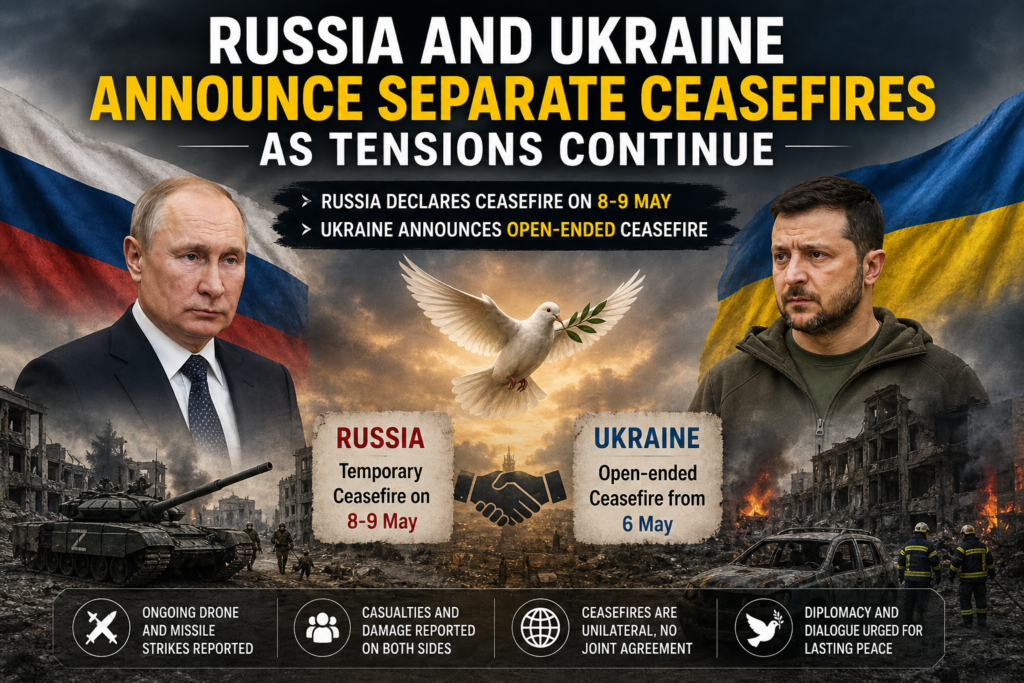
Russia and Ukraine have each announced their own ceasefire plans this week, raising cautious hopes for a possible de-escalation in the ongoing conflict. However, the absence of a jointly agreed framework and continued reports of military activity highlight the fragile and uncertain nature of the situation.
The developments come at a sensitive time, particularly for Russia, which is preparing for its annual Victory Day celebrations on 9 May. This event commemorates the Soviet Union’s victory over Nazi Germany in World War II and holds deep historical and political significance in the country. Against this backdrop, Russia declared a temporary ceasefire scheduled for 8 and 9 May, presenting it as a humanitarian gesture during a period of national remembrance.
At the same time, Ukraine has taken a different approach by announcing an open-ended ceasefire starting from midnight on 6 May. Ukrainian leadership has emphasized that its ceasefire is not limited to symbolic dates but is intended as a broader step toward reducing hostilities. President Volodymyr Zelensky has repeatedly called for meaningful diplomatic engagement, stating that lasting peace can only be achieved through sustained dialogue rather than temporary pauses.
Ukrainian officials have also made it clear that their ceasefire will be implemented in a “reciprocal” manner. This means that Ukraine’s actions will depend on how Russia responds. If the ceasefire is respected, Ukrainian authorities have indicated they are prepared to maintain it. This conditional approach reflects both a willingness to reduce tensions and a level of caution based on past experiences during the conflict.
Despite these announcements, reports from both sides suggest that military activity has not fully subsided. Various regions have experienced aerial incidents involving drones and missiles, leading to casualties and damage to infrastructure. While specific details differ between sources, the overall picture indicates that the situation on the ground remains volatile.
In Ukraine, officials have reported overnight incidents affecting multiple areas. Emergency services have responded to damage in residential and industrial zones, with efforts focused on rescue operations and restoring essential services. These incidents serve as a reminder of the ongoing risks faced by civilians, even during periods when ceasefires are being discussed.
On the Russian side, regional authorities have also reported drone-related activity. In some areas, these incidents have led to injuries and disruptions, prompting temporary safety measures such as airport closures and increased security protocols. Local governments have emphasized their commitment to maintaining public safety while monitoring the evolving situation.
The fact that both countries are reporting continued incidents highlights a key challenge: the ceasefires announced so far are unilateral. This means they were declared independently, without mutual agreement on terms, duration, or enforcement mechanisms. In the absence of a coordinated plan, it becomes difficult to ensure compliance or verify claims of violations.
Experts often note that effective ceasefires typically require clear communication channels, third-party monitoring, and agreed-upon rules of engagement. Without these elements, misunderstandings and mistrust can quickly undermine any temporary pause in fighting. The current situation appears to reflect these challenges, as both sides remain cautious about each other’s intentions.
Another important factor is the broader strategic context of the conflict. In recent weeks, both Russia and Ukraine have increased their focus on long-range capabilities. This includes the use of drones and other systems to target locations far from the immediate front lines. Such developments have expanded the geographical scope of the conflict and introduced new complexities in terms of defense and response.
Ukraine, in particular, has demonstrated growing capability in conducting long-range operations. These efforts are often aimed at strategic infrastructure, with the goal of disrupting supply chains and reducing operational capacity. At the same time, Russia has continued its own operations, targeting various locations across Ukraine. This ongoing exchange underscores the difficulty of achieving a sustained reduction in hostilities without a comprehensive agreement.
The timing of Russia’s ceasefire announcement is also significant due to Victory Day. Over the years, the event has become a major display of national pride, often featuring large military parades and public gatherings. However, officials have indicated that this year’s celebrations may be adjusted due to security considerations. Reports suggest that certain elements, such as large-scale displays of heavy equipment, could be scaled down.
Security concerns surrounding the event have also led to precautionary measures in major cities, including potential disruptions to mobile internet services and increased monitoring of public spaces. These steps reflect a heightened awareness of potential risks during a high-profile national occasion.
From Ukraine’s perspective, the earlier and open-ended ceasefire can be seen as an attempt to demonstrate a proactive commitment to de-escalation. By announcing a ceasefire ahead of Russia’s planned dates, Ukrainian leadership may be aiming to signal its willingness to move toward a more stable situation while also placing responsibility on Russia to respond in kind.
President Zelensky has emphasized the importance of prioritizing human life over symbolic or political considerations. In his public statements, he has called for a shift from temporary pauses to meaningful steps that could lead to a lasting resolution. This messaging aligns with broader international calls for dialogue and conflict resolution.
The international community continues to closely monitor these developments. While there is cautious optimism whenever ceasefires are announced, past experience has shown that sustaining them can be challenging. Violations, differing interpretations, and lack of trust have frequently hindered progress in similar situations.
Humanitarian considerations remain a central concern. Civilians on both sides of the conflict have been affected by ongoing disruptions, including damage to homes, infrastructure, and essential services. Temporary ceasefires, even if limited, can provide opportunities for aid delivery, evacuation efforts, and repair work. However, their effectiveness depends heavily on adherence by all parties involved.
Another layer of complexity is the information environment surrounding the conflict. Both sides regularly share updates and statements, but independent verification is not always possible. This makes it important for observers to approach reports with caution and rely on multiple sources when assessing the situation.
Looking ahead, the key question is whether these unilateral ceasefires can evolve into a coordinated effort. For that to happen, both Russia and Ukraine would need to engage in direct or mediated discussions to establish clear terms and conditions. This could include defining the scope of the ceasefire, setting up monitoring mechanisms, and agreeing on steps to address violations.
Diplomatic channels, whether bilateral or involving international посредники, are likely to play a crucial role in this process. Confidence-building measures, such as prisoner exchanges or humanitarian corridors, could also help create a more favorable environment for negotiations.
At the same time, the broader geopolitical context cannot be ignored. The conflict has significant implications beyond the immediate region, influencing global economic conditions, energy markets, and international relations. As a result, efforts to de-escalate are closely watched by governments and organizations around the world.
In conclusion, the announcement of separate ceasefires by Russia and Ukraine represents a notable development, but it is only a small step in a much larger and more complex process. While both sides have expressed some level of willingness to reduce hostilities, the lack of a coordinated agreement and continued reports of military activity underscore the challenges that remain.
For now, the situation continues to evolve, with uncertainty surrounding how long these ceasefires will hold and whether they can lead to more substantial progress. Achieving lasting peace will likely require sustained diplomatic efforts, mutual trust, and a shared commitment to prioritizing stability over conflict.
Leave a Reply