Pakistan’s Economy in 2026: Is the Worst Really Over, or Are We Just Getting Started?
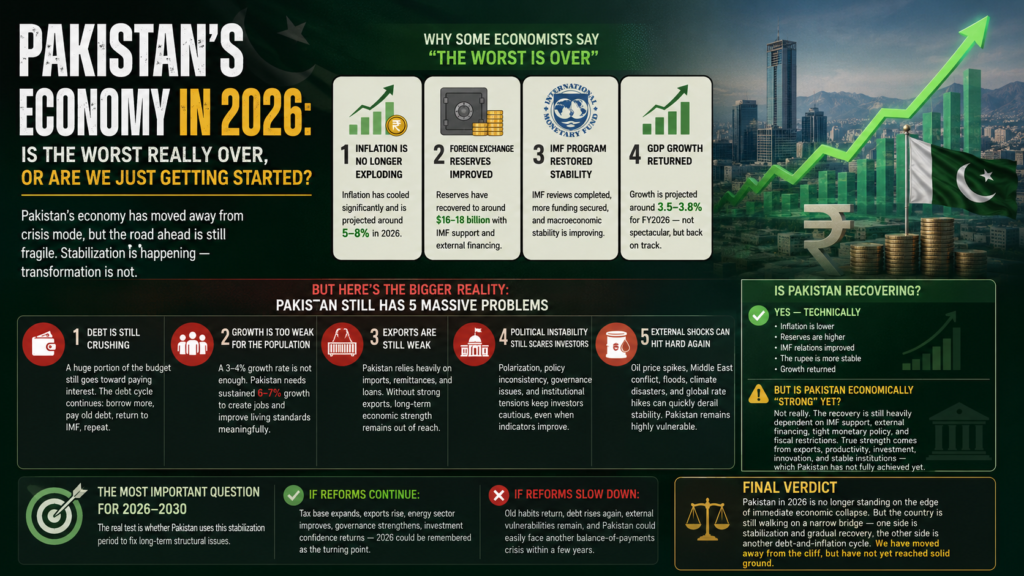
Pakistan’s Economy in 2026: Is the Worst Really Over, or Are We Just Getting Started?
For the past few years, Pakistan’s economy has been a topic of dinner table arguments, WhatsApp forwards, and late-night anxiety. Inflation hit record highs. The rupee fell sharply. Petrol prices made headlines every week. And millions of ordinary Pakistanis felt it — in grocery bills, electricity bills, and the general sense that things were getting harder.
But 2026 has brought some cautious optimism. The question is: should we believe it?
Let’s break down what’s actually happening, what the numbers mean, and what everyday Pakistanis should realistically expect.
The IMF Deal Changed Everything — For Now
Pakistan secured a crucial Extended Fund Facility (EFF) with the International Monetary Fund, and the government has been working hard to meet the conditions attached to it. Foreign exchange reserves have slowly started recovering. The rupee has stabilized — not dramatically, but enough to stop the bleeding.
This matters because a stable rupee means imports don’t automatically become more expensive every month. For a country that imports everything from fuel to edible oil, this is genuinely significant.
However — and this is the part most headlines skip — the IMF deal comes with painful conditions. Subsidies have been cut. Tax collection targets have been raised. Energy prices remain high. So yes, the macroeconomic picture looks better, but the experience on the ground is still very tough for working-class families.
Inflation Is Falling, But Prices Haven’t Come Down
Here’s something important that many people misunderstand: when inflation falls, it doesn’t mean prices go down. It just means prices are rising more slowly.
Pakistan’s inflation rate has dropped significantly from its peak. That’s good news. But if bread cost Rs. 30 three years ago and Rs. 80 today, a lower inflation rate just means it’s now going up by Rs. 2 instead of Rs. 10 per year. The Rs. 80 price is still there.
This is why you’ll see economists celebrating falling inflation while the average person still says “yaar, sab kuch mehenga hai.”
What’s Actually Growing?
A few sectors are showing real momentum:
IT and Freelancing exports have grown consistently. Pakistan has a young, skilled workforce, and with global demand for remote work, this sector has quietly become one of the country’s most promising earners. Cities like Lahore, Islamabad, and Karachi now have thriving freelance communities earning in dollars.
Agriculture had a better year compared to the flood-damaged 2022 season. Better harvests mean more stability in food prices — though climate volatility remains a serious long-term threat.
Remittances from overseas Pakistanis continue to be a lifeline for the economy and for millions of families directly. In 2025-2026, these flows remained strong.
The Challenges That Don’t Go Away
Let’s be honest about the structural problems that no IMF package fixes on its own:
Energy costs remain one of the biggest burdens on both households and businesses. The electricity circular debt issue has not been resolved. Manufacturers are struggling with high input costs, and many small businesses haven’t recovered from the inflation years.
Youth unemployment remains critically high. Pakistan has one of the youngest populations in the world, and not enough formal jobs are being created to absorb them. This is both an economic risk and a social one.
Political instability adds uncertainty. Investors — both local and foreign — need predictability. Frequent political crises make long-term investment decisions harder.
So, Is the Worst Over?
Honestly? It’s complicated.
For the macroeconomic indicators — yes, things look better than they did in 2023. The country avoided default. The currency has stabilized. Inflation is lower.
But for the average Pakistani family, daily life is still hard. Recovery from an economic crisis takes years, not months. The gains being celebrated in finance ministries don’t always translate quickly to kitchen tables.
The most realistic answer is that Pakistan is in a fragile recovery. If political stability holds, if the IMF program stays on track, and if global conditions cooperate, there is a genuine path forward. But it requires consistent policy, not just a few good quarters.
What Should You Do?
If you’re a Pakistani worried about your own finances in 2026, here are some grounded thoughts:
If you have any skills that can be sold online — writing, design, coding, digital marketing — now is the time to build that income stream. The dollar-to-rupee gap makes even small foreign income meaningful in local terms.
Don’t wait for the economy to “fully recover” before making financial decisions. Build an emergency fund, even a small one. Reduce high-interest debt where possible.
And stay informed — not through panic-inducing WhatsApp forwards, but through actual news sources. Understanding what’s happening gives you agency.
Pakistan’s economy has been through worse and survived. The question now is whether this moment of relative stability can be turned into something more lasting.
That depends on decisions being made right now — by the government, by institutions, and by 240 million people navigating the same uncertainty together.
Leave a Reply