Trump Returns to a More Powerful and Confident China After Nearly a Decade
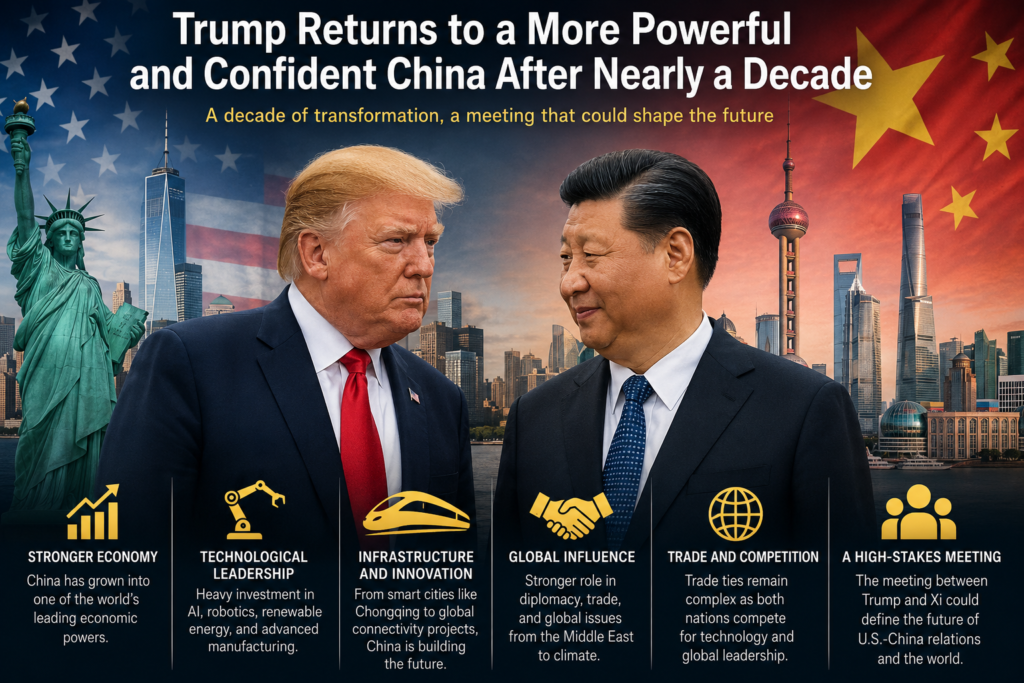
Nearly a decade after his first state visit to China, former U.S. President Donald Trump is once again stepping into a nation that has changed dramatically. Since his last visit in 2017, China has expanded its global influence, strengthened its economy, and accelerated its technological growth under the leadership of Xi Jinping.
Back in 2017, Trump was welcomed with extraordinary ceremony in Beijing, including a historic dinner inside the Forbidden City — an honor rarely offered to foreign leaders. This time, the visit is expected to carry the same level of symbolism, but the political and economic landscape is far more complex.
China’s Rapid Transformation
Over the last decade, China has invested heavily in advanced technologies, renewable energy, robotics, artificial intelligence, and electric vehicles. These developments are part of Beijing’s long-term strategy to modernize its economy and reduce dependence on foreign powers.
Cities such as Chongqing have become examples of this transformation. Once known mainly as an industrial manufacturing center, Chongqing is now recognized for its futuristic skyline, smart infrastructure, and fast-growing technology sector.
Massive investments in transport systems, urban development, and innovation have turned the city into one of China’s most important economic hubs. Social media users and tourists often describe it as one of the most futuristic cities in the world because of its layered highways, neon-lit skyline, and unique architecture.
Technology and Artificial Intelligence
China is also rapidly expanding its robotics and AI industries. Factories across the country increasingly rely on automation, helping China become one of the world’s largest users of industrial robots.
Artificial intelligence remains a key area of competition between China and the United States. Chinese companies continue to seek access to advanced semiconductor technology, while American officials remain cautious about exporting high-end AI chips due to national security concerns.
Experts believe the global race for AI leadership could shape future economic and military power. At the same time, some analysts argue that cooperation between major powers is necessary to ensure AI technologies are used responsibly.
Trade Relations Still Under Pressure
Trade tensions between the U.S. and China remain a major issue. During Trump’s presidency, both countries imposed heavy tariffs on each other’s goods, creating economic uncertainty across global markets.
Since then, China has worked to diversify its trading relationships. Southeast Asia and the European Union have become increasingly important trade partners for Beijing.
Chinese industries, especially electric vehicle manufacturers, are also focusing on expanding exports to Europe, Central Asia, and other international markets. Infrastructure projects and rail connections linking western China to Europe are helping support these efforts.
China’s Growing Global Influence
China’s role in global diplomacy has also expanded significantly. Beijing now plays a more active part in international negotiations, regional security discussions, and global economic partnerships.
As global conflicts and economic uncertainty continue, China presents itself as a stable and open partner for international cooperation. At the same time, critics continue to raise concerns about censorship, state surveillance, and restrictions on political freedoms inside the country.
Despite these concerns, China’s growing economic strength and technological progress have increased its influence on the world stage.
A High-Stakes Meeting
The renewed meeting between Trump and Xi comes at a time when both nations are trying to protect their economic interests while managing intense competition in technology, trade, and global influence.
For the United States, discussions may focus on trade balances, regional security, and international stability. For China, the visit provides an opportunity to showcase its modernization efforts and reinforce its image as a major global power.
Observers around the world will closely watch whether the talks lead to improved cooperation or deepen the rivalry between the two largest economies on Earth.
Looking Toward the Future
China today is very different from the country Trump visited in 2017. Its cities are more advanced, its industries more competitive, and its international ambitions more visible.
From high-speed rail networks and electric vehicles to AI-powered robotics and mega-cities like Chongqing, China continues to position itself as a leading force in the future global economy.
As relations between Washington and Beijing evolve, the decisions made by both sides could shape international politics, trade, and technology for years to come.
Leave a Reply